
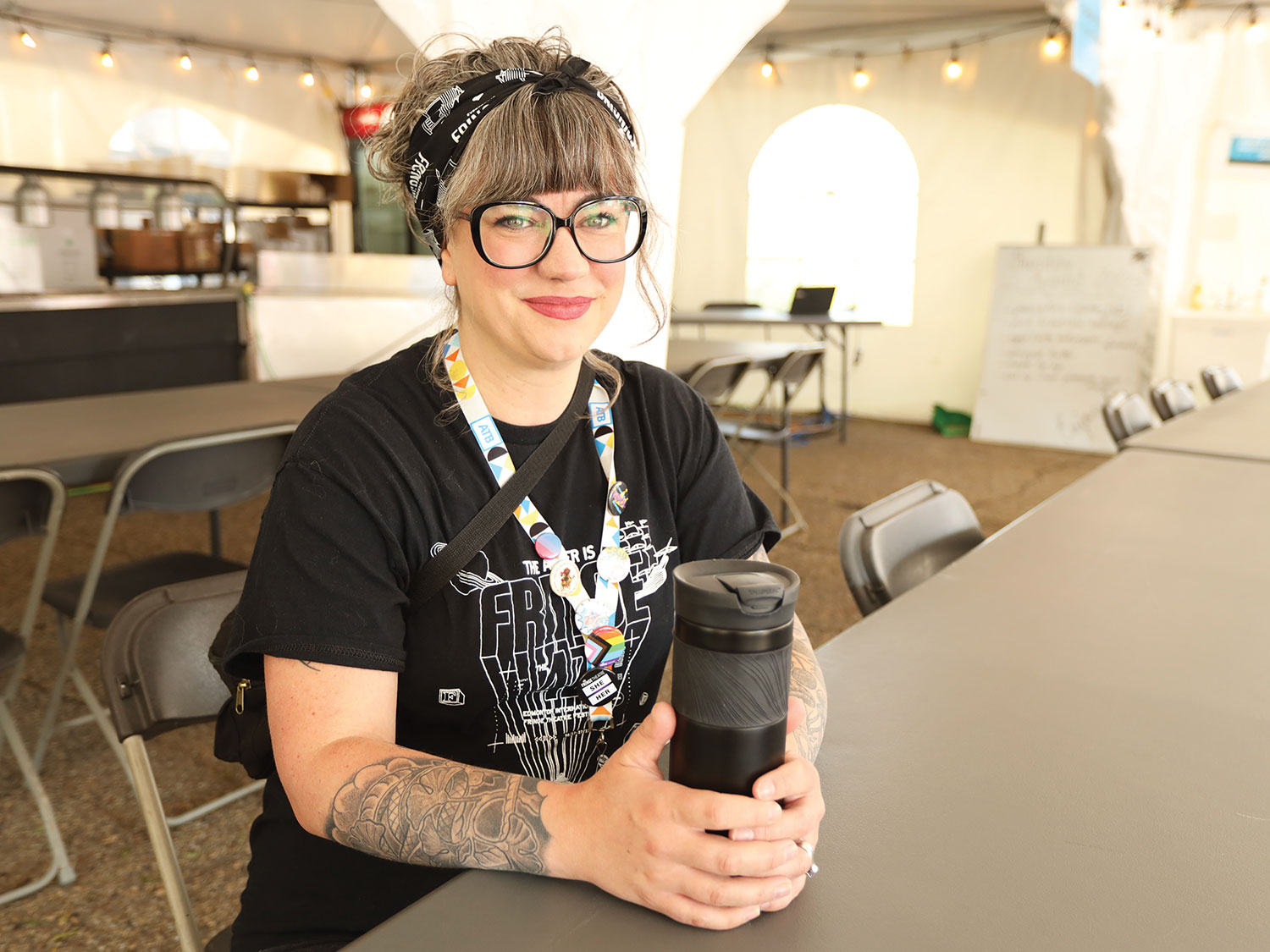
Megan Dart is excited to talk about the Fringe, any time of the year. The executive director of the Edmonton International Fringe Theatre Festival is sharing her two decades of experience in the theatre industry with a small group of artists who are looking to improve their marketing skills and bring an audience to their art. In other words, “how to get butts into seats.”
“Without an audience there is no theatre,” she tells the group, a wide smile on her face. The participants in the workshop definitely want theatre, so they are happy to learn from someone who has been at the top of the Edmonton scene. The session was part of a series of workshops back in March called Launchpad, designed to teach artists about different aspects of theatre, from writing and budgeting to sound and lighting.
Dart sits at the head of an organization with 22 permanent staff that balloons to more than 200 during the festival, and a volunteer base of more than 1,000, producing the oldest fringe festival in North America and one of the city’s premier summer events. She spends a lot of time thinking about intentional expansion of the Fringe.
She is trying to build a sustainable festival that everyone can enjoy. She talks about “collective effervescence,” a sociological concept coined by Émile Durkheim to describe the feeling when a large group shares a joyous emotional experience, such as a major concert or a big sports game. If the festival grows too quickly, or without intentionality, it risks losing that.
Dart has been with the Fringe for more than a decade, starting as a communications specialist. Before that she worked with a litany of Edmonton theatre groups, from Azimuth Theatre to Nextfest and SkirtsAFire. She moved into the top role at the Fringe in 2021, a year after the festival was cancelled due to the pandemic.
“Recovering from that really took time. I think the pandemic gave us an opportunity to pause and think about how we returned as a more resilient organization,” Dart says. The team’s main goal in this effort was to protect and develop the organization’s top resource: its people. “How do we do this work kinder, how do we be more thoughtful about building capacity and building redundancy across all of our operations?”

That return to operations came with a $3 million hole the organization has been trying to dig itself out of for five years, even as it struggles with the same inflationary pressures facing every arts organization — and every household. Everything costs more, and it costs more to put on the Fringe. What the organization first assumed would be a three- to five-year recovery period in the arts industry, its website now calls “a 10-year post-pandemic rebuild.”
Aside from seeking measured growth for reasons of resilience and stability, simply booking more shows wouldn’t really build operating revenue for the organization. Ticket sales to the more than 220 productions go almost exclusively back to the artists. Dart has worked with her team to grow their other revenue sources, to expand their reach beyond the festival season. For example, the organization staged “Countries Shaped Like Stars,” a Fringe cult classic, in February of 2026. And the team has grown the donor pool. Monthly donors have increased from 34 in 2024 to more than 800 in 2026. Initiatives such as “Adopt a Porta-Potty” have proven hugely popular, with 35 toilets bringing in nearly $9,000.
The initiative, whereby sponsors can donate $250 for naming rights to a porta-potty, offsets the hard cost of providing toilets on site, but it’s also an unexpected growth opportunity. Most of the people who adopted a porta-potty were first-time donors, and they were also looking for a way to get involved on site.
“During the festival we had so many people come and decorate their porta-potties,” Dart says. “What started as a crass joke grew into a touchpoint for community building. It really took off in ways we did not expect.”
These initiatives are part of her plan to expand the Fringe outside of the 11 days, while looking to grow slowly and carefully. In the year before the pandemic, there were more than 250 productions across 56 venues. Those numbers dropped significantly, but have grown slowly every year since, reaching a little over 220 shows this year at about 40 venues.


It’s not for a lack of demand. Last year they sold almost 140,000 tickets and returned nearly $1.5 million in ticket sales to artists. For the 90 spots in the festival lottery system, they received nearly 600 applications. Unlucky artists have to book a venue for themselves, known as “bring your own venue” (BYOV), or skip the festival entirely.
“We are here to connect artists and audiences, and those moments when we get to witness that happening, whether inside a theatre or out on the festival site, is the best measure of a successful festival,” said Dart.
In a busy year, she barely stops during those 11 days. But no matter how busy she is during the festival itself, she makes a special point to head to the Late-Night Cabaret, a midnight variety show with special guests from a variety of productions at the festival.
“I get to connect with artists at the end of the day, I get to connect with staff at the end of their day. I get to connect with volunteers at the end of their day. And does that mean I’m going home at 2 a.m.?” Dart asks, before answering her own question emphatically: “Absolutely. But I am making that choice because I love being in that room and just seeing how the community comes together to celebrate at the end of a long festival day.”
For her, it’s not about tickets sold, buzz generated, number of performances or sell-out shows they can boast about. It’s about a feeling, about community, about bringing together artists and audiences. Dart’s sincerity is clear. She isn’t an executive parroting prepared comments about caring for the community. She talks about caring for artists, caring for volunteers, caring for audiences and caring for the community. Maybe you could call that approach a kind of collective effervescence.
This article appears in the June 2026 issue of Edify