
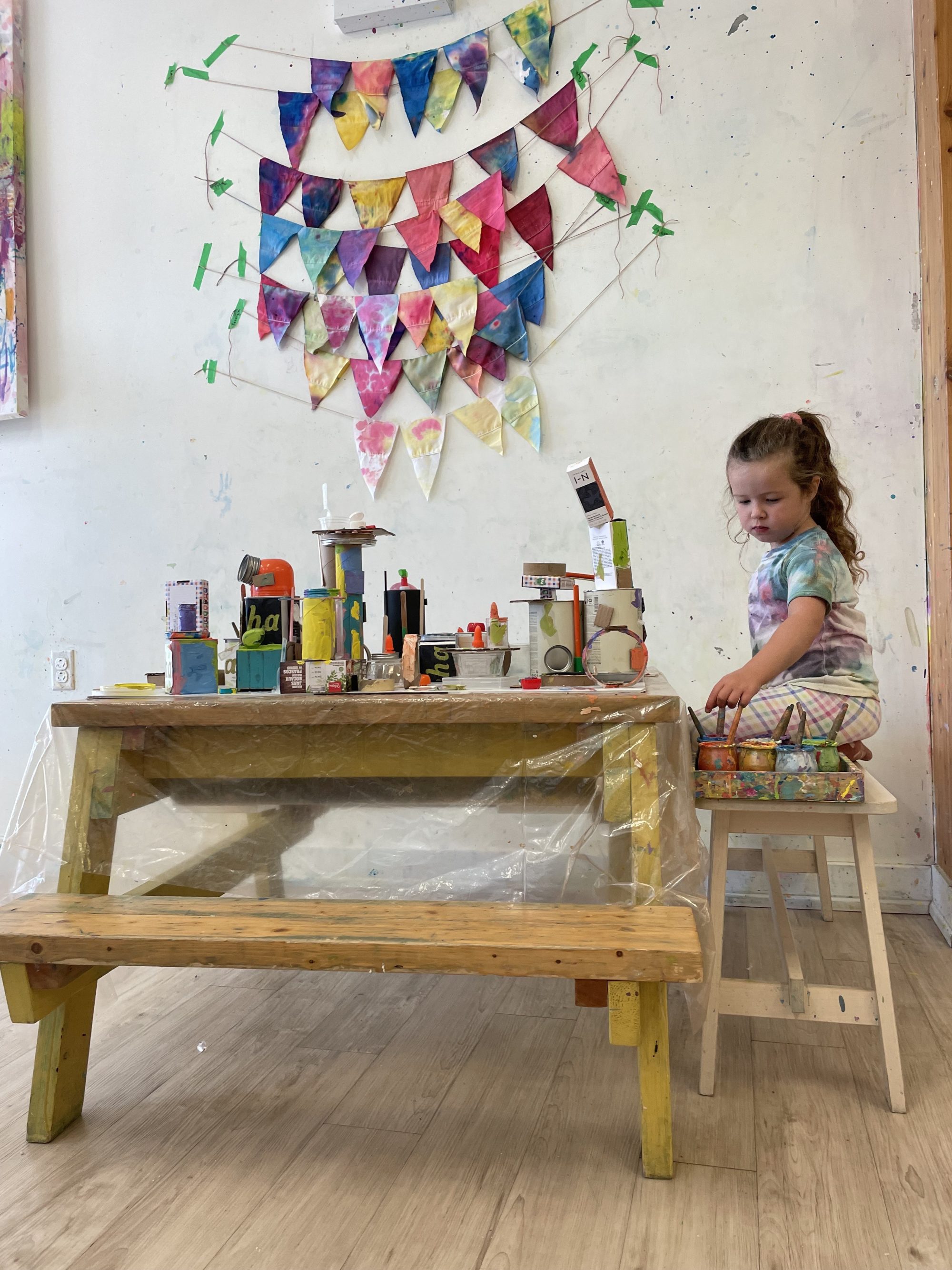
Over the last nine years, Edmonton artist Alie Service has quietly created a whimsical refuge in a small studio perched above Whyte Avenue. Creation Space has grown alongside her two daughters — from sensory bins and preschool art projects to more structured classes for older kids.
Service acknowledges that parenting can sometimes feel at odds with growing a career. “But I actually feel like having kids was a catalyst for me,” she says.
Her seasonal classes and one-off workshops usually sell out within a day of launch and are often filled with the same faces year after year. It’s not hard to see why; no two sessions are the same. The materials are open-ended, creative and elaborate: a table filled with metal teapots alongside flower stems to be clipped, ripped and stirred into colourful, sparkly liquid; themed water bins with large chunks of ice, polar bears and metal colanders; and throughout, containers of paint and various objects on which to apply it.
“I usually have more ideas than I have time for,” Service says. “Ideas are not the problem.”
Last May, Service and her daughters brought that playful vibe to the Alberta Art Gallery’s Children’s Gallery in their exhibit Tied Together. The show — running until March 2 — drew inspiration from the children’s book Extra Yarn and features white cabinets that open to display dioramas with painted backdrops and tiny ceramic animals, all connected by strings of yarn. In the centre of the room, visitors can wrap yarn around a desk, rocking horse and wooden chair.
“People would think I made all the decisions, but I didn’t,” Service says. “I think it’s important to allow children to have power within their artwork. Children don’t have a lot of power in their lives, but art is a place they can have it.”
With nearly two decades of teaching experience, Service shared her tips for fostering children’s relationship with art.

Some parents might cringe at the idea of sensory bins, which conjure up images of rice stuck in floor boards and flour smeared across walls, but it doesn’t have to be that complicated. “I do have a lot of fancy things, but I’ve had time to build those up,” Service says. “You can use the pots you own and small scoops. You could be making stew and put carrot and celery ends into a bit of water. If you have expired beans, you could use those.” She explains that when kids are young, they need just a vessel for pouring and something that scoops or grabs smaller items.
Art supplies don’t have to break the bank. Yes, Service has a mind-boggling array of adorable, miniature beads, figurines and gems, but a trip to a thrift store is all you need. “I get a lot of cool stuff from Goodwill or Value Village,” she says. “Wooden bowls, metal teapots, it’s a great resource for beads and fabrics.”
When her kids were small, Service used to take them to the Muttart Conservatory and they would sketch plants together. “Art is one of the most amazing ways to connect with kids,” she says. Sure, sometimes you can set up supplies for independent play, but sitting down with your kids — despite your own perceived abilities — to draw or paint can help them open up. “It provides a moment for connection and relaxation together.”
The first part of this advice feels counterintuitive, but you don’t have to keep all of your kids’ art, Service says. Sometimes, it’s just about the process. But, she adds, it can boost their confidence if you frame the pieces you love — or simply hang them on the fridge. “It makes your kid feel proud to see their work on the wall,” she says. “All any art tries to do is connect with you. What are you going to connect with more than something someone you love made?”
Don’t feel bad about having boundaries around mess, Service says. It’s OK to save a project for the summer when it can be done outside, for example. But, if you’re able, finding a space in your home to keep art and craft supplies readily available can prompt kids to use them more. “I find that kids will come and go (to work on art),” she says. “It can also be a lot of work to pull that stuff out. If you can find a small spot you’re comfortable with and leave it out, that can be easier.”
Fun fact: Service has never seen a small kid cut their finger on scissors. The reason: they simply don’t have the strength to do damage. The same goes for other “adult” art tools. “Two is actually the age to introduce scissors to our children,” she says. “I think they’re more capable than we give them credit for.”