
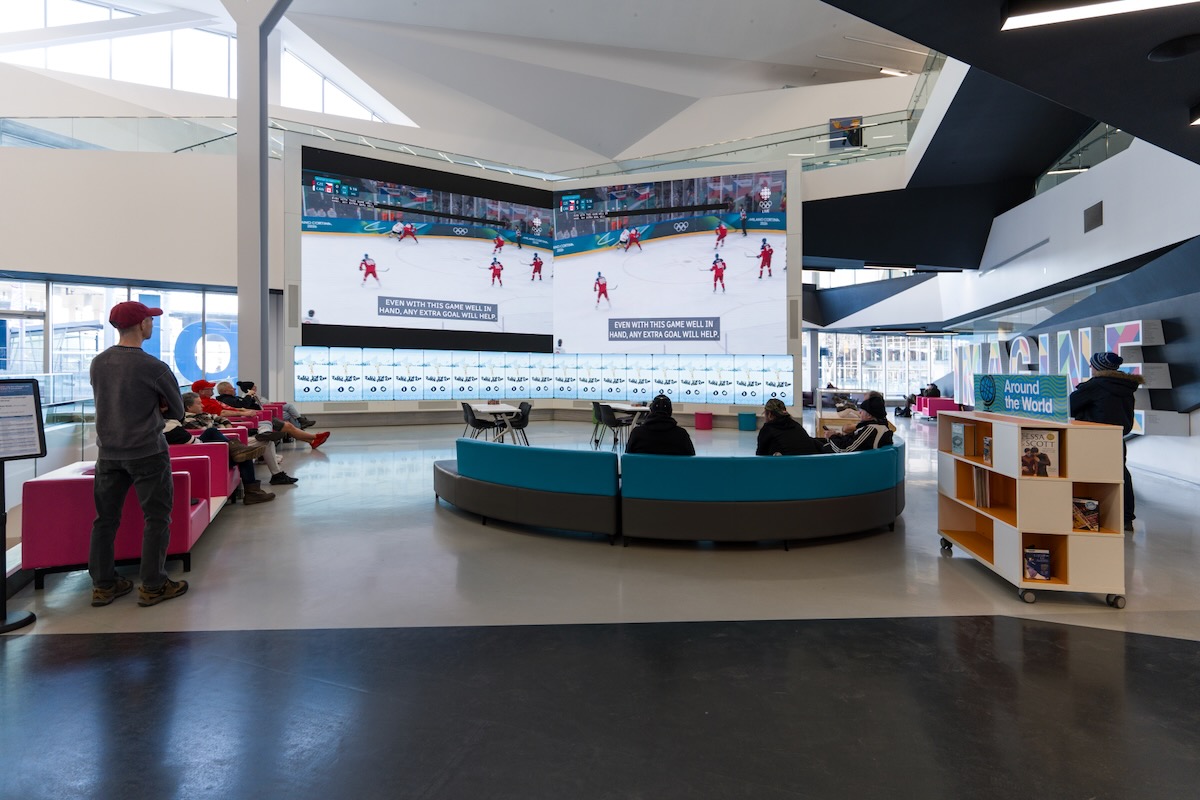
In April, a gathered crowd of Edmontonians craned their necks to look up as the Artemis II rocket arced into the air, carrying the first crewed space flight to the moon in 50 years. In the same spot in February, fans had watched as Canada competed in the Winter Olympics. Neither group had to leave town — the action took place on the massive 40-foot-wide, 20-foot-tall digital wall at the Stanley A. Milner branch of the Edmonton Public Library.
Dubbed the Wall by staff, it’s a spot that has evolved beyond an architectural feature into a community gathering space.
“Whenever I’m meeting somebody that hasn’t been to Milner before, I’ll say, ‘Meet you in front of the Wall. Trust me, you’ll know what I mean,’” says Vicky Varga, EPL’s director of collections and technology.
The idea for the Wall came to former CEO Pilar Martinez on her speaking tour in Australia, around the same time EPL was planning the Milner redesign. On the tour, Martinez saw a Queensland University of Technology digital display that used a similar technology. The Milner redesign was meant to push the flagship branch to the forefront of libraries, and the technology Martinez saw in Queensland seemed like a fit.
While it’s the only installation of its scale in North America, the Wall is not the only digital exhibit EPL has had. The touchtable at the Mill Woods library branch served as a testbed for some of the Wall’s technology while Milner was being renovated. It’s where the library’s collaboration with MacEwan University’s computer science program started.
“It helped us think about what we could do,” Varga says. “We knew the Wall was coming, so we thought about how we could work with external groups to build partnerships.”
Today, students in the computer science program can design games for the touchtable wall at Mill Woods or the touch screens that line the bottom section of Milner’s Wall. The games can be anything from word games to Space Invaders-style shoot-’em-ups, but they must achieve a level of polish. “It’s a great way for students to get community feedback,” Varga says.

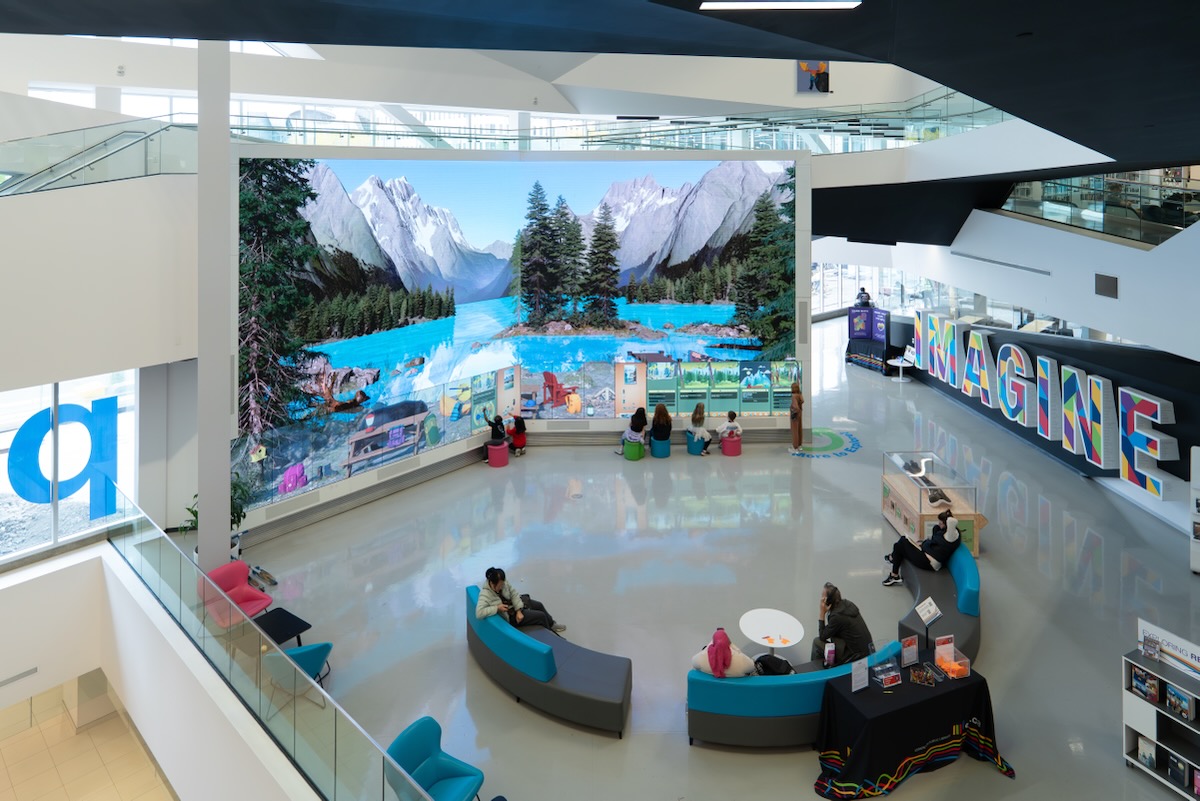
Digital exhibits and games programming for the Wall are scheduled in advance and posted on the library’s website, but an unexpected benefit is the ability to stream live events — which have also included the World Cup, the Olympics and Oilers playoff hockey. “We try to be responsive to those events,” Varga explains, saying that livestreaming Artemis II was a last-minute idea that they were able to pull together.
“It wasn’t a use case we initially saw for it,” she says, “but people have really liked it. During the World Cup we had people from all sorts of backgrounds watching on all three levels at Milner, sharing this experience together.”
The Wall
Edmonton Public Library Stanley A. Milner Branch | 7 Sir Winston Churchill Sq NW, Edmonton | epl.ca
The writer’s wife is an employee of Edmonton Public Library. This personal connection is disclosed for transparency.