

Idioms are confusing because I had to relearn English as an adult. What are you talking about, “When pigs fly?” Or, “It’s raining cats and dogs?” When I hear an idiom, I spend hours researching it so that I can incorporate it into my speech, because I want to be treated like a normal person. The image of a flying pig isn’t helpful to me.
Maybe the image of a social butterfly is helpful to you. By the end of February 2013, I had gone from being a social butterfly — who went straight from work to dinner with friends to hockey practice — to spending my time alone in the dark in my living room. Strangers came to my house every day, trying to make me eat, make me take medication, help me in the bathroom. No one explained what was happening — though I usually couldn’t understand what they were saying. And no one could tell me when I was going back to work, which was all I cared about.
I had a lot of internal anger. I never directed it outwards. Somehow, my sense of humour remained intact, which surprised people. How could I be making jokes when I couldn’t remember the word for the colour of a banana? Humour was an essential survival strategy. As my speech therapist (now dear friend) Suzanne Sauvé could explain in detail, humour is one language pathway that was undisturbed by my injury. Humour relieves tension in social situations, helps me keep my perspective and makes it easier for me to speak clearly.
I started working with Suzanne about three months after the accident. I cannot emphasize enough that I speak fluently and carry on a more-or-less independent life because I had an unprecedented amount of speech therapy. When people think of speech therapy, they think of a kid with a lisp, not an adult with a brain injury. Alberta Health Services doesn’t offer speech therapy as part of long-term rehabilitation. I was lucky with my insurance. Suzanne agrees that without my years of speech therapy, my world would be smaller.
I also attended a student speech therapist clinic at the U of A for several months after my injury. At the end of one of those sessions, I went straight to therapy with Suzanne and said, “I’m never going back! They’re taking us to the deli and making us order cocaine.”



What she said next was — and you have to understand that Suzanne speaks very properly — “What the hell?”
At the time, I didn’t remember what a deli was, and the student speech therapists were trying to get us clients to practise ordering by the gram. That’s how simple a misunderstanding can be for someone with a language disorder. I’ve never purchased cocaine, but I love crime dramas. My brain had made a connection between street drugs and grams.
Therapists kept noting my attention was terrible, which is a common brain injury issue, but, in fact, since my injury I had been mostly deaf. At the same time, I had hyperacusis, which means that any noise was like nails on a chalkboard. (That isn’t an idiom. That’s how it sounded.)
My hearing loss was discovered when a student speech therapist was practising hearing tests on me.
When the audiologist told me I was getting hearing aids, I thought they were going to fix language! I waited four weeks for them, believing I was about to be cured.
I will never forget the day they put the hearing aids in. I couldn’t handle the noise, and it didn’t change the way I comprehended language. I was broken. It hurt my soul.
Meanwhile, the third anniversary of my accident came and went and I got a letter from my insurer that said I would never be employable again. All I had been waiting for was to go back to work. I was devastated, but a three-year holding pattern was broken.
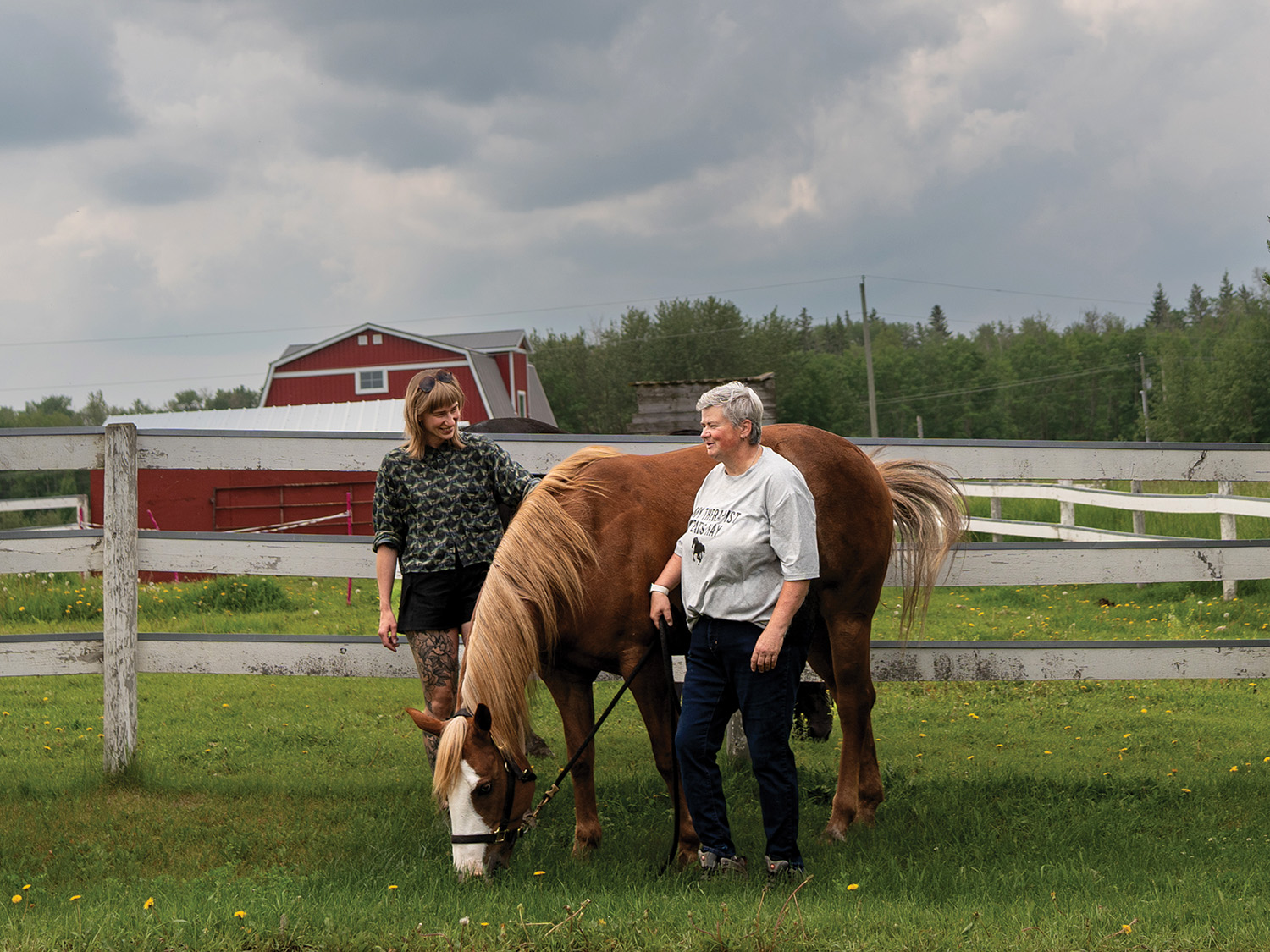
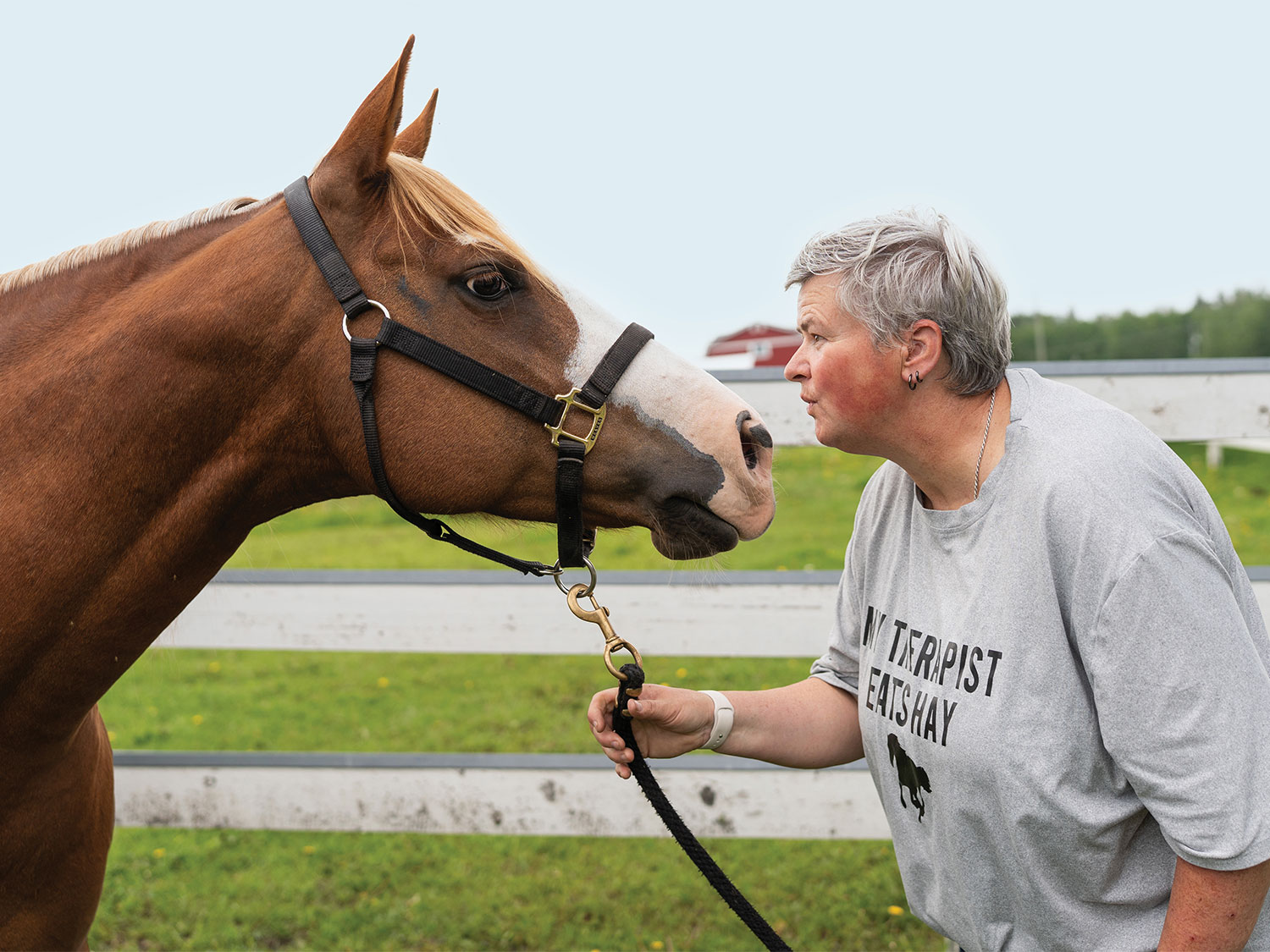
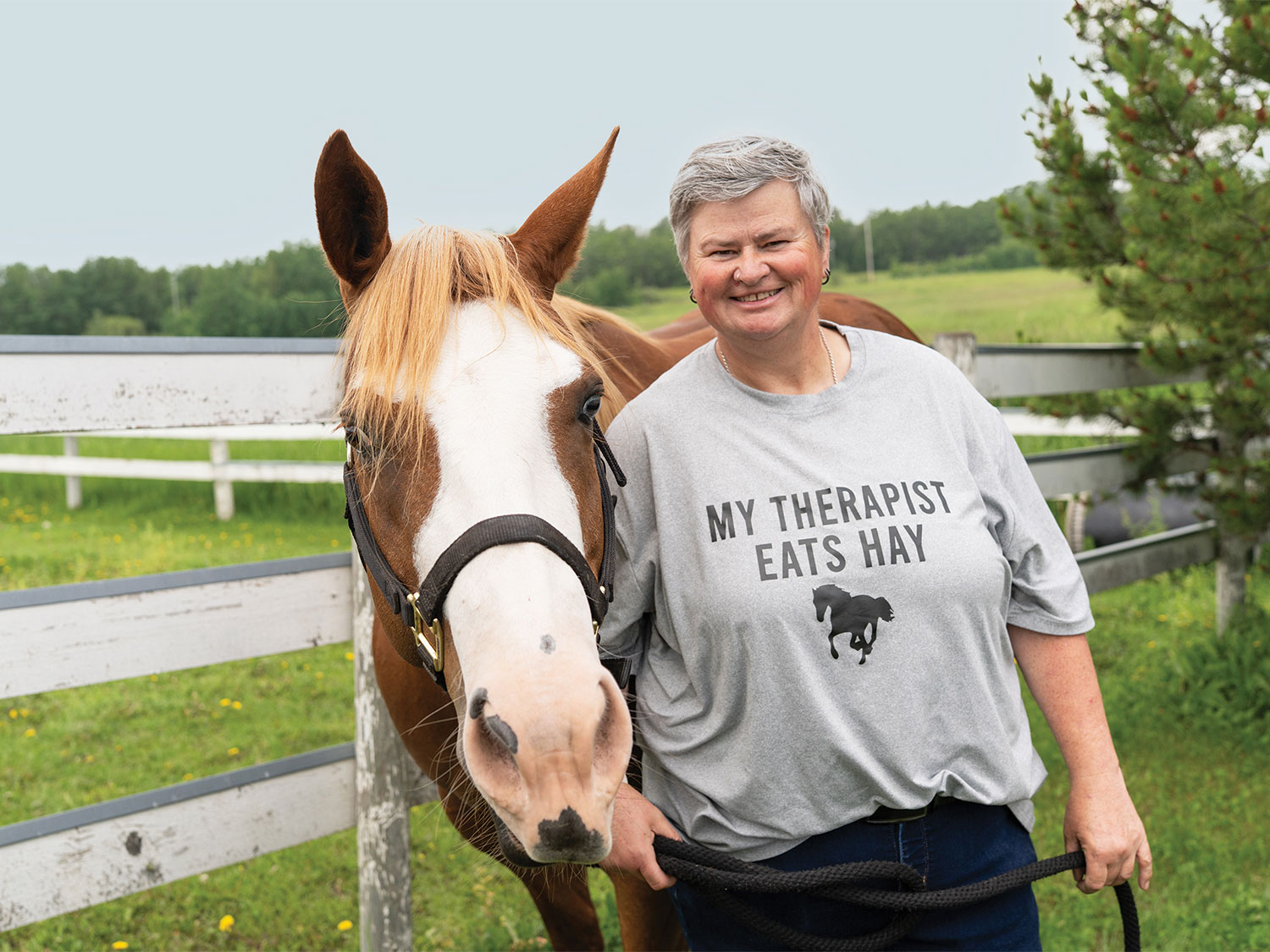
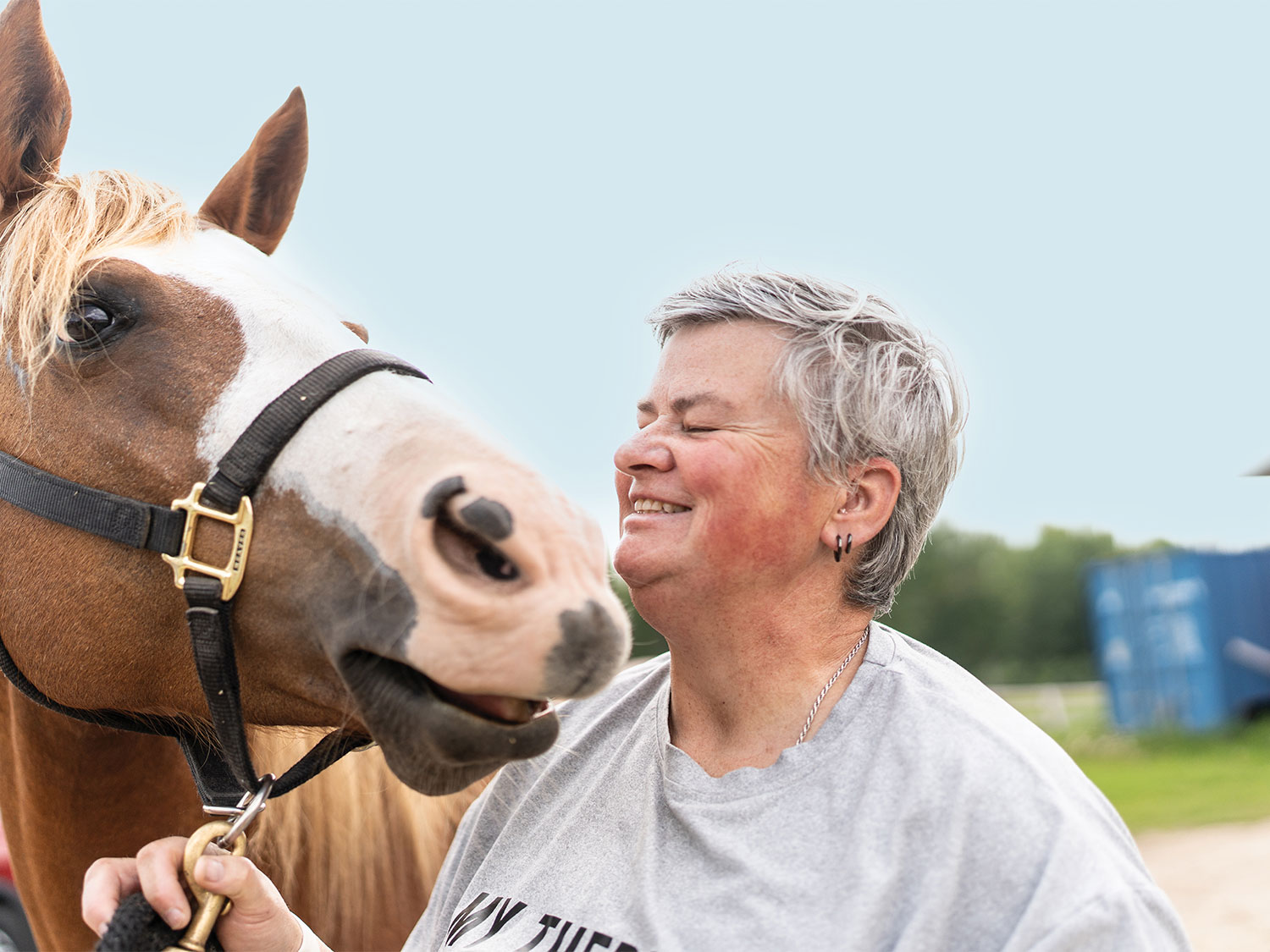
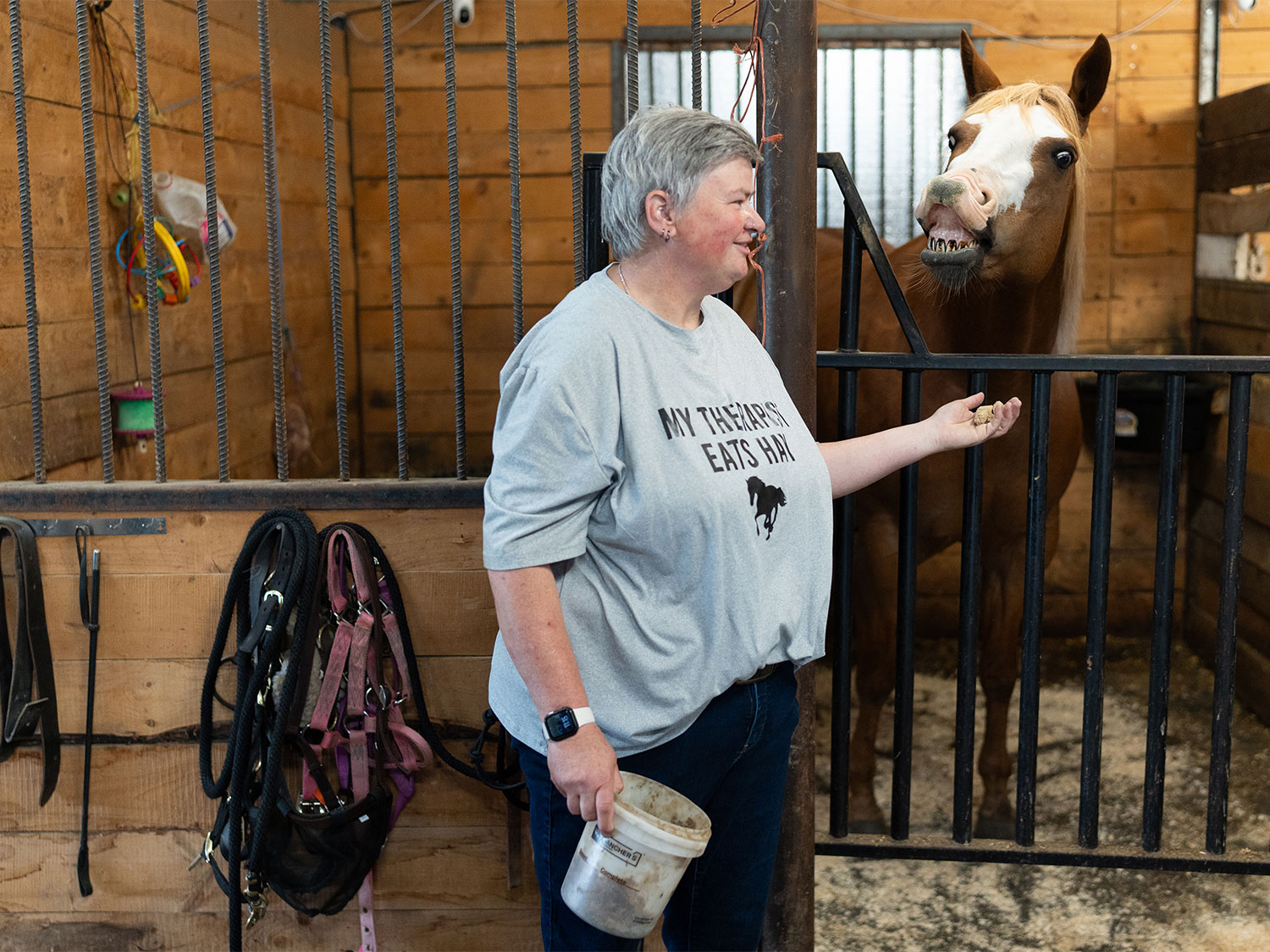
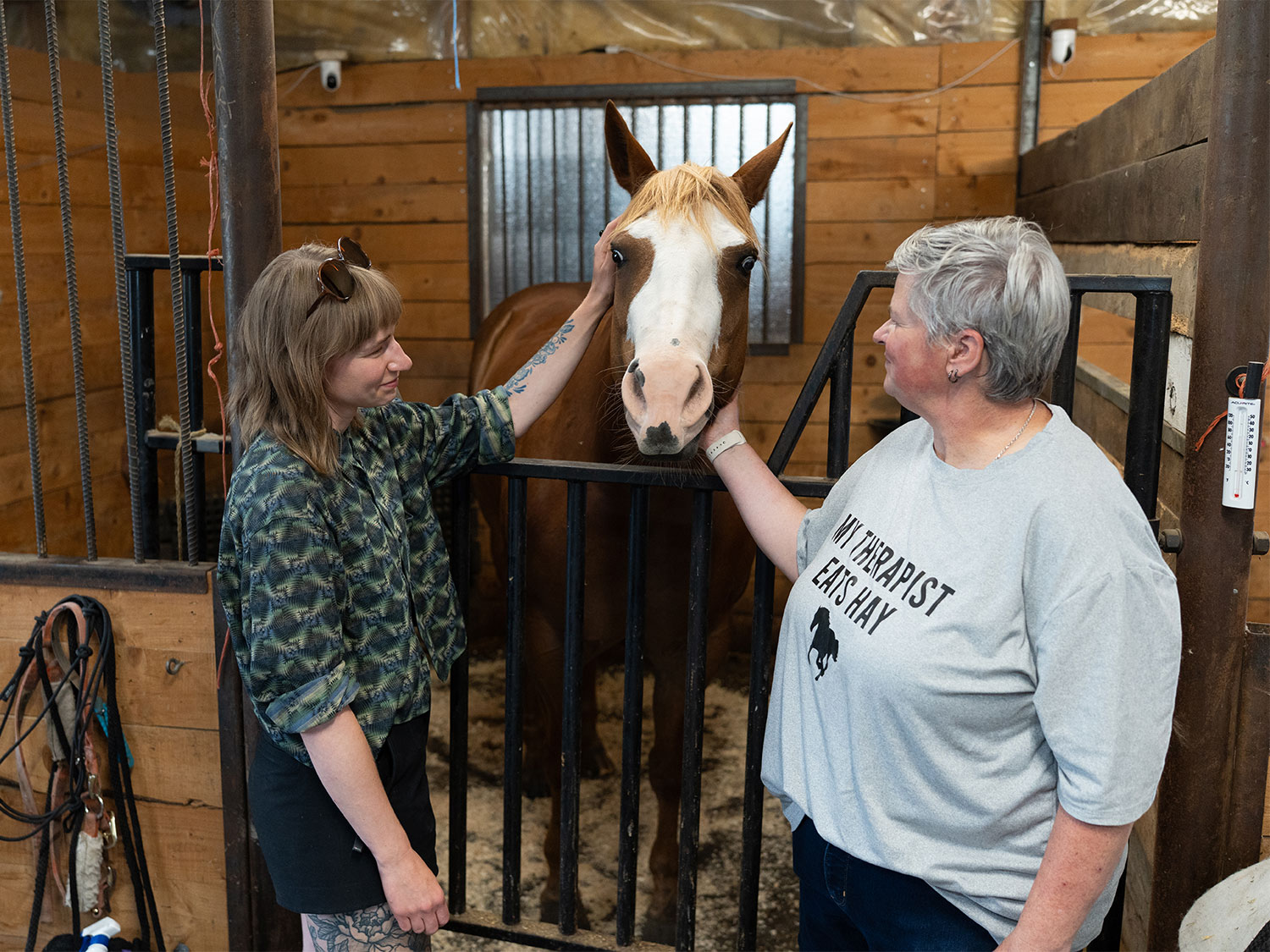
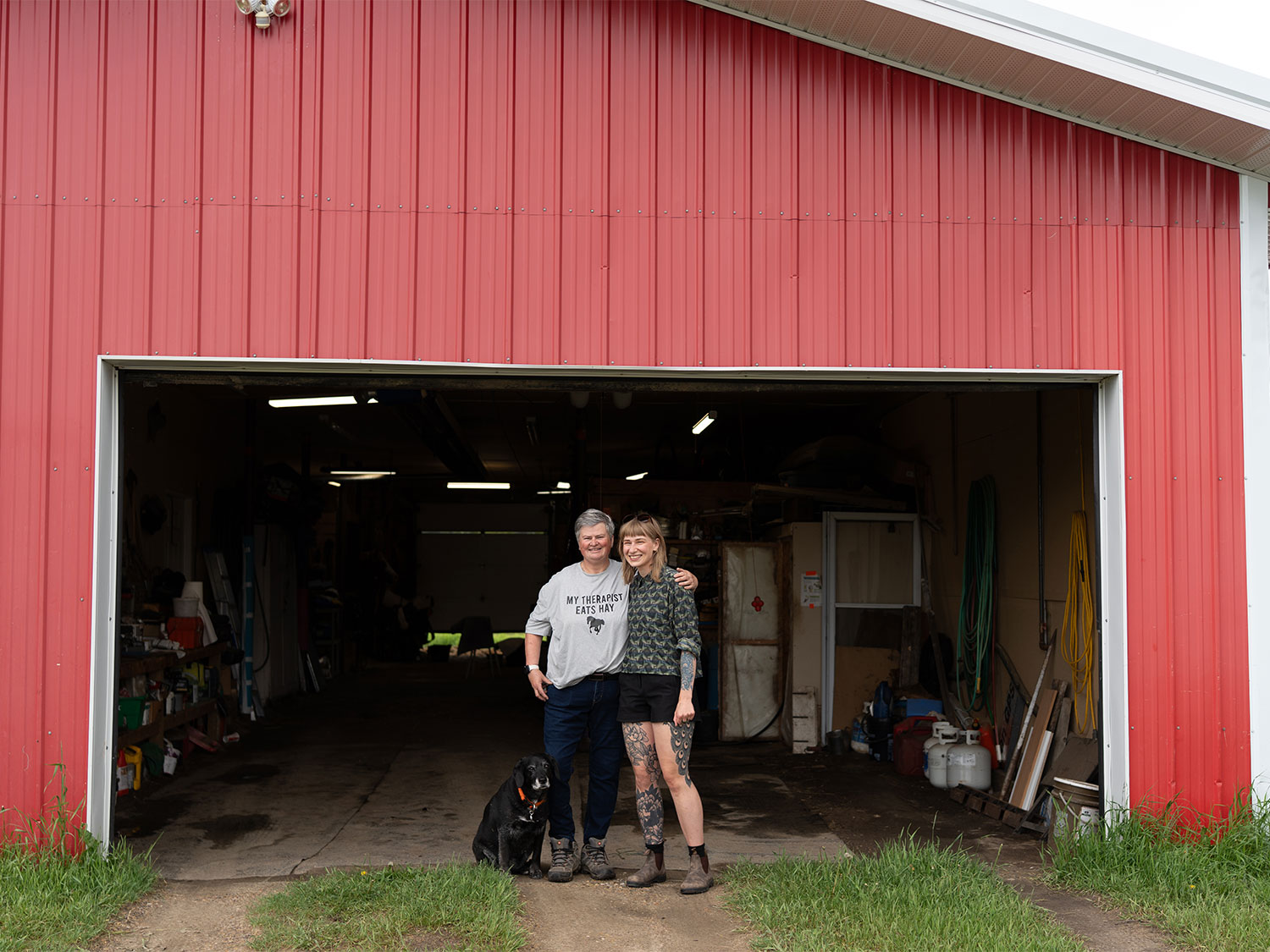
Within a couple of months, I bought a horse, Lucy. Because I had a horse, I needed a dog. So I adopted my service dog, Mildred Beatrice. I grew up on a horse. A horse doesn’t judge me; a relationship with an animal is non-verbal. Getting a house and animals meant getting my life back to normal.
But I was still so angry with the world. I was going to show them. So I bought a house. I had no idea what I was doing; I’d always rented. The bank told me I needed insurance. So, I called a broker and this lady sold me insurance. I didn’t understand what the broker was saying, so I agreed to everything she offered.


In 2017, four years after my injury, I got involved with a communication access initiative through Alberta Health Services and started giving presentations to staff at the Glenrose Rehabilitation Hospital.
I had some horrific experiences with health-care professionals who didn’t have strategies for communicating with someone with a language disorder. People equate language fluency with intelligence, autonomy and personhood. I had been treated as if I were stupid, talked over, intubated without my consent. I wanted to help change the system.
I started learning about the lack of speech services for adults in post-acute care. We all attend Aphasia Camp, an annual event that has become a kind of family reunion. But in 2017, community speech services were pretty much non-existent.
Many Albertans who have had a stroke or brain injury go from being working professionals to living on AISH (now ADAP). How do you afford $140 an hour for private speech therapy? I was lucky with my insurance. But generally, it doesn’t happen unless you’re rich.
By 2019, learning more about the health-care system and developing friendships with other adults with aphasia, I felt ashamed that I was fluent around all these people who couldn’t speak. Why me and not them?
One night, the thought popped into my head that maybe I had been given language to help those who had none. If somebody cannot speak, they cannot be the squeaky wheel — there’s another idiom. I decided to start a not-for-profit to help people who don’t have access to speech therapy. The Communication, Health and Therapy (C.H.A.T.) Society was born.
I founded the C.H.A.T. Society in December 2019 with the help of the two women behind Aphasia Camp: Esther Kim, the dean of rehabilitation medicine at the University of Alberta, and Angela Ruelling, co-chair of the speech language pathology master’s program.
From the beginning, my long-term goal has been to fundraise to subsidize speech therapy for C.H.A.T. Society members. We developed a three-pronged mission to assist aphasic adults through education, therapy and community. I became president and fundraising chair, and we created a board on which both aphasic and non-aphasic people could work together. Then COVID hit. Right away we started a weekly Zoom group, and had people from all over the province join in.


Over the past seven years, we’ve had up to 75 active members, with up to 20 of them attending the conversation group. If somebody takes 20 minutes to get something out, we wait. No one pressures them or tries to talk for them. It makes all the difference. A few weeks ago, I attended a meet-up, and there was a fellow who was non-verbal in 2020 — now you can’t shut him up.
The C.H.A.T. Society is diverse: We have one member who’s non-verbal but he’ll sit there and read War and Peace.
He wishes he could speak. I wish I could read the book.
Another friend who had a stroke 15 years ago is non-verbal, but she understands everything you say. One day we were having coffee. I was talking at her, trying to decipher the key words she was writing — kind of a comedy act, but we were connecting deeply. I said, “What did you do before your stroke?” She started crying. No one had ever asked her. Nobody talks to her. She was a dietician. And now she’s a board member; she’s been with C.H.A.T. since the beginning.
It’s been an exciting year. The C.H.A.T. Society is co-signing a grant with the University of Alberta for a project to train frontline and service workers to help people with language disorders. There are businesses I don’t patronize because of how I’ve been treated. This is true for people with aphasia, for neurodivergent people, for people who speak English as an additional language. If we were asked in a business or a clinic, “What is the best way to communicate with you?” it would be life-changing.
I hope we’ll soon be able to start subsidizing speech therapy for some members. Now, my focus is shifting toward advocacy to increase provincially funded speech services. I’ve been asked to act as a leadership advisor with the Alberta Health Services’ communication access initiative. It feels like a good start.


In 2025, someone asked me why my insurance premiums were so high. I called my insurance provider, and they said they couldn’t change my policy before the end of the year. Five days later my house burned down.
Turns out, agreeing to what everything the lady offered meant I was insured through the you-know-what. I had been paying for something called Total Home Replacement. As Lizzie and I work on this piece together, my new house is almost finished. I’m tiling the backsplash myself.
I’m no longer the woman who spent her days alone in a dark living room. I could sit on the La-Z-Boy in bubble wrap, but I refuse to live my life like that. Sure, I only plan one social engagement per day. I can do physical stuff ’til the cows come home — that’s a farm idiom — but I cannot sit and try to follow a long conversation.
I am a normal person. I do normal things. My brother and sister-in-law and I did seven trips to the mountains with my horse last summer. And I trained my horse recently — my poor brother, I think I took years off his life. Yes, I wear a helmet. Yes, horses can be dangerous. But so can walking down an icy sidewalk.
If I could go back and push a button and not fall that day in 2013, I don’t think I would. This is who I am. This is who I was meant to be, maybe.
I’m proud to be a part of this community. I do not know one person with aphasia who hasn’t regained language every single year after the onset of the disorder.
I’m still becoming more fluent, 13 years on. Every day, I learn a new word.
This article appears in the September 2026 issue of Edify