

Cynthia Palmaria was 11 years old in 1979 when her parents left the Philippines for Spain. She was old enough to understand why. Her parents wanted to send her and her little sister, Mirasol, to good schools, but education was expensive. They could earn better money as migrant workers abroad than they ever could at home.
And they weren’t alone. Cynthia’s parents were among the waves of overseas Filipino workers to set out for opportunities elsewhere. In the 1970s the Philippines’ currency was collapsing, unemployment and inflation were ballooning, and a frustrated populace started to agitate. Then-President Ferdinand Marcos was a dictator who instituted a labour export strategy that allowed citizens to gain wages and employment opportunities abroad while contributing to the national coffers through mandatory remittances. These transfers of foreign currency quickly became vital to the Filipino economy.
Marcos’ strategy was meant to be a measure to appease the political and economic unrest, but the Philippines’ “warm body export” economy never ceased. According to government statistics, 2.16 million overseas Filipino workers lived abroad on work contracts in 2023, the majority of them women, and sent home nearly $6 billion, an important part of the Philippines’ gross domestic product. The country couldn’t survive without the workers who go abroad.
The overseas jobs didn’t just separate Cynthia and Mirasol from their parents. They were separated from each other. “When we learned that my parents were leaving, they asked us which auntie we wanted to stay with.” Cynthia opted to live with her mother’s eldest sister, Charine, who was her favourite. Mirasol ended up with Auntie Delia, and each aunt received money from the girls’ parents. Arrangements like this demonstrate the financial importance of migrant labour to the extended families the overseas workers leave behind, even as they further cleave immediate families.
Cynthia’s parents earned good wages in Europe. They worked for a family of Spanish nobility who employed a crew of workers to care for their children, clean their expansive house, prepare meals and perform other household duties. In the summer, Cynthia’s parents worked aboard the family yacht. They’d sail from port to port and host parties attended by Spanish celebrities. Tucked within one of the letters Cynthia’s parents sent back to their daughters every couple of weeks was a photo of them standing on deck next to Julio Iglesias, Spain’s most famous singer-songwriter.

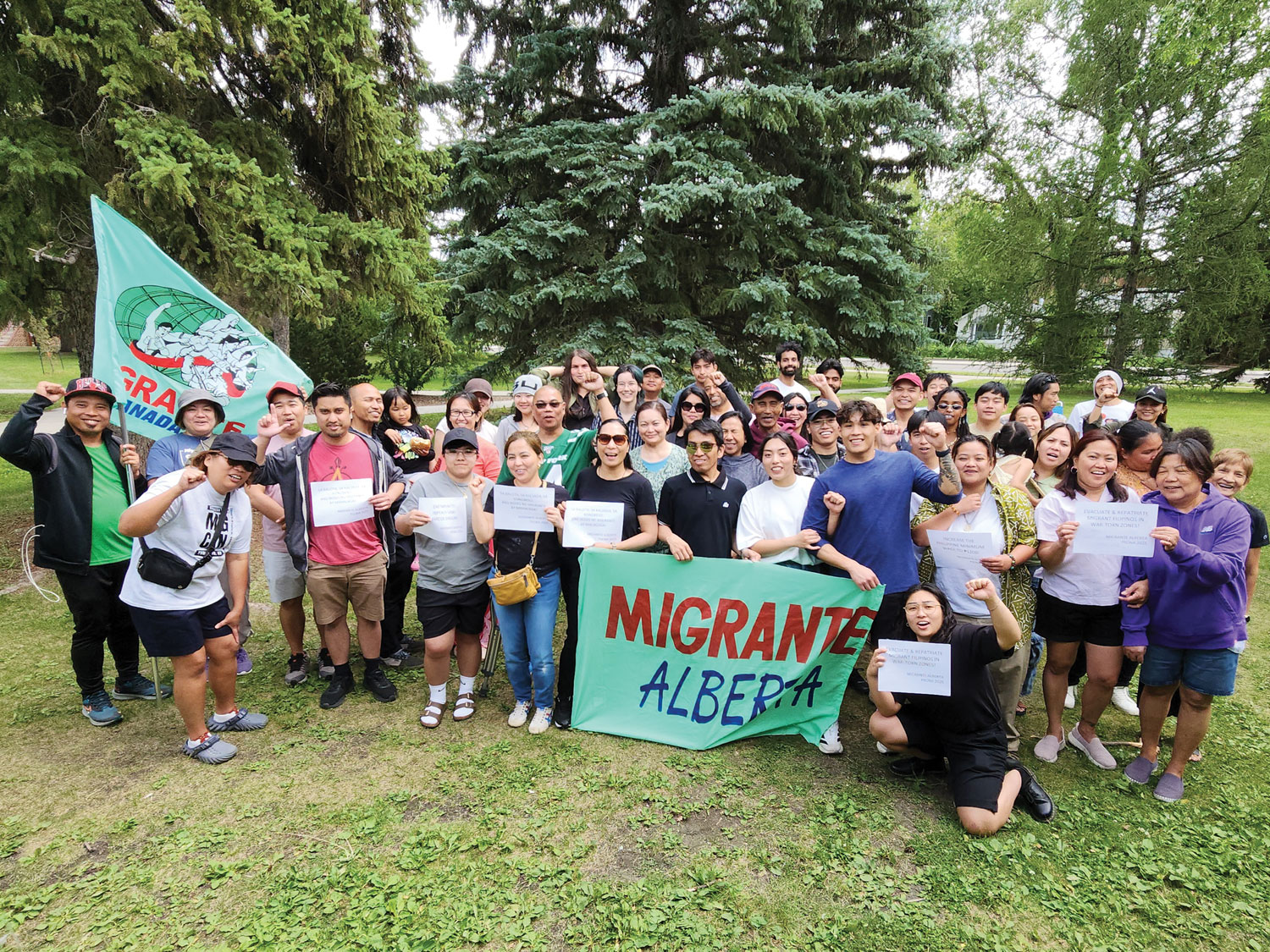
Being together made bearing the separation from their daughters a little easier. Most migrant workers, from the Philippines and elsewhere, don’t have this opportunity. Still, Cynthia’s parents longed for their daughters. Spain’s migrant labour programs offered no chance for family reunification. So Cynthia’s parents looked westward towards Canada, which granted eventual pathways to permanent residency to temporary workers. Cynthia’s parents might miss sailing between Mediterranean ports-of-call with legendary Spanish crooners, especially during Canada’s oppressive winters, but at least they could live with their girls.
And they certainly wouldn’t be the only Filipinos around. Canada has always been one of the world’s most reliable hosts for overseas Filipino workers. At the end of 2024, Canada hosted more than 38,000 temporary foreign worker permit holders from the Philippines, exceeding 16 per cent of all temporary foreign workers. Only India had more permit holders here. In Alberta, overseas Filipino workers can be found in multiple sectors, from caregiving to food service to meat-packing.
In 1984, Cynthia’s mother took a caregiving job in Montreal working for a Quebec luxury cosmetics magnate. Cynthia’s father joined her a year later. Cynthia’s mother cared for family’s children, prepared meals and tended to the household cleaning. Her father worked as the household’s chauffeur and outdoor maintenance man. In 1987, after obtaining their permanent residency, they sent for Cynthia and Mirasol. Cynthia was three years into a university biology degree but abandoned her studies to reunite with her family in Canada. She told her uncle that she’d return to finish her degree and apply for medical school in the Philippines. She wanted to spend some time with her parents, who she’d seen only once in the last eight years, then she’d come back. “I don’t think you’re coming back,” her uncle told her.
In Montreal, the family shared a basement apartment with a roommate. Cynthia’s parents worked long hours, from 7 a.m. until 7 p.m. on weekdays. “We only saw my parents around dinner time,” Cynthia says. Her father would sometimes bring home chocolates for Cynthia and Mirasol, just as he did back in the Philippines when they were little girls. “But I was 19 years old by then,” Cynthia says. “They were making up for the lost time when they left when I was 11. In their minds, I was the same Cynthia that they left.”




Often, their employers would ask Cynthia’s parents to work on the weekends, and they would allow Cynthia and her sister to swim in the pool while her parents worked. “That’s how we were able to spend time with them,” Cynthia says. But such kindness was rare. Cynthia says the family never paid her parents for these extra shifts, and she recalls that they could be verbally abusive, too. Cynthia says she once asked her father why he put up with this mistreatment. He told her, “Well, you wouldn’t have been able to come here if not for them, right?”
Cynthia spent a year with her family in Montreal before leaving for the University of Waterloo to finish her bachelor of science degree. Cynthia never spoke to her classmates about her parents’ jobs as migrant caregivers. “I was ashamed,” she says. “I wouldn’t talk about my background. That’s something I kept to myself for years.”
After graduation, Cynthia returned to Montreal to live with her parents as she trained to become a radiation therapist at Dawson College. There, she helped establish an independent youth organization called the Montreal Coalition of Filipino Students. Many members were also children of migrant workers who’d also endured the trials of family separation. “Everyone was bitter about being left to their uncle or auntie or grandparents,” Cynthia says. They faced similar challenges reintegrating with their families after being reunited.
It was during this time that Cynthia stopped being embarrassed about her migrant background. “My community internalized the racism and oppression.” They felt they had to be happy that they had a better life in Canada, and thankful that their employers accepted them into this country. Filipinos have a phrase for this accommodating attitude: utang na loob — debt of gratitude. “But in my mind, I knew that wasn’t right,” Cynthia says. “That doesn’t give anyone the right to abuse you. I started to speak up.”
In 2005, Cynthia moved to Toronto for a radiation therapist job with her husband, a union organizer with CUPE. When Cynthia’s husband’s parents moved to Calgary in 2012, she and her husband decided to follow them to Alberta to be closer. She’d done her research: radiation therapists received better pay in Alberta. They ended up settling in Edmonton.



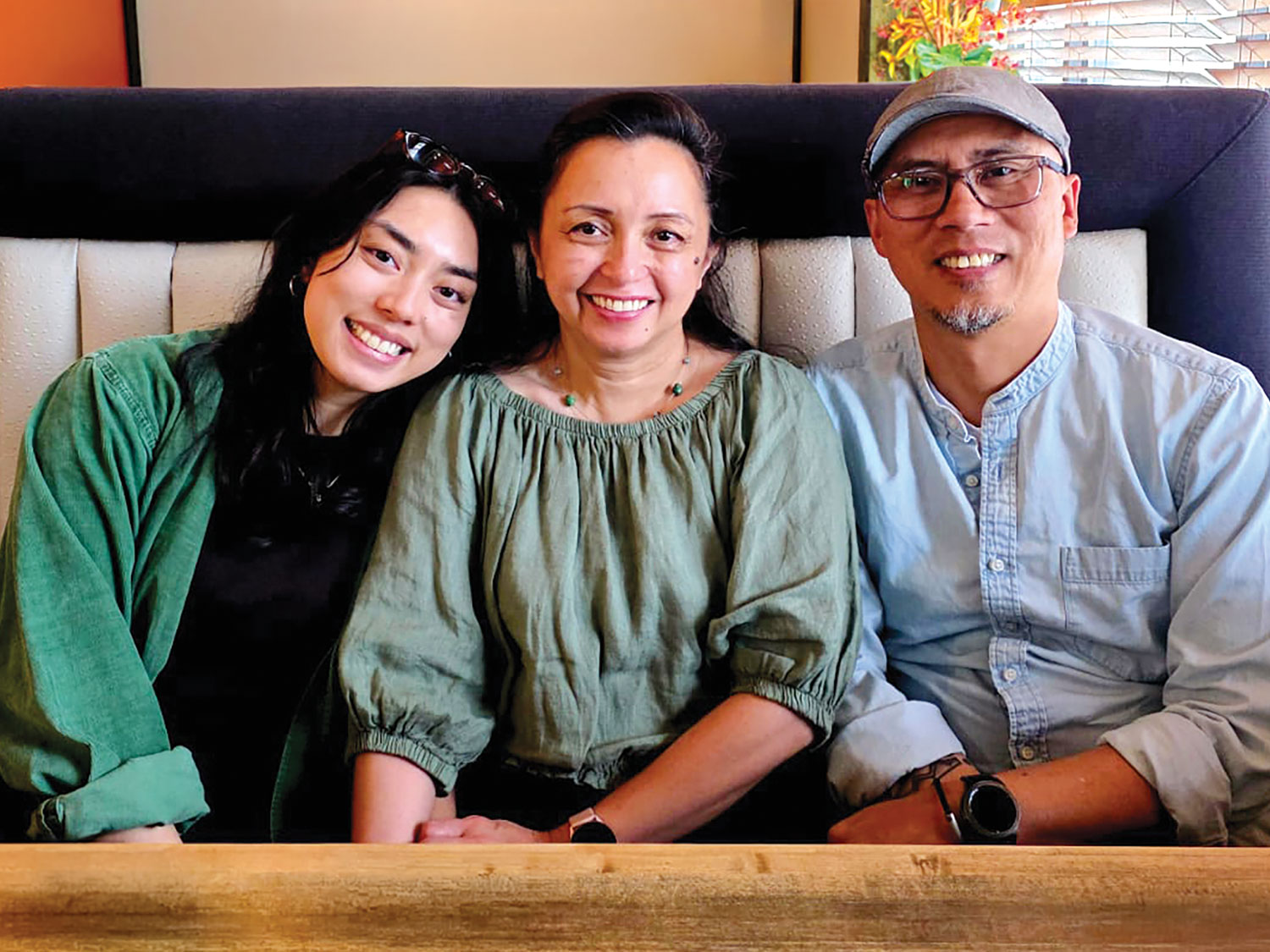
Cynthia quickly realized the migrant Filipino community in Edmonton lacked the sort of organized advocacy she had encountered in Montreal and Toronto. So, in 2013, Cynthia and her friend Novie Mae Sambat founded Migrante Alberta, a provincial chapter of an international organization that defends the rights and welfare of Filipino migrant workers around the world.
Migrante Alberta’s first campaign was to establish a Philippines Consulate in Alberta. At the time, Alberta’s Filipinos needed to fly to Vancouver to renew their passports, which entailed paying for flights and losing a couple of day’s wages. Migrante Alberta partnered with the Gabriela Women’s Party, a progressive political party in the Philippines with members in the national congress, to advocate for a consulate here. Their proposal succeeded, and a consulate opened in Calgary in 2016.
Most of Migrante’s achievements are born of the struggle for community justice rather than diplomatic convenience. One of the organization’s early victories was the effort to help Maria Victoria “Vicky” Venancio. In 2012, a truck struck down Vicky as she rode her bicycle to her McDonald’s job. The accident left her wheelchair bound. Since she was a temporary foreign worker who could no longer work, the feds revoked Vicky’s permit — rendering her ineligible for health care and marked for deportation.
“When I was in the hospital, I didn’t have anyone at all to help me. And I didn’t know where to go,” Vicky says. Her ailing parents in the Philippines depended on the money she sent to them. Her thoughts grew dark. “I prayed for God to take me away rather than to get better.”
Migrante Alberta fought the deportation order and petitioned the government to grant Vicky permanent residency status on humanitarian and compassionate grounds. The organization found allies in unions, community groups and in the Alberta legislature itself, particularly with then-Minister of Health Sarah Hoffman. Migrante even hosted a Justice 4 Vicky benefit concert to raise funds for her legal fight. Vicky received her permanent residency in 2017.



Vicky still lives in Edmonton where she started a catering endeavour called “Chef on Wheels” — her pork siomai dumplings are revered. Her injuries still cause Vicky constant anguish, but the cooking helps her cope. “I do some cooking just to forget that I’m in pain,” Vicky says. “I love being in the kitchen.” She remains thankful for all Cynthia and her Migrante Alberta colleagues did for her. “Without them, staying in Canada wouldn’t be possible. They stood up for me at the moment I couldn’t stand for myself.”
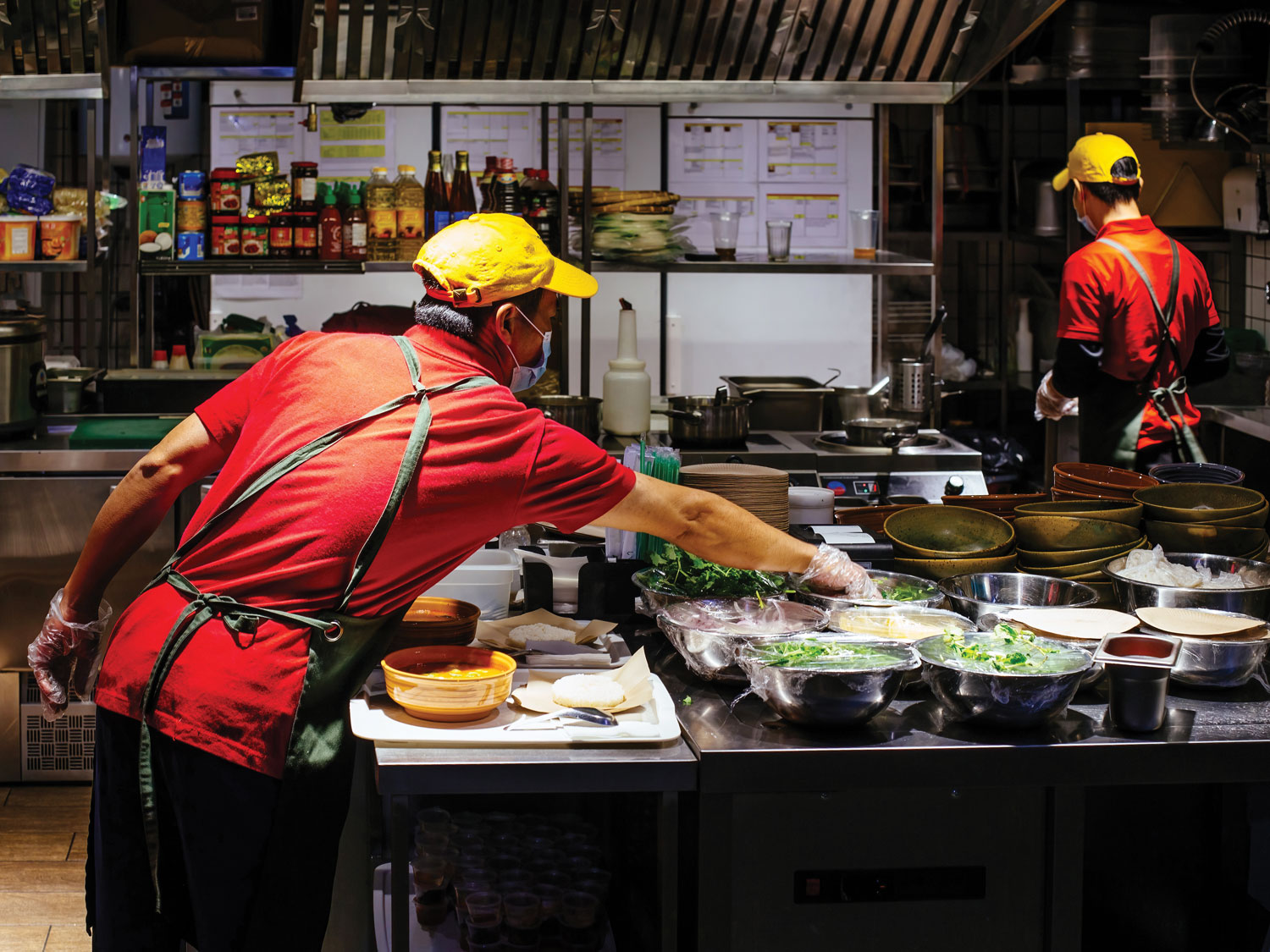
In 2014, a sudden decision by then-Minister of Immigration, Refugees and Citizenship Jason Kenney also spurred Migrante Alberta into action. In 2008, prompted by labour shortages brought on by Alberta’s oil and gas boom, the Canadian government expanded the Temporary Foreign Worker Program to include hospitality and service sectors. The bulk of these new work visas were issued to fast-food workers from the Philippines — workers like Vicky. Businesses quickly started to rely on migrant labour. By 2014, McDonald’s restaurants in Canada brought in more than 3,400 migrant workers, and Tim Hortons an estimated 4,500. A little more than four per cent of the workforces for both restaurants came from abroad.
Employers had long complained about the Canadian workers who worked these low-wage jobs. Many were teenagers and young adults. Few had any work experience at all, certainly not in the exhausting world of fast-food service. And they rarely stayed long. Some restaurants turned over their entire staff every year. These new Filipino workers were a godsend. Many possessed managerial experience after years toiling at the deep fryers at Jollibee or McDonald’s back home. They were older too, and tied to their jobs through closed permits. The expansion of the Temporary Foreign Worker Program allowed employers to staff their restaurants with capable and stable workers for the same meagre wages they paid less reliable local teens.
Inevitably, reports of employers abusing the program, and their workers, started making national news. In December 2013, for example, two Filipino workers accused their boss at a Tim Hortons in Fernie, B.C., of cheating them out of overtime pay and charging them hundreds of dollars for their work permits — costs their employer was legally obligated to pay. The following spring, the feds suspended permits for three McDonald’s locations in Victoria that favoured temporary foreign workers over their Canadian staff. And five temporary foreign workers in Edmonton told the CBC their McDonald’s boss insisted they share a posh penthouse downtown apartment and deducted almost half of their earnings as rent. The employer collected a tidy $600 monthly profit off the grift.



Stories like these prompted Jason Kenney to abruptly freeze the food service sector’s access to migrant workers. The snap decision left many of Alberta’s Filipino workers in a precarious position. Work permit renewals were cancelled, and hopes for permanent residency under provincial nominee programs were dashed. By the time Kenney lifted the moratorium a couple months later, thousands of food-service workers faced deportation.
“This was a crisis situation,” Cynthia says. Migrante Alberta held information sessions and consulted with the workers who found themselves in immigration limbo. “It really was a prime time for Migrante to be out there, reaching out to the community and finding out their situation.” Even non-Filipino migrant workers started knocking on Migrante’s doors.
Many of the migrants who lost their status during Kenney’s brief moratorium made the difficult decision to stay in Canada undocumented. One undocumented worker told of an employer who asked her if she’d prefer to be paid in cash or by cheque. The worker was without status and hesitated to leave a paper trail for the authorities to follow. It left her vulnerable to exploitation and underpayment.
The already intense vulnerability of some undocumented workers spiked during the pandemic as they weren’t eligible for regular government supports. “Undocumented people who’d been hiding in the shadows since 2014 came to Migrante because they needed help,” Cynthia says. The organization launched a “Serve the People” brigade to deliver food hampers to undocumented migrant families in Edmonton and Calgary, Filipino and non-Filipino both.
After the pandemic, once gathering rules lifted, Migrante Alberta started hosting a regular migrants’ cafe. “It was just a way for us to have coffee on a Sunday. Even the undocumented would come and bring Filipino cooking,” Cynthia says. “We started seeing the trust that we gained from the work that we did.” Undocumented Filipinos gained such strength from Migrante’s support they started marching in rallies and showing up for demonstrations. “They saw how we were fighting for them. And they started fighting with us.”



In 2015, children weren’t eligible for health care in Alberta if their parents didn’t have legal status. Undocumented parents had to pay out of pocket for medical care for their Canadian-born children. Migrante partnered on a campaign demanding a law be passed that guaranteed health services for all Canadian citizens, regardless of their parents’ status. The campaign became another Migrante Alberta success story. The Alberta government passed a law in 2017 that extended health coverage to all Canadian-born Albertans.
In one public case, Migrante Alberta started a petition demanding the revocation of a removal order to keep a vulnerable mother and daughter in Canada. Migrante sent letters to Immigration, Refugees and Citizenship Canada and collected signatures in support of them. It held a press conference and spoke to the media. Migrante’s activism worked. The mother and daughter received a temporary residency permit, followed by permanent residency.
These days, Cynthia fears the number of undocumented Albertans will rise in the wake of new federal immigration policies. Rules restricting post-graduate work permits for international students, for example, will result in migrant graduates and their families remaining in Canada without status. Children have already been kicked out of Alberta schools because their parents lost their status. The Government of Alberta’s “Alberta Next” strategy also raises fears among the province’s already vulnerable migrant worker population that services may be withdrawn. A video on the government website ominously claims, “We may have the option to withhold provincial social programs to any non-citizen or non-permanent resident who does not have an Alberta-approved immigration status.”
Migrante Alberta can provide these migrants with the information and support they need to address the increasing precarity they face. “We want the workers to be empowered to organize themselves so that they can support each other,” Cynthia says. She understands that marshalling the courage to speak up can take years for the vulnerable Filipinos who come through Migrante’s door. The organization continues to advocate for a decent life back in their home country, but in the meantime, they advocate for the rights and welfare of immigrants in Canada. The immediate work, Cynthia says, is to ensure these workers that the organization will be there to empower them — just as Migrante Alberta has always done.
Marcello Di Cintio is the author of Precarious: The Lives of Migrant Workers, Driven: The Secret Lives of Taxi Drivers, and Pay No Heed to the Rockets: Palestine in Present Tense.
This article appears in the April 2026 issue of Edify