

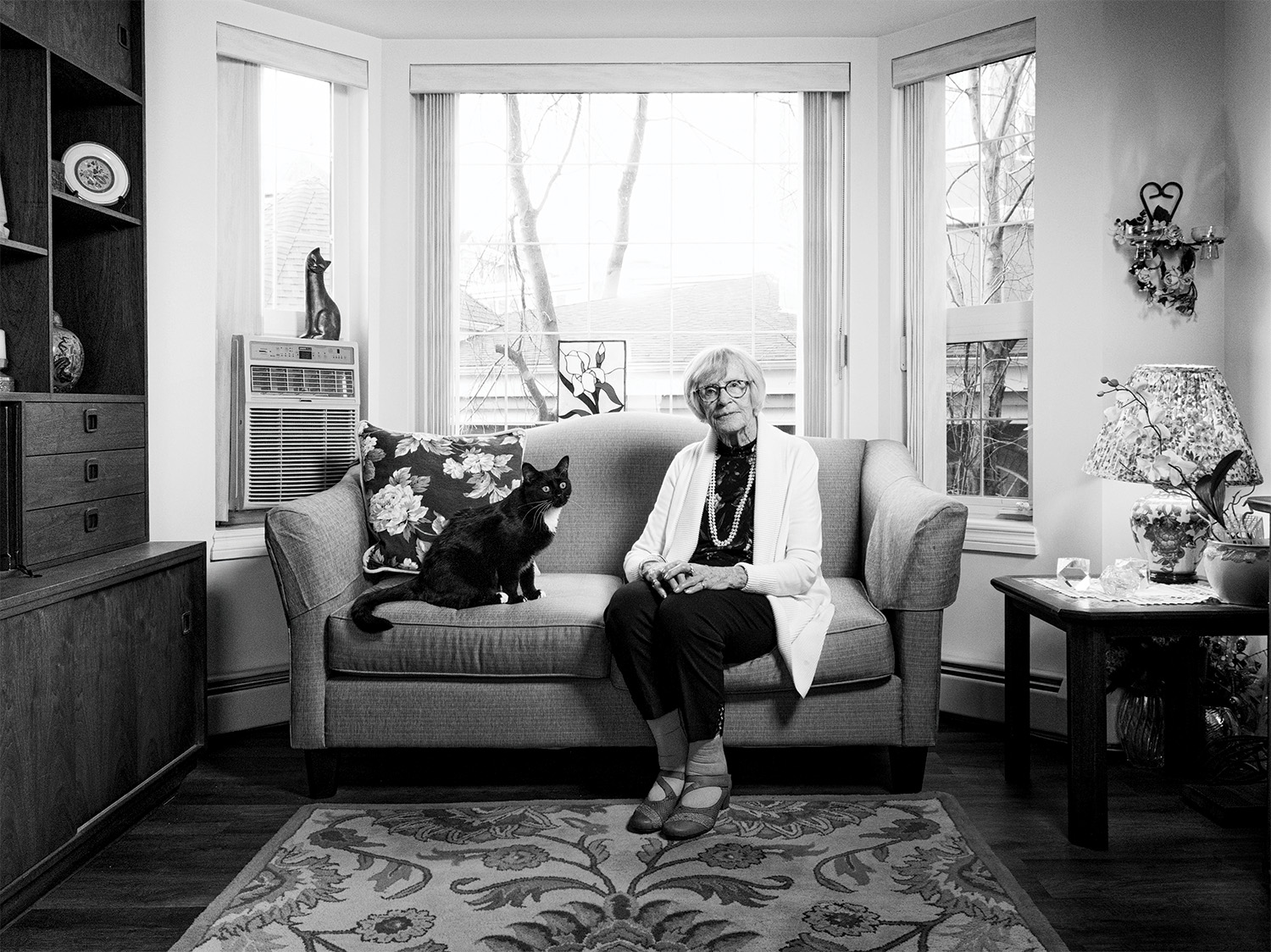
In March 2023, Edith Stein moved into The Churchill retirement residence across from City Hall. With its white-and-grey exterior and blue-awned windows, her new home blended into the downtown streetscape, noticed by few. The street level windows were covered with stock images of smiling seniors, but behind generic coverings was a genuinely vibrant community of downtown residents.
It felt like a natural choice for Stein, who lived minutes from the core in her family home for most of her 95 years — and has been a Citadel Theatre subscriber for almost as long. She’d need only cut across Churchill Square to attend the matinees now. Even better, a pedway connection between the retirement residence and City Centre mall meant she could do her shopping without having to worry about transportation or slipping on treacherous winter sidewalks. “This was my comfort zone,” Stein told me. She simply couldn’t picture herself living in the suburbs.
With graduated levels of care available at The Churchill, from independent and assisted living to memory care, Stein anticipated living downtown for the rest of her life. She sold her car, learned the transit system and, with help from City Hall’s friendly information desk staff, started mapping out her routes. Even though downtown had changed so much since the “heydays” of Edith’s fondest memories, she and her new friends were able to look past insufficient shopping options, pockets of dereliction and increased security concerns, and made the most of living in Edmonton’s arts and culture district. The Churchill, if nothing else, had attracted like-minded people with a taste for urban life. “It was an unbelievably special group of people.” They made fast friends.
Then, just 15 months into her new downtown life, Edith and her fellow residents were forced to move. The building owner, a real estate investment trust, had sold it to another investment firm, which had plans to turn it into apartments. A past employee of The Churchill’s management company, who asked not to be named, told me that social disorder and safety concerns had made it difficult to attract new residents, which is essential for the sustainability of any retirement community.

Days after the last resident moved out, renovations began for The Churchill Apartments, with modernized furnishings and updated recreational amenities. As a building for seniors, it was no longer viable, but financial speculation pointed to the profitability of a younger clientele.
Stewarded by then mayor Bill Smith, Edmonton’s first Capital City Downtown Plan, released in 1997, came at a time when the downtown core was rendered lifeless by the previous decade’s recession. Austerity measures decimated thousands of government jobs that were essential to its retail and hospitality ecosystem. Department stores shuttered, small businesses moved, their abandoned store fronts looking out onto emptier streets.
Key to solving the problem, reported the document, was attracting and growing a diverse resident population; a revitalized downtown, among other things, would be a place “where seniors gather.” To incentivize this, the Downtown Housing Reinvestment program offered developers a $4,500 subsidy per unit, which Manulife Financial used in a $12 million project to convert a nearly vacant office tower on 100th street and 103rd avenue into The Churchill seniors’ residence.
When it opened in 1999, the arrival of 200 seniors was celebrated and considered a significant boost for social and economic vibrancy. “It will get people living in the heart of the city and its positive impacts will be felt beyond its new walls,” Craig Henderson, lead architect of the project and then chair of the Edmonton Downtown Business Association, told Real Estate Weekly. A new pedway construction to the 21-storey tower was vaunted as an accessibility feature for residents, but it also symbolized what was considered a mutually beneficial relationship between seniors and downtown vibrancy. Decades on, Henderson’s stance hasn’t changed. By just being present downtown, Churchill residents had added to urban density and enjoyability. “It’s nice to see a cross-section of people,” he recently told me.



An updated version of the Capital City Plan in 2010 promised to double down on that symbiotic relationship. With an aging population and more people trading big homes for convenient city living, the plan called for housing built on universal design principles that helped people age in place. The city aimed to work with seniors’ housing groups and developers to make it happen. According to Robert Lipka, the city’s principal urban designer, housing that serves people of all ages helps create a safer, more vibrant downtown, as different groups use public spaces at different times of day.
I first met residents of the Churchill retirement community in 2023 during my doctoral research about how downtown revitalization affects seniors. It quickly became clear they were a distinct group — people drawn to the convenience and energy of city living who wanted to stay active in civic life. A salon and pharmacy on the ground floor were used by some residents, but they often walked or wheeled through the pedways for errands or leisure, becoming familiar faces to nearby shop owners. And when disability, illness or bad weather kept them home, the city’s sights and sounds still reached them.
These were the kind of people who like the energy of being in the heart of it all — people like 90-year-old Dolores Huizinga on the 12th floor, who delighted in the view of people skating or splashing in City Hall’s plaza, the festival cheers and fireworks bursting in the square. They often repeated the same refrain to me — that moving in felt like “coming home.” One woman, Marie Delisle, 85, a retired City employee, worked in buildings “all over” downtown, including The Churchill, back when it was The Centennial building with temporary office space for city employees. “Who would have ever thought I’d be retired here,” she said.
Another resident, Bud Salloum, still worked full-time as a financial advisor with his son, sharing an office on the 22nd floor of the Edmonton Tower. He’d spent his entire working life downtown, commuting by car from his Dovercourt bungalow where he’d lived with his wife for six decades. When she passed away, rather than live alone, he moved into The Churchill — a mere block and a half from the office. Looking back at it now, he feels lucky to have, however briefly, enjoyed the professional and social advantages every day.



But in the aftermath of the COVID-19 pandemic, poverty and open drug use became more visible in the surrounding neighbourhood, and office vacancy rose to 24 per cent — almost double the rate of some Canadian cities. The doors to Sage Seniors Association, a block south, were locked due to security concerns. Edmonton Police Service reported that the number of violent criminal incidents reached a record high in 2022. A concentration of these crimes occurred in downtown and central neighbourhoods, and included several high-profile unprovoked attacks perpetrated against seniors.
Seniors I spoke to about safety said the presence of street-involved people grew after the pharmacy on the ground level began offering addiction services, like opioid dependency treatment. But they simply adapted their routines and used their “common sense” when getting around. For instance, Stein, who was apprehensive about travelling underground to access the LRT on account of the people who were often camped out in the stairwells, requested the accompaniment of a security guard. Other residents travelled as a group or avoided walking at night. “I’m not going to let worrying about what may happen make me stay in this suite all the time,” said Delisle.
Of course, it troubled Delisle and her neighbours to witness extreme poverty, to see increased vandalism on the streets and pedways. But for the most part, the benefits of living downtown outweighed the risks. They were more afraid of the potential fallout for The Churchill itself, which was facing high vacancy as few new residents moved in, due in part to safety concerns as well as declining trust in congregate care after the pandemic.
Fears of closure stirred in the fall of 2023 when on-site nursing services were discontinued, prompting the first relocation of around 35 residents living on the assisted living and memory care floors. As it became clearer that the owner was divesting of the property, the remaining independent residents who’d been promised graduated care now faced the likelihood that they wouldn’t age in place after all — and they’d have to leave downtown sooner than they ever expected.



The Churchill residents were given six weeks notice before it officially changed hands, on June 1, 2024. Within weeks, leasing signs appeared, and by year’s end it had quietly transformed into housing for “young, active renters” (or so said the advertising).
In the end, sustainable urban vibrancy depends on two things: attracting more residents to the core and keeping them there.
But this is easier said than done. Though Edmonton’s population has increased more than 15 per cent since 2020, downtown has only grown by five per cent to about 13,000 residents. At this rate, the target population of 24,000 — first set in 2010 as critical mass for a strong downtown and reinforced in the 2024 Downtown Investment Plan — will take, quite literally, a lifetime.
The percentage of “working age” people, that is between 25 and 54, living downtown is roughly 65 per cent, significantly higher than the neighbourhood average — and the inverse is true when it comes to people of retirement age.
This is by design. Rogers Place and the Ice District deliberately cater to a young clientele through high-energy and high-ticket events. The current housing initiative for downtown offers subsidies for student housing, in particular. Even former mayor Stephen Mandel, while throwing his support for the city’s 10-year extension of the community revitalization levy, which is intended to add the Fan Park event space and more housing to the Ice District, told Global News that the future of downtown is “all about young people.”
On the surface, catering the core to students and young professionals might seem like the surest way to invigorate downtown’s economy. After all, this is the population who is likely to pay for high-ticket events at the Ice District, which according to the Edmonton Arena Corp. generated $3.2 billion in economic impact. Yet, downtown’s share of the city’s overall tax base has decreased by half since 2010. The Ice District was boosted as a revitalizing project, yet the street on which The Churchill was located, one block away, has remained markedly unrevitalized. This, despite a $2-million city project that resurfaced and redesigned the avenue.



According to Ken Cantor, retired Qualico developer who worked on the EPCOR Tower and other downtown projects, creating urban vibrancy depends on how people in the core spend their money, not just how much is spent. And while true that pensioners are likely to spend less on recreation, they do spend their money on transit and local retailers, both animating streets and the local economy, which are necessary for a balanced urban ecosystem. “They’re buying what they (need) often within walking distance of where they live,” says Cantor. “And they’ll do that by shopping five or six or seven days a week, instead of a bi-monthly trip to Costco.”
Few options for seniors’ housing remain downtown: There are subsidized rental apartments at Cathedral Close, and the Chinese Seniors Lodge offers independent and assisted living. The shortage ensures the downtown population will remain young as those entering later stages of life are pushed to the peripheries for what they need, though not what they want. And if so-called “catalyst projects” like Rogers Place and the planned Fan Park — both publicly subsidized through the community revitalization levy — continue to cater mainly to younger crowds, we’re not just borrowing against future tax revenue; we’re impoverishing the very futures of those who call downtown home today.
City planners have historically struggled with appreciating the value of old age. The courthouse, the Tegler, both Bank of Montreal buildings: each fell to the wrecking ball of progress, as if anything past its prime must make way for something shinier. Perhaps it is no surprise then that when The Churchill was shuttered, neither city council nor the downtown business community paid any attention. As one resident, foreseeing the inevitable closure in 2024, put it to me, “Worse than metaphorically being put out to pasture is literally being put out to pasture.”
This may be to our detriment. By 2041, it’s estimated that a fifth of Edmontonians will be over 65. The Capital City Downtown Plan didn’t just plan for this inevitability, it saw it as an opportunity. “With our aging population,” wrote local historian Lawrence Herzog in a 1999 Real Estate Weekly article, following the opening of The Churchill, “a complex aimed at those in their golden years make demographic sense.” And it still does — perhaps more than ever. Aging in the suburbs presents challenges that downtown living can ease. With amenities and services close at hand, seniors can maintain independence even after they stop driving, while the social opportunities in denser neighbourhoods help combat isolation.



But planning a downtown for an aging population — of which we’re all a part — is more than just demographic logic. The world’s best cities have found ways to weave together people and infrastructure that serve both young and old. If Edmonton doesn’t do the same, we risk never building a truly vibrant downtown — only chasing the idea of one.
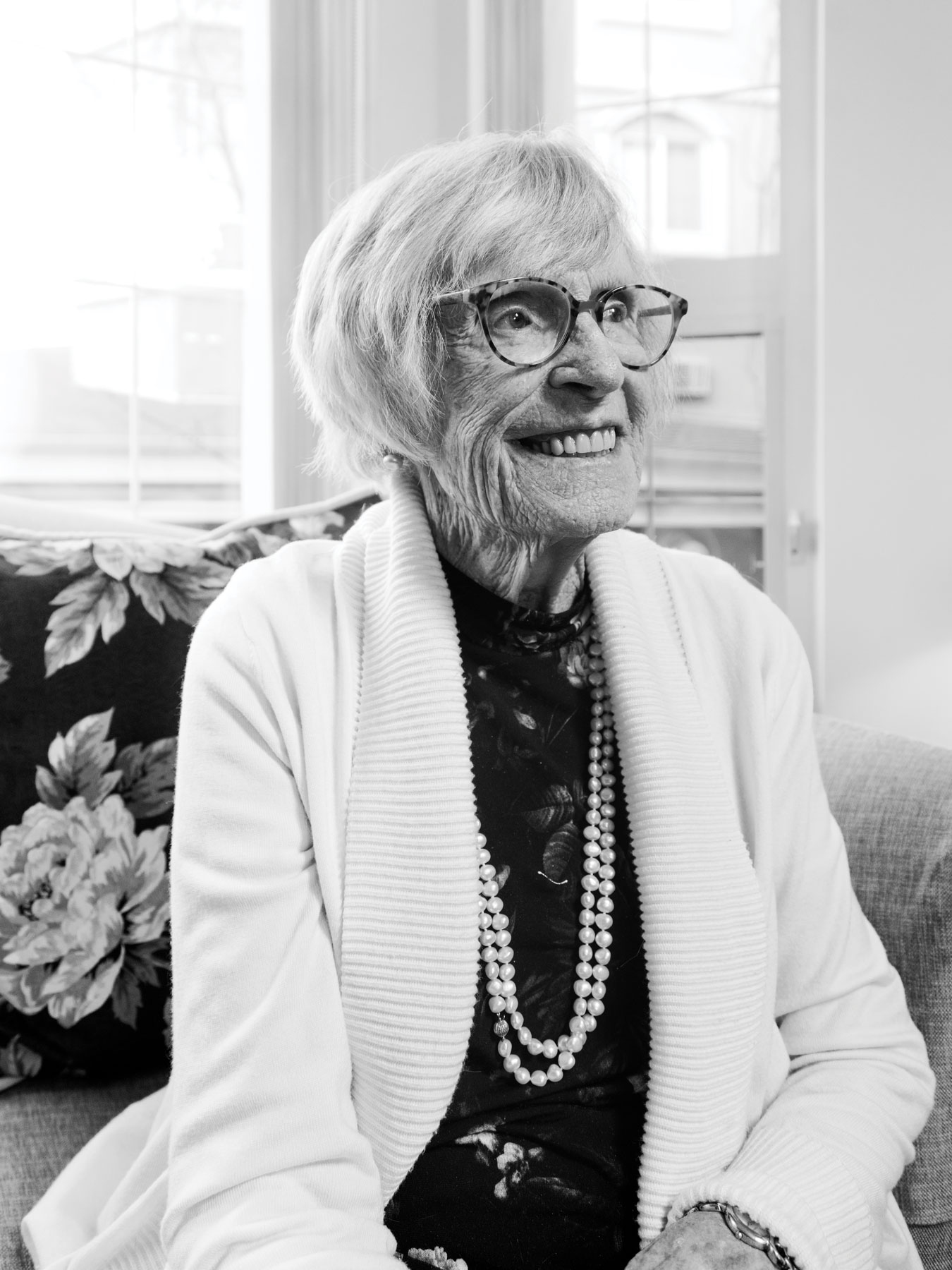
Last May, nearing the anniversary of The Churchill’s closing, Edith Stein had me over for tea at her new home inside a Wîhkwêntôwin seniors’ residence. Like many of her former neighbours, she settled as close to downtown as she could — but it’s a far cry from living in the middle of the arts district. Many of her friends rarely make it downtown anymore. Stein still keeps her Citadel subscription, but now every outing — to the theatre, the doctor, the pharmacy or to visit Churchill friends — requires careful planning. She insists she’s adjusted, but admits she’d return to the heart of the city in a heartbeat if she could. As she reflected to me what losing her home at The Churchill felt like, it was apparent that it had also had an impact on her own sense of value. “I mean, didn’t we contribute just by our very presence?” she asked, frustrated that downtown’s idea of vibrancy no longer included her. “Didn’t we somewhat contribute to the vitality?”
This article appears in the January/February 2026 issue of Edify