In Edmonton, the question comes early, and it comes often. “Where are you from?” a stranger asks at the counter of a hardware store. A new colleague asks on the first morning of a new job. A friend of a friend asks at a dinner party. The asking is not malicious. It is human. We hear an accent and we want to be told the rest.
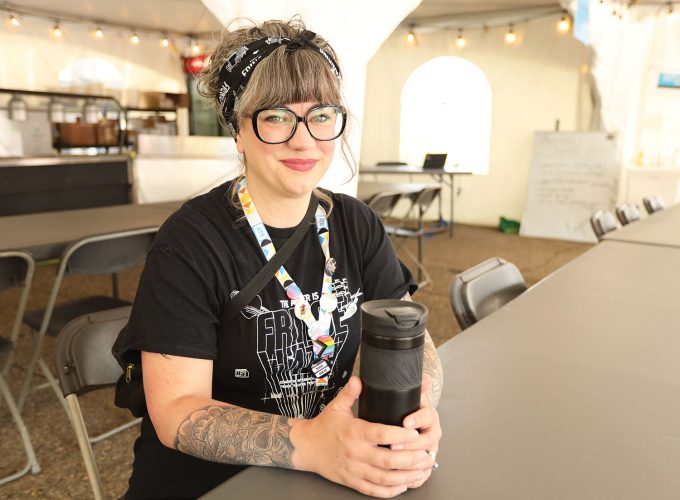
It is also, for the person being asked, exhausting. “One of the girls here jokes that she wants a button that says, ‘Don’t ask me about the war,’” Janice Krissa tells me.
Janice and her daughter Jorgia Lindquist are established Canadian-Ukrainians. They, along with others like them who have been in Edmonton for years or generations, wanted to help the influx of newcomers fleeing from the war in Ukraine. So in 2022, the mother and daughter opened a community hub, a not-for-profit to help families arriving in Edmonton. It operated in the Great West Saddlery Building and included a store with free household goods for newcomers. Janice and Jorgia eventually opened a kitchen and employed some newcomers to produce frozen, packaged Ukrainian foods. The demand was such that the model they were operating under no longer made sense.
By 2024, the little organization had incorporated as a business with a café on Fort Road and another downtown. It was named Don’ya, which means beloved daughter in Ukrainian, a word a mother might use for her own child. Janice says she and Jorgia chose that name because they wanted every woman who came through the door to feel that loving warmth.
Janice and the staff brought their idea to the entrepreneurial pitch show Dragon’s Den, where they learned some lessons about scaling up to franchises. There are plans afoot to open a new location in Windermere. Every employee is a newcomer who has left the full-scale war in Ukraine.
And still, every newcomer’s accent is a prompt. Every “Where are you from?” is a small request for a story that the answerer may not want to tell — again. The asking is curious. The answering is labour.
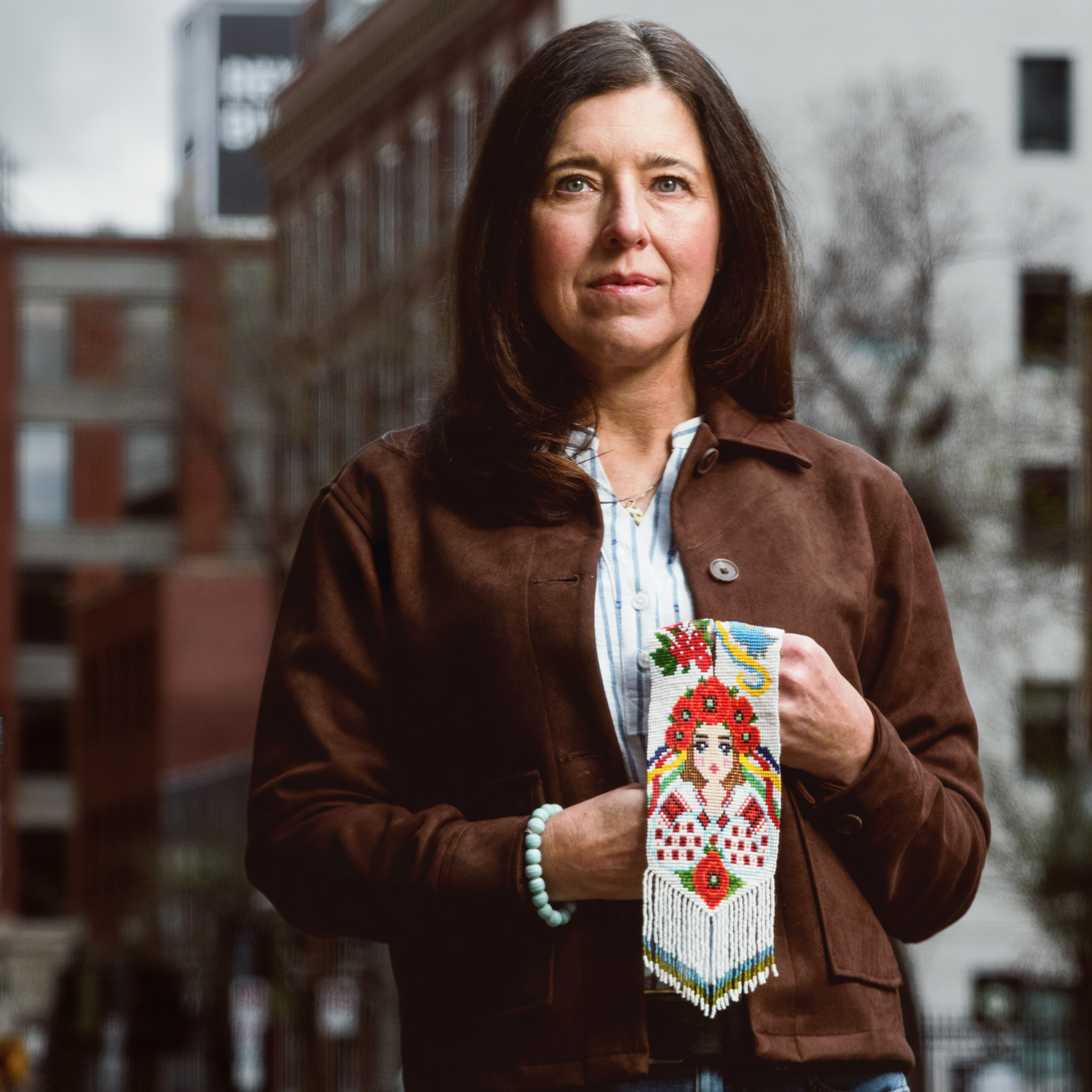
What we are really asking for, when we ask, is not just geography. We are asking for kinship. The shared grammar, the accent, the people who share enough of our sense of the world that being around them feels like respite. We want to be understood without having to explain ourselves. We want to fit in.
One answer to the question, in Edmonton, is Ukraine. Ukrainians have been arriving here for 135 years, across five waves. The first came in 1891, when two men from Galicia settled at Edna-Star, east of what is now Edmonton. The homesteaders who followed filled the prairie with place names that are still there: Mundare and Myrnam in Kalyna country, and lakes and creeks such as Anton and Slawa. Three more waves arrived through the political ruptures of the 20th century in Eastern Europe.
The fifth wave, the largest, is still arriving, and it includes the women of Don’ya, who I meet exclusively at their workplace. That’s because roughly two-thirds of the Ukrainians who have come to Canada since Russia started its full-scale invasion of their country in February 2022 are women and children. Under Ukrainian martial law, most men between 18 and 60 cannot leave. (Or, if they do, may be called back.) The women are here alone, with children to support. So I meet them on a lunch break by phone, and in Don’ya’s kitchen, where Nataliia and Oksana work most days.
Ukrainian history is not hard to find in Edmonton. The Ukrainian Centennial Pioneer Monument sits on the grounds of the Alberta legislature, a bronze triptych for the first hundred years of Ukrainian settlement in Alberta, with a time capsule inside set to open in 2091. St. Josaphat Ukrainian Catholic Cathedral rises over McCauley, its seven copper domes visible from blocks away. The neighbourhood of Oleskiw is named for a Ukrainian doctor and proponent of immigration. The University of Alberta’s Canadian Institute of Ukrainian Studies, founded in 1976 with offices in Edmonton, Toronto and Lviv, anchors one of the most important centres of Ukrainian scholarship in the world.


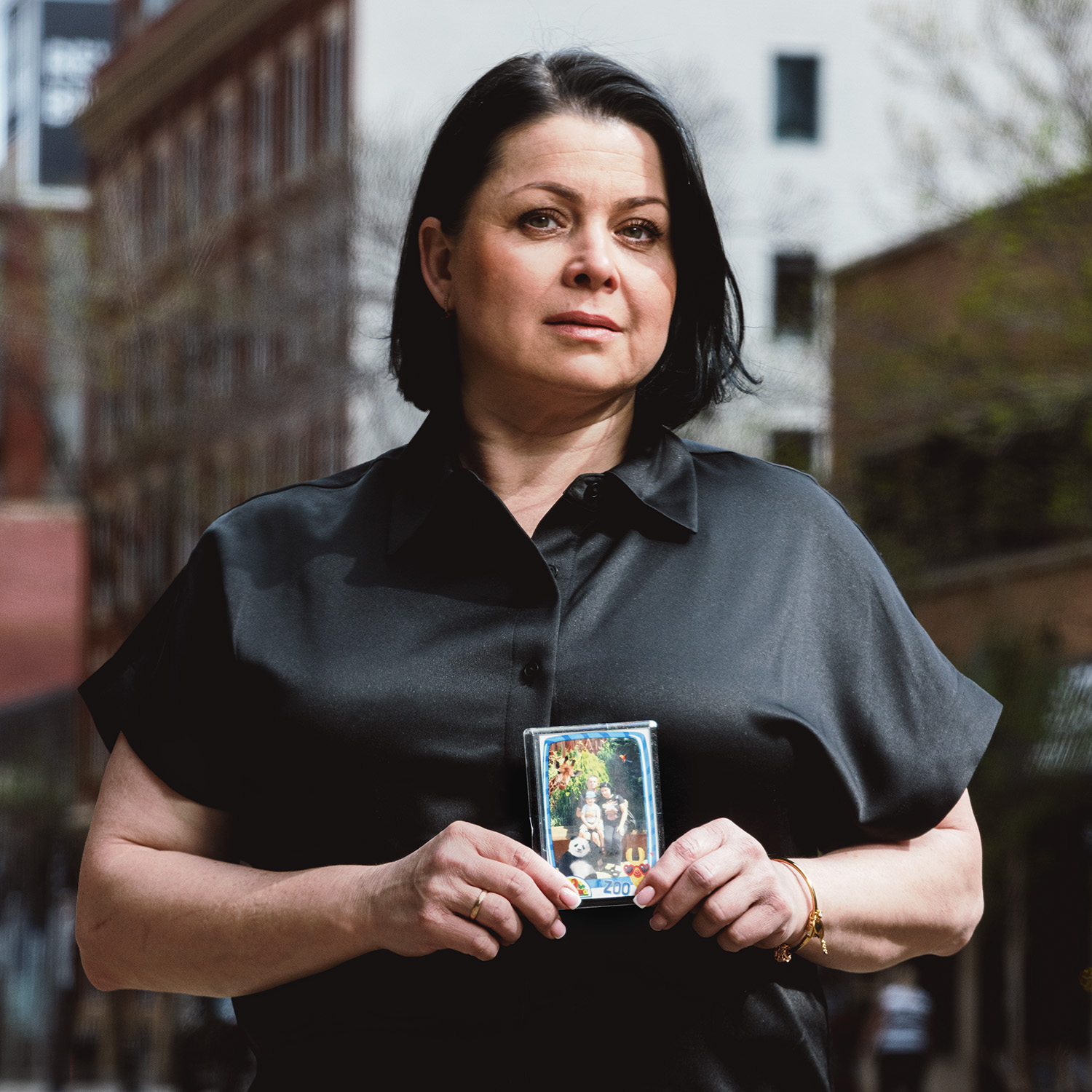
Each wave has brought a different Ukraine. Ukraine is not one country in the way Canadians sometimes imagine it, explains Jars Balan, a historian at the Canadian Institute of Ukrainian Studies. It is ethnographic regions layered on a political map: Galicia, Hutsulshchyna, Bukovyna, the Donbas, with its many native-Russian speakers. A wedding sash from one region is not a wedding sash from another. What makes it all Ukrainian is not its sameness.
“Ukrainian-Canadian is basically another one of those regions,” says Balan. That new region has been made here over the course of 135 years, derived from whichever region’s people arrived and when they did, and how they mixed with the Prairie and the parish halls. An ethnographic region, a real region. Not a lesser Ukraine. A different one.
Newcomers from the current war do not always recognize the Ukraine they find here. The diaspora has been preserving a country the living one no longer quite recognizes. Canadians with roots in the pioneer wave want to help, and they do, with paperwork, with leads on jobs, with housewares.
“We’re kind of frozen in the time of when our ancestors came,” Janice says. “The diaspora is a different kind of offshoot of Ukrainian.”
When you emigrate, Balan agreed, you carry a kind of time capsule: the culture of the period you left.
What you preserve becomes what you understand Ukrainian to be. Meanwhile the country keeps changing.
The Iron Curtain maintained the time capsule effect, keeping the diaspora and Ukraine apart for most of the 20th century. The post-war displaced persons waited decades for the Soviet Union to collapse so they could go home. Most of them never did. Their Ukraine stayed frozen at 1945.
Russia’s 2022 full-scale invasion has had the opposite of its intended effect. “They’ve united Ukraine in ways it’s never been united before,” Balan told me. “You’ve got these Russian-speaking Ukrainians fighting on the front lines, consciously making the decision to use the Ukrainian language.” President Volodymyr Zelenskyy is himself a native Russian-speaking Ukrainian. “He had to learn it,” Balan says, “and he speaks beautiful Ukrainian now.” The war that was meant to erase the country has made it more Ukrainian. And in Edmonton, at the edge of that same pressure, people from the different waves are being pushed, a little, toward each other.


The waves of immigrants are talking to each other. Sometimes across generations. Sometimes through the women who walked into Don’ya’s free store stayed to cook. Sometimes through their answers to questions from well-intentioned strangers. Each woman in this piece is answering “Where are you from?” from her perspective, and from her date of arrival. None of them is answering it the same way.
Alla Brisky was 16 when she arrived in Canada in 2005, alone, into a small Catholic high school in Winnipeg where she was the only international student from Ukraine. She moved to Alberta as an adult, with a Canadian husband and children. She has been in Canada for 21 years. Her accent is slight, occasional.
She puts it plainly: “That’s the hardest thing, right?” she said. “When you come here as a newcomer, you try to fit in. You don’t want to be different. No matter what. You don’t want to have an accent. You don’t want to say something silly. You don’t want to dress how you dress back home.”
Alla is describing fitting in. She was also describing the longing underneath the question. It is what the stranger is reaching for, clumsily, when they ask. It is what the newcomer is reaching for, exhausted, when they answer.
Nataliia Didenko came here in 2022, alone. She’s 24. She picked Edmonton from pictures on the internet: the river valley in summer, the nature she had read about, and because of the diaspora. She could not have pointed to it on a map six months prior. When I asked her how she found the city when she arrived, she said, “I just came, myself.” She works at Don’ya most days, as many shifts as they will give her.
On her days off, she goes. Jasper. Banff. Sylvan Lake. Calgary. Wabamun last summer with friends, she tells me, smiling, was beautiful. She had wanted a bonfire after the long winter. The fire ban stopped them.
Four years in, her documents still renew in increments. “We are just here sitting on our suitcase,” she says.


Oksana Sandolska came because she had friends here, a soft landing in a city that was not a blank page. She is small and strong-looking, with black hair pulled back. She has children in Edmonton Catholic schools. Her documents also depend on a visa program that renews in increments. Her Ukrainian is the language I hear in the kitchen most, faster than Nataliia’s, and she laughs more easily. She is serious, and thoughtful. When I ask questions she does not understand, Nataliia translates, and when Nataliia is unsure, they turn to each other and work it out in Ukrainian first.
Oksana’s documents are still not settled. She does not know if she will be here in five years, or if she will have to go back, or where “back” even is now, with her home on the news. Her Ukraine is from February 2024.
Janice is Canadian-born, elegant, with dark hair and a wide smile. She attended St. Martin Catholic Elementary School, the Ukrainian bilingual school in south Edmonton, in its early years. Her Ukrainian was learned in those classrooms and in her grandmothers’ kitchens.
The word baba is one Ukrainian word many Albertans know. In our diaspora it means grandmother. It is a word of love, worn smooth by generations of Prairie kitchens. In present-day Ukraine, it means old woman, and it can be rude. Grandmother is babusia. “The language really evolved,” Janice says. Her newcomers were calling their own babusias on video calls across seven time zones. Two words for the same kind of love, neither feeling quite right in the other’s mouth.
Food carries a similar split. In Alberta, we say perogies. Nobody in Ukraine says perogies. They are varenyky. We eat them as snacks, as a quick dinner, dropped into boiling water on a Tuesday. But they are special in Ukraine, made for Sunday dinner. And we might put cheddar cheese in ours, which no Ukrainian would do.
When I ask Janice if she considers herself Ukrainian, she pauses. She says she has Ukrainian roots. She is careful with the distinction. The people working next to her fled a war. She did not. She uses the word roots because she is making room for those newcomers. It is a generous answer to the question.
Janice is the host. She greets everyone who comes in, and she jokes with the regulars.
The afternoon I sat with Janice at one of the downtown tables, a woman named Omnia Abdelaziz came in from the drugstore next door. She had not come to order anything. She had come to say hello. She told me, unprompted, how much she loves this place, how much she loves the girls. She chatted at the tables for a minute, smiled at Janice, and went back to work.


The firefighters who park their truck out front come in when they can for syrnyky — a kind of puffy, cheesy pancake with berry sauce on top. The café sits in a downtown neighbourhood that has benefitted from the return of office workers who visit at lunch. The block feels safer. And last summer, Don’ya catered a Muslim wedding. Cabbage rolls and varenyky at the reception, with halal chicken beside them.
This is what Edmonton offers that a monument cannot. Not the sealed time capsule. The room where it is opened. Where the recipes are made again, and the people who come to eat walk down Jasper Avenue at lunch, from down the block, over the Low Level bridge, from the corners of Edmonton, from across the ocean.
On a Tuesday afternoon in April, Nataliia is taking an order, Oksana is at her elbow plating varenyky, speaking fast Ukrainian, Janice is wiping the counter while answering the phone, and Omnia pops in to say hello. The question can be asked here. It will be answered in five dialects and eight accents. Nobody will get it down to one word.
I’m Irish, Scottish, Polish or Belarusian (the border has moved) and Ukrainian. Larissa, my baba, arrived in Canada in 1948 after crossing five countries in three years. Her father had been executed in 1938 by the NKVD, the secret police organization that was a precursor to the KGB. My grandparents’ funerals were held in a language I do not speak. I went to Ukraine once, in 2013, on my honeymoon. Ukraine from 2013 is a country that no longer exists, not exactly. I planned to go back this spring but cancelled my trip when a drone struck a UNESCO site beside my hotel in Lviv. I stayed in Edmonton and went to Don’ya instead.
My answer — like Nataliia’s, Oksana’s, Janice’s and Alla’s — is careful. None of us uses just one word.
That is not a failure of the question. That is Edmonton
This article appears in the July/August 2026 issue of Edify