
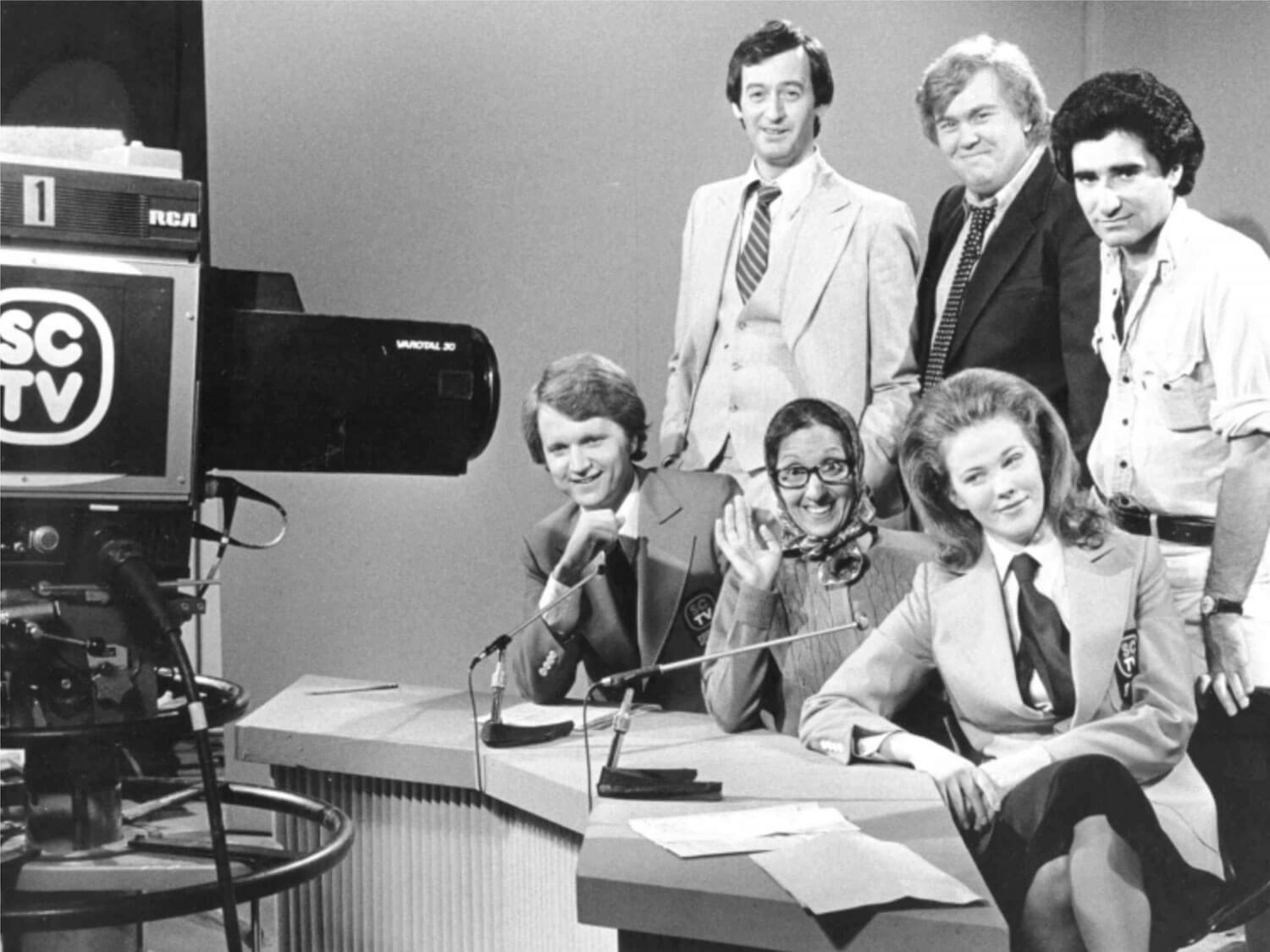
It is 1981 and musician Michael McDonald — later the titan of “yacht rock” — is on tour. After a show he and a friend smoke some weed and, a little too high to do anything else, McDonald goes back to his hotel room to relax. He opens his door and the TV is still playing, as he’d left it earlier.
“This thing is in progress on television, this guy looks really familiar… and it’s Rick Moranis dressed like me,” McDonald recounted to YouTuber Rick Beato on Beato’s show in 2025.
The scene opens with Moranis driving around just off Calgary Trail while the Christopher Cross song “Ride Like the Wind” plays, with McDonald on backing vocals. It looks like a music video but it’s not. On his hotel room TV, McDonald sees a bearded Moranis-as-McDonald rush into a recording studio, briefly gladhanding the personnel before hitting McDonald’s mark exactly behind the microphone. “I thought, ‘I’m losing it’… but as it plays out, I realize, this is SCTV and it’s a skit,” McDonald told Beato. “And thank God for that. It was hilarious.”
SCTV was meant to be a version of Saturday Night Live, and it’s easy to see that’s how it was sold. When SCTV started in Toronto in 1976, Saturday Night Live was hot, with a cast scraped out of improv clubs, showcasing shaggy or edgy skits. A counterculture vibe was achieved with the help of the show’s hip musical guests. Just as Second City was a Toronto spin-off of Chicago’s eponymous comedy institution, SCTV was an effort to put Toronto’s alternative comedy scene on TV in the way Saturday Night Live introduced young comedians from around America. And it could have been just that: a Canadian knock-off. In Dave Thomas’ book, he quotes Joe Flaherty who said, “I’d worked with all these people on the stage and now they were living in New York getting famous.” But SCTV needed Edmonton to reach comedy perfection.
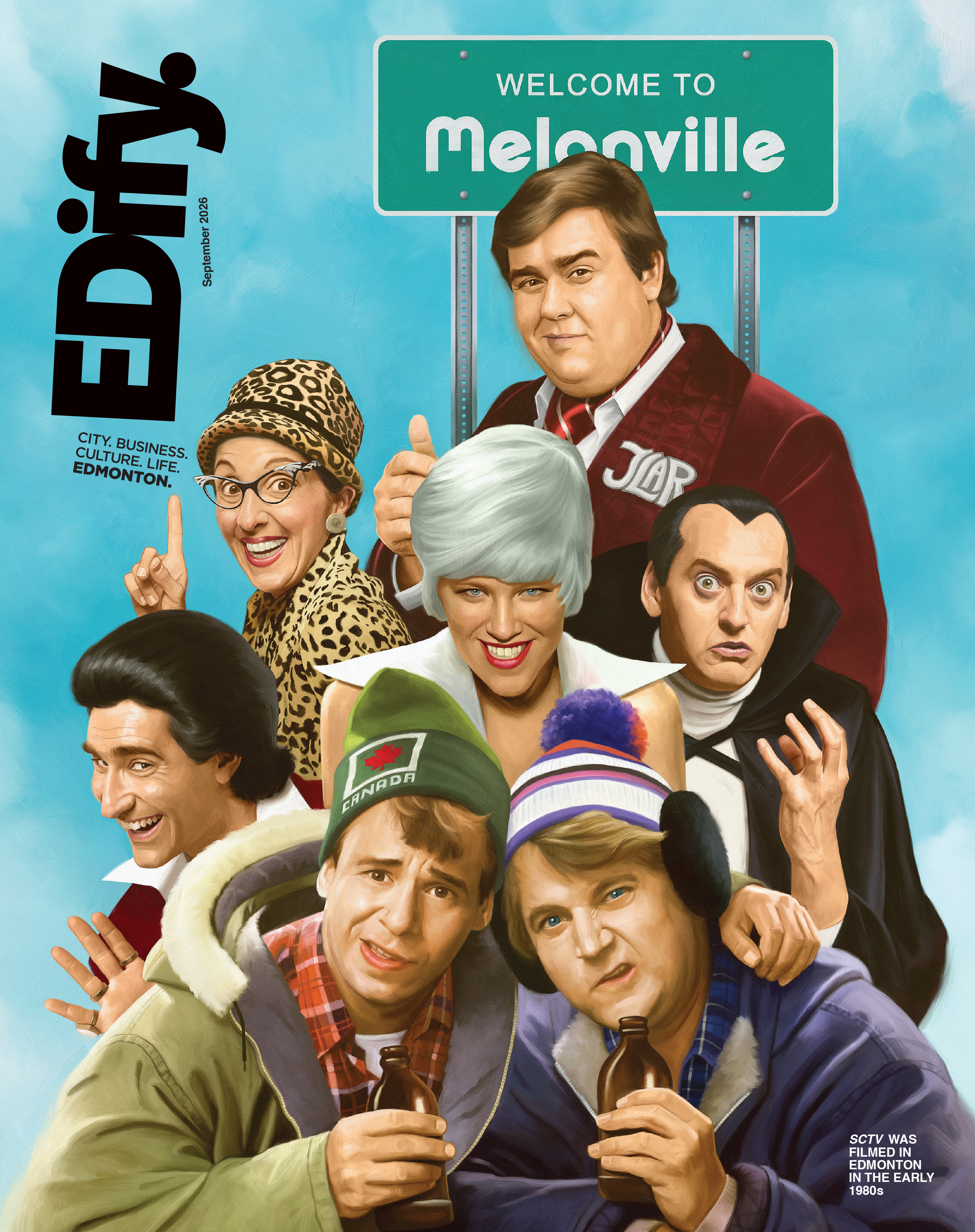
The concept of SCTV is that it’s a no-budget TV station in a town called Melonville. The idea, letting the creators parody the breadth of television programming, doesn’t have a clear origin. There had been comedies before 1976 that parodied aspects of TV: think evening news sketches. But there hadn’t been a show that was a full-throated parody of the whole concept of TV, from old movies to cheap talk shows to awkward news anchors.

It was an idea whose time had come. The Baby Boomers, the first generation raised on the boob tube, were in a position to goof on the world in a language they knew. Unlike SNL, which had plenty of sketches that took place in other settings, SCTV would draw on the cast’s profound love of pop culture minutia and impressions to world-build an entire fake TV station in a fake town and blast out a digest of its programming.
The origin story of the academic study of television goes like this: Welsh cultural studies scholar Raymond Williams took his first visit to the United States in the 1970s. In the days after his arrival, he turned on a TV and immediately perceived the basic notion that would become the foundation of academic studies of television. “One night in Miami, still dazed from a week on an Atlantic liner, I began watching a film and at first had some difficulty in adjusting to… for all the occasional bizarre disparities — a single irresponsible flow of images and feelings.” The significance of TV was its firehose flow of programs. A moralist and socialist, Williams’ concern was the way that TV made natural disasters and social issues sound and look like Hollywood movies and cop shows, and made the news sound like entertainment. In his sincerity, Williams missed what all those folks (like the SCTV cast) raised on TV knew: this was also all goofy and funny.
But by 1979, SCTV was nearly dead. Its ratings weren’t good enough for Toronto’s Global TV. The only way the show could persist was to make more money and cost less. Enter Charles Allard. A surgeon and businessman in Edmonton, Allard owned an independent TV station, ITV, and he offered to deficit finance the show using his own facilities and the resource of Edmonton itself.
In the words of ITV lighting man Des Spence, “Somebody should pick this up and do a good job on it, and lo and behold, we did.” The cast and writers flew west and joined the ITV crew, most of whom, like Spence, still live in Edmonton, and began shooting. The effect was immediate.



In the Toronto years, SCTV’s fictional Melonville was frequently urban downtown; it might have been an American city. In Edmonton, it was something else. One early joke has John Candy portraying Johnny LaRue, a TV host frustrated by budget constraints, hitting the street to look for interviews. LaRue inadvertently starts a riot, which rages out of control in a shot that keeps pulling further and further back until it’s clear that what started as an inexpensive TV streeter is now being filmed from a helicopter, showing us a crowd of extras and crew brawling, and giving us the first time we ever see Melonville, the whole town, from above. It’s Devon, at least that time. In other episodes it’s Leduc, and at least once it’s Pigeon Lake.
But mostly, Melonville is Edmonton. The opening credits, with John Candy pitching TV sets out of an apartment window, was even reshot in Windsor Park. The show filmed on Whyte Avenue, at the University of Alberta and, for a parody of the nuclear thriller movie The China Syndrome, on the outskirts of an area refinery. When they needed New York — well, they filmed outside the old Stanley Milner Library, but when they needed Melonville they didn’t have to do much of anything.
As it happens, the cast of SCTV has said few kind things about Edmonton. Joe Flaherty said the cast reacted to the proposed move with: “Couldn’t be Vancouver? Couldn’t be Montreal?”
His brother, writer Paul Flaherty, said of Edmonton, “You might as well be in the Sahara. But the polar opposite.”
More bluntly, Eugene Levy said, “People didn’t want to move to Edmonton because it was Edmonton.” Flying in to interview the cast, Playboy magazine reporter Robert Crane recalled, “I looked out the window and saw miles and miles of wheat fields and farmland. This was a comedy hub?” This all worked for the show — not just because Edmonton was Melonville, but because the demand for content meant working 20- hour days. (Once NBC bought into the show, episodes were 90 minutes.) A less obvious benefit of working far from Rockefeller Plaza or Toronto? It was easier to stay focused and work hard.



And ITV was the fictional station SCTV in more ways than one. When Rick Moranis is driving around as Michael McDonald in that sketch, it’s Gateway Boulevard he’s driving along — and he stops outside ITV and rushes into the real control room of the actual station where the show was shot. Unlike most shows, you see a lot of ITV in SCTV’s fictional station. You could see this as solely a budget decision: when you need a dressing room, you just shoot the actual dressing room. When Bob and Doug, the show’s iconic beer-drinking brothers get thrown out of the studio in one sketch, you shoot their show from the actual parking lot full of dirty snow. ITV plays SCTV, just as Edmonton plays Melonville.
If you talk to the crew, it was a lovely experience, and it never felt like the cast were big shots parachuting in and clocking out. “Everybody was all in,” says soundman Peter Wugalter.
Cameraman Wayne Noga says that it always felt collaborative, and the cast involved the crew from the start. “They just yell out to the crew saying, ‘Hey you guys got anything?’ and we’d go ‘Well, you know, there’s hockey, there’s this, there’s that’… and they would just brainstorm.” Crew would even end up in front of the camera. Peter Wugalter remembers ending up onscreen during a scene in Borden Park, where Joe Flaherty’s combative New Yorker Norman Gorman stages Shakespeare: “People start showing up and asking ‘What are you taping?’ It’s SCTV and I’m thinking, ‘Wow, there’s a fair amount of people coming to see this. People are watching this on television!”
Edmonton let SCTV finally become itself. The only seasons of the show available on home video were the Edmonton years, but they’re also considered the peak of the show. It’s easy to point to ways the show used Edmonton — I’m fond of the episode where the Soviets jam the SCTV feed and the show turns into the bleak nightmare of Soviet TV, with Edmonton’s Ukrainian churches as onion domes in the background.



Candy told writer Robert Crane in an interview in Playboy magazine in 1989 about a time he and Levy were sitting in a hotel watching a polka show (presumably Mr. Polka himself, Gaby Haas), and Candy said, bastardizing the Yiddish word for nonsense, “Boy, there’s a couple of shmenges for you.”
“That afternoon,” Candy said to Crane, “we created Yosh and Stan and wrote the first script.” The Shmenges would eventually get their own movie. Could that have happened anywhere other than Edmonton? Well, it didn’t.
But the most obvious thing about the Edmonton years is the most obvious thing about the show itself. Allard was financing the show, but the CBC was co-producing as well. With that CBC money came a mandate: the show had to become more Canadian. But it was a spoof of American TV, and the CBC’s directive to provide a few minutes of “distinctly Canadian” material pissed off SCTV’s creators.
What happened next is the kind of alchemy comedians describe when, inexplicably, everything suddenly works. Moranis and Dave Thomas cooked up a notion that should have been a miserable failure: the two of them, dressed like slobs, cooking back bacon and swigging Molson stubbies, rambling unscripted in outrageous accents. Cameraman Loris Mattiello describes the work as easy — “They only used one camera shot!” — and the atmosphere was casual, like stage improv. The crew would shout suggestions. Wayne Noga says, “We had a floor director who found a mouse in his beer bottle,” which led to one of the most famous Bob and Doug segments, concerning methods of defrauding beer companies for a free supply. They’d take two hours and film dozens of two-minute segments, and put the best on air. Bob and Doug were born, and the show launched into the stratosphere.
Though it’s difficult to believe audiences saw quite the same thing on both sides of the border, Bob and Doug became huge in Canada and the United States. There was a 1982 Playboy Q&A with the entire cast, but the cover blurb made it look like it was just about the hoser brothers. A Rolling Stone cover line from 1982 called Bob and Doug “SCTV’s Best Joke.” That kind of thing is rough for an ensemble comedy. By the time SCTV left Edmonton, the show had launched its cast into the next level: Martin Short, about to join the cast in 1981, said the show was “the hottest thing going in comedy.”


And they all became comedy legends.
But their roots are pure SCTV. Take John Candy’s famous monologue in Planes, Trains and Automobiles, the one that showed the world he could hit your heartstrings hard. To me, you can see the glimmerings of it in the last show ever filmed in Edmonton. Once again Johnny LaRue is dispatched to make cheap TV streeters, only it’s Christmas Eve and everything is closed. Candy drunkenly wanders the street — 91 Street just off 95 Avenue outside the old Red Ox Inn — and falls into the snow, waxing maudlin about his failures, especially wrecking his career over his love of expensive crane shots. That’s when Santa, or maybe God, speaks to him, and everything turns around as the camera rises. Loris Mattiello, the cameraman, describes an all-night nightmare of lighting an entire street in temperatures of “about minus 15.” And then Candy, in a suit jacket where the crew was in parkas, nailed the rambling monologue in one take. “And we’re all watching him, going on and on, and we’re saying ‘Oh my God.’” Candy makes you feel for him, before it gets real silly, real fast.
The show’s legacy is reflected in its fans. Ben Stiller and Judd Apatow called The Ben Stiller Show “SCTV with a budget.” Last year, Prime Minister Mark Carney told media personality George Stroumboulopoulos that he took his best jokes from the show. Carney was a student at St. Francis Xavier High School in Edmonton while SCTV was being filmed here.
There’s a lasting monument, too — when Edify was Avenue Edmonton, publisher Orville Chubb and editor Steven Sandor got to talking about how some cities celebrate whimsy instead of serious parts of their history. “Orville said, ‘Wouldn’t it be great if we did something like that in Edmonton?’” Sandor recalls. The SCTV Monument Committee was born, with crucial support from Charles Allard’s son, real estate developer Paul Allard. Raising money and selecting a local sculptor, Ritchie Velthuis, the original idea was for statues of the entire main cast from the Edmonton days. While Velthuis made clay maquettes of seven of the show’s characters, cost issues led the committee to scale down — and seek out a partnership with the Oilers and the ICE District. Chubb, who passed away in 2018, is honoured for his efforts on the plaque at the feet of the McKenzie brothers statue, not far from the skating rink on 103 Avenue.



You can pick dozens of moments, characters and concepts from SCTV that show its strengths, just like you can list famous fans. From the improv games of Perini Scleroso to the cringe humour of Lola Heatherton and Bobby Bittman, this is a show that did ambitious parodies and no-budget walk-arounds. But it was here in Edmonton that it hit its stride.
Let’s turn the TV on again. Newton Minow, chairman of the FCC under the presidency of John F. Kennedy, gave a famous speech in 1961 where he told a roomful of increasingly agitated affiliates that TV sucked. If you watch it all day, he said, you’ll see that it’s just a vast wasteland. I keep thinking about that vast wasteland, and the one that Robert Crane called Edmonton when he saw it from his airplane window as he flew in on his way to interview the cast for Playboy magazine. Every time Moranis and Thomas drag-raced their way into the city from the airport, they saw a vast wasteland, the same one Moranis-as-Michael-McDonald saw on his way to ITV-as-SCTV. I think about it when I see those “Still in Edmonton” t-shirts, and when I encounter the metaphorical chip on Edmonton’s shoulder, its eff-you attitude. And when I think about how Minow described TV, I want to say, “Hell yeah, it’s a vast wasteland, but that’s where I grew up.”
That is what SCTV did: it said that TV sucks, and we love it. It said music videos are dumb, talk shows are sycophantic and pop stars are idiots, and even if you’re smart like Alex Trebek, you still can’t escape the firehose flow of what we now call content. The whole world is Melonville, but Melonville is Edmonton.
This article appears in the September 2026 issue of Edify