

Yes, that is a SWIFTIE sign set proudly on Mayor Andrew Knack’s desk. And yes, it’s there to proclaim his love for pop icon Taylor Swift. Knack is an optimist who also likes bright blue suits and wears loud eyeglass frames. Is it off-brand that he also supports a regional defence-led industrial policy? Knack is the first to admit he didn’t expect to be the frontman for the Edmonton Region Defence Alliance, a new economic development organization pushing Ottawa and defence contractors to invest billions here. “Even on election day, if you’d asked me, ‘Is defence going to be something you focus on?’ I probably would have looked at you with a bit of an odd stare,” he says.
Like many Edmontonians, he is pragmatic. His transformation has been prompted by what Knack calls a “perfect storm,” a mix of the global chaos United States President Donald Trump has unleashed and Canada’s evolving response. Trump casually but directly threatened to make Canada the 51st state; Canada went “elbows up,” buying Canadian-made products and pushing a hawkish Liberal, Mark Carney, to a minority government in late 2025. In February, Trump’s ongoing attacks on what remains of the former American-backed global order pushed Carney to launch Canada’s Defence Industrial Strategy. It commits $82 billion directly to the Canadian Armed Forces, and $290 billion to associated infrastructure, by 2030. Ottawa aims to see 70 per cent of defence acquisitions come from Canadian companies, more than doubling the current percentage, by intentionally recreating our military industrial complex.
But re-creation is the operative word. Now that the U.S. is throwing a rules-based order out along with allies, unsettling realities appear. Three of Canada’s four 1980s-era submarines are confined to a dock for maintenance; most of our 95 CF-18 Hornet fighter jets have been in service since 1982; a 2025 audit of several military bases found deficiencies as mild as missing wifi and as damning as lacking potable water. “After decades of the negligent hollowing-out of our military, hard and imperative decisions will have to be made,” wrote Wayne Eyre, Canada’s former defence staff chief, last April in the Globe and Mail. The same holds true for Edmonton. In the 1940s, Blatchford airfield housed a U.S. Air Force detachment as part of what then-U.S. President Franklin D. Roosevelt called the “Aerodrome of Democracy,” which supplied the Soviets with aircraft in their fight against the Nazis. Today it’s a struggling housing development. In the 1950s and 1960s, Edmonton was so integral to the West’s security that it was assumed the Soviets targeted us with nukes and we had a citizen committee charged with evacuating the city. Today, the city has no air raid sirens, having removed the last of them in the 1990s. Despite decades of hollowing, some significant legacy remains: the region still houses one-third of Canada’s fighting force at CFB Edmonton.


Brent Jensen says Ottawa’s plans have been added to Edmonton Global’s existing work promoting energy, agriculture, transportation and logistics. He is the senior director of business development with Edmonton Global, a foreign direct investment agency that was created in 2017 by 14 municipalities to boost economic development in the region. “Until a few months ago, it wasn’t a real sector for us,” Jensen says of defence. But he adds it’s an easy fit. “Our value proposition isn’t new. It’s things that have always been here.”
Knack says Edmonton’s pitch goes deeper than our proximity to the Arctic. Today, it’s also about our competencies with AI, our post-secondary bench strength applied to build dual use technologies, and our manufacturing and logistics capabilities driven by our energy industry. He pitched this recipe to National Defence Minister David McGuinty in February, and says it was well received. “Edmonton has a major role in this,” Knack says.
But do Edmonton residents want that role again? Is a city now known for its progressivism and bike lanes going to support a future economy driven by ballistic missiles and bayonets? Knack laughs when I make this point (and adds we won’t build ballistic missiles, anyway). “This, to me, is not incongruent with our city,” he says, adding that it might feel that way to some. “I think if you went to ask the average suburban Edmontonian who might be new to the city in the last 10 years, they might not realize the connection we’ve had” with defence. But Knack argues the stakes are too high to let such disconnection stop us, noting hundreds of billions will be spent by 2030. “You think about that volume of money … there is nothing that will come close to that.”
The music builds. We see Canadian Forces cargo being loaded into a plane, Edmonton’s skyline, then dark green military trucks moving out in winter. Heather Stewart appears on screen. She is the CEO of BBE, a multi-modal logistics company founded in Nisku in 1977, one of several partners in the Edmonton Region Defence Alliance. “We can move critical goods and equipment north reliably, because the fundamentals are here,” Stewart says in the video. “Infrastructure, secure sites and supply chains that can adapt when requirements change.”




In 2024, Smith helped write the university’s successful application to NATO, called the Defence Innovation Accelerator for the North Atlantic. The result: Edmonton is now host to one of 180 test centres around the world. NATO, Smith says, acknowledged that private tech was accelerating faster than military tech. Edmonton’s accelerator works to validate that a dual use technology is applicable for NATO members in general.
That the University of Alberta has such open links to defence may surprise some, but Smith proudly says they go deep. During the Second World War, the Royal Canadian Airforce took over university residences as it supplied the Soviets and helped the U.S. build infrastructure to defend against Japan. During the Cold War, the university was a nexus for engineering research on the Distant Early Warning Line in the Arctic. Today, it’s Canada’s only university that hosts defence innovation research, currently overseeing $25 million in projects.
Smith explains that much of his work is aimed at building the ecosystem, which builds sovereignty and adds what he calls “credible deterrence” — both for Canada and Edmonton. He’s proud that the university is less an ivory tower than it is a place that gets things done, right down to training service members how to 3D print headlight covers and jerry-can lids to make Canada’s military more operational. “They’re not big, sexy things,” Smith says. “These are really practical things that make it easier to have equipment more operable.”
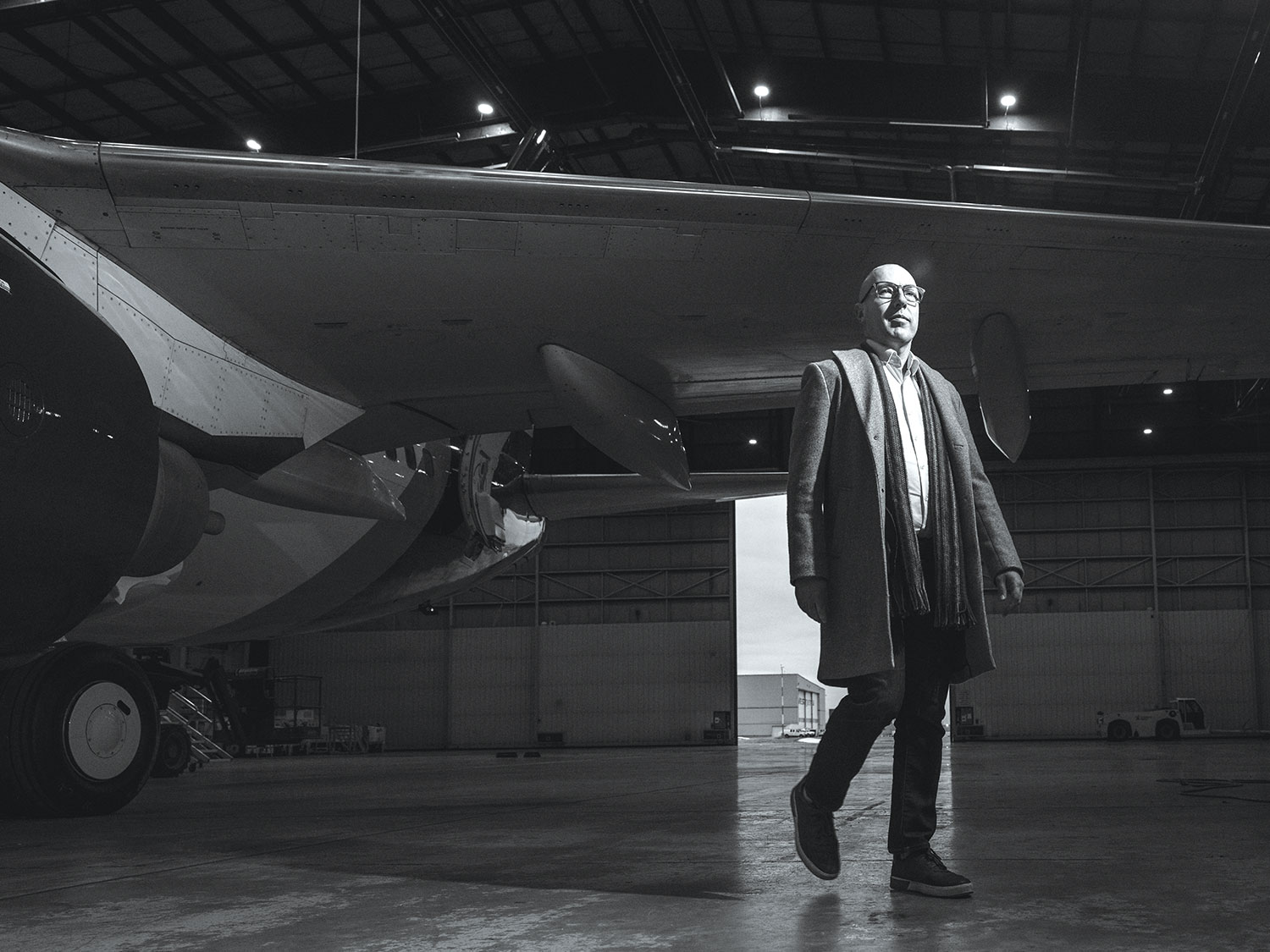
When I meet James Jackson, vice-president of air service and business development with the Edmonton International Airport, another alliance member, the discussion is part practical and part wow. “Simply put, Edmonton has the secret sauce for what the defence industrial strategy is looking for,” Jackson says.
We cycle through evidence that it’s coming. In 2023, Ottawa announced that Canada’s 82 Leopard 2 tanks would be moved to CFB Edmonton and serviced at a new centre in Nisku, next door to the airport. The service contract is worth $2 billion and will create 295 jobs.