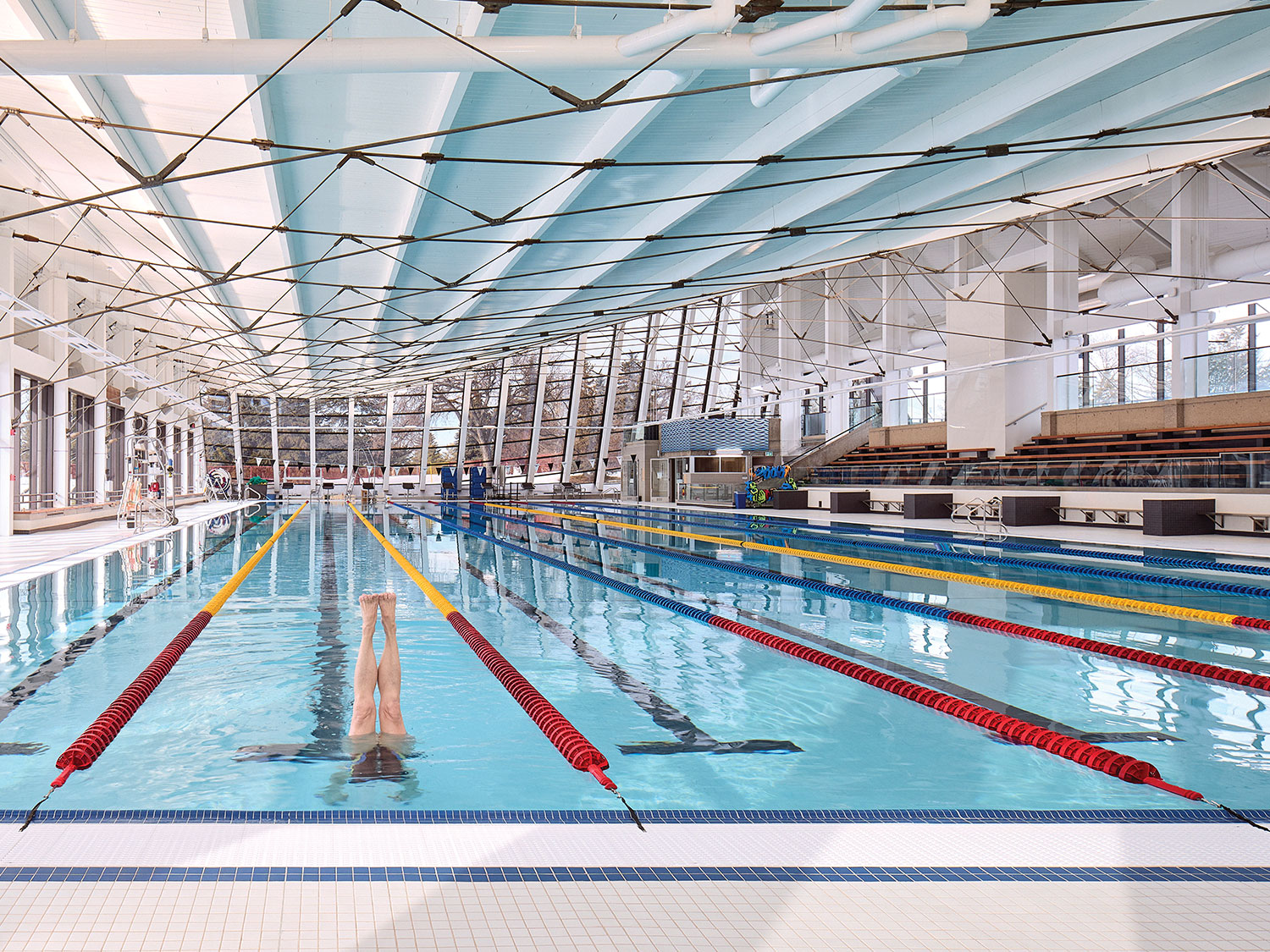

On a chilly February day in central Edmonton, the pool is packed.
Life-jacketed kids dog paddle about. A brave soul picks the cold-plunge tank over the busy hot tub. Someone sits on a deck chair, bathing in the natural light from floor-to-ceiling windows.
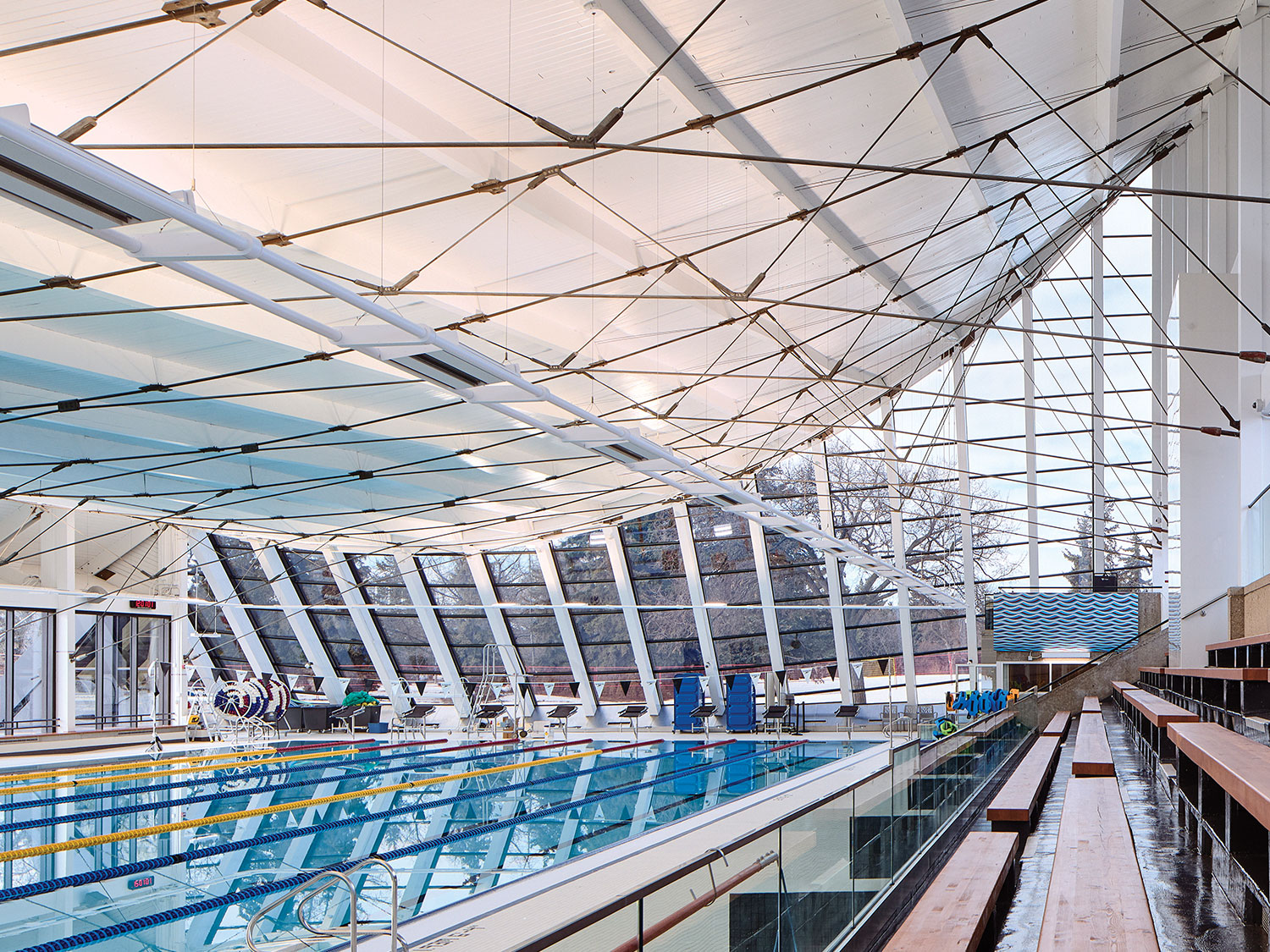
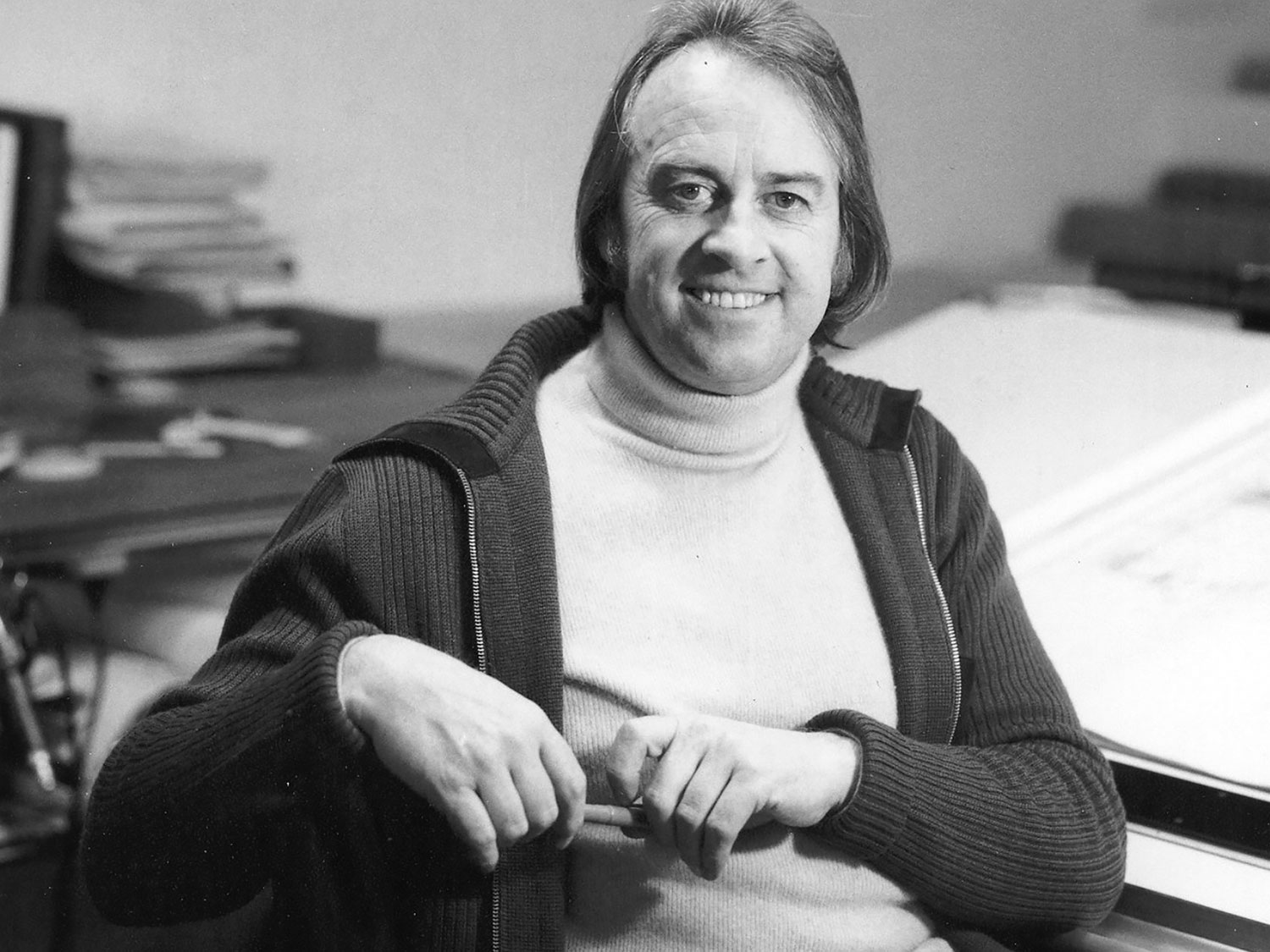
The thing no one seems to be doing is marvelling at the building they’re in, the Peter Hemingway Aquatic Centre, its swooping, pointed roofline soaring above. They’d have good reason to gawk. Opened in Coronation Park in 1970, it’s a copper-clad contrast to the blocky Ross Sheppard High School that even then sat directly east. The same year, it won a Massey Medal for Architecture, then Canada’s highest honour for architecture. It’s one of a kind, the mold broken like the city’s structural conventions that the pool’s lead architect, Peter Hemingway, encountered when he arrived from England in 1954.
But that everyone sticks to splashing is important. For one thing, it’s a pool and that’s the point. For another, it proves that being able to while away the hours in an architectural wonder is just an Edmonton thing to do. Local swimmers have had years to get used to that privilege, thanks to successive city administrations exercising the foresight to preserve the structure. The latest group designated it a protected historic resource on Jan. 27, 2026, the day it reopened after closing in 2020 for major mechanical upgrades.
That opportunity — an ordinary swim in an extraordinary structure — wouldn’t have existed without Hemingway, a designer described as “an iconoclast,” “poetic,” “extraordinarily innovative” and having (no construction pun intended) “pushed the envelope.” He came to a city bolstered by post-war optimism and oil-boom confidence. But it was relatively isolated and largely unadorned. In capitalizing on the former, Hemingway would relieve Edmonton of the latter.
Hemingway and Edmonton of the mid-1950s were well matched. The architect had an ambition typical of someone in his mid-20s and previously nowhere to nurture it. Great Britain, where he was born and educated, languished after the Second World War. A job offer from Alberta’s Department of Public Works, his first stop in Canada, may have seemed a welcome escape.

The province was thriving. The success at Leduc oil well No. 1 in February 1947, tapping into a field of around 200 million barrels, sparked decades of population and economic growth. As J.G. MacGregor writes in Edmonton: A History, “Alberta had hit the jackpot and Edmonton scooped up the take.”
“There was all this newfound money, all this space,” says Mistaya Hemingway, Peter’s daughter, recalling the mythology of her father. And that, adds the Montreal-based dancer and artist, gave him “the opportunity to build.”
It had also invited a new approach to building. Local architects were already embracing modern materials such as aluminum and glass, and opting for the sleek surfaces and strong lines of the International Style, an architectural movement originating in Europe. Emboldened by its boom, Edmonton was eager to remake itself as a city of the future, and open to trusting such visionaries as Hemingway, who opened a practice with a partner in 1956.
“He got to punctuate the sky in a way that I don’t think he would have been able to in Europe at the time,” says Mistaya.
And he’d do it in a way unlike Edmonton designers before him.
Hemingway’s architectural language was heavily influenced by the landscape of Alberta. “He was just in awe of the nature,” says Mistaya.
Edmonton architect and historian David Murray agrees. In fact, “Peter Hemingway was one of the first acknowledged practitioners of what I like to term the Canadian Prairie Style,” he says.
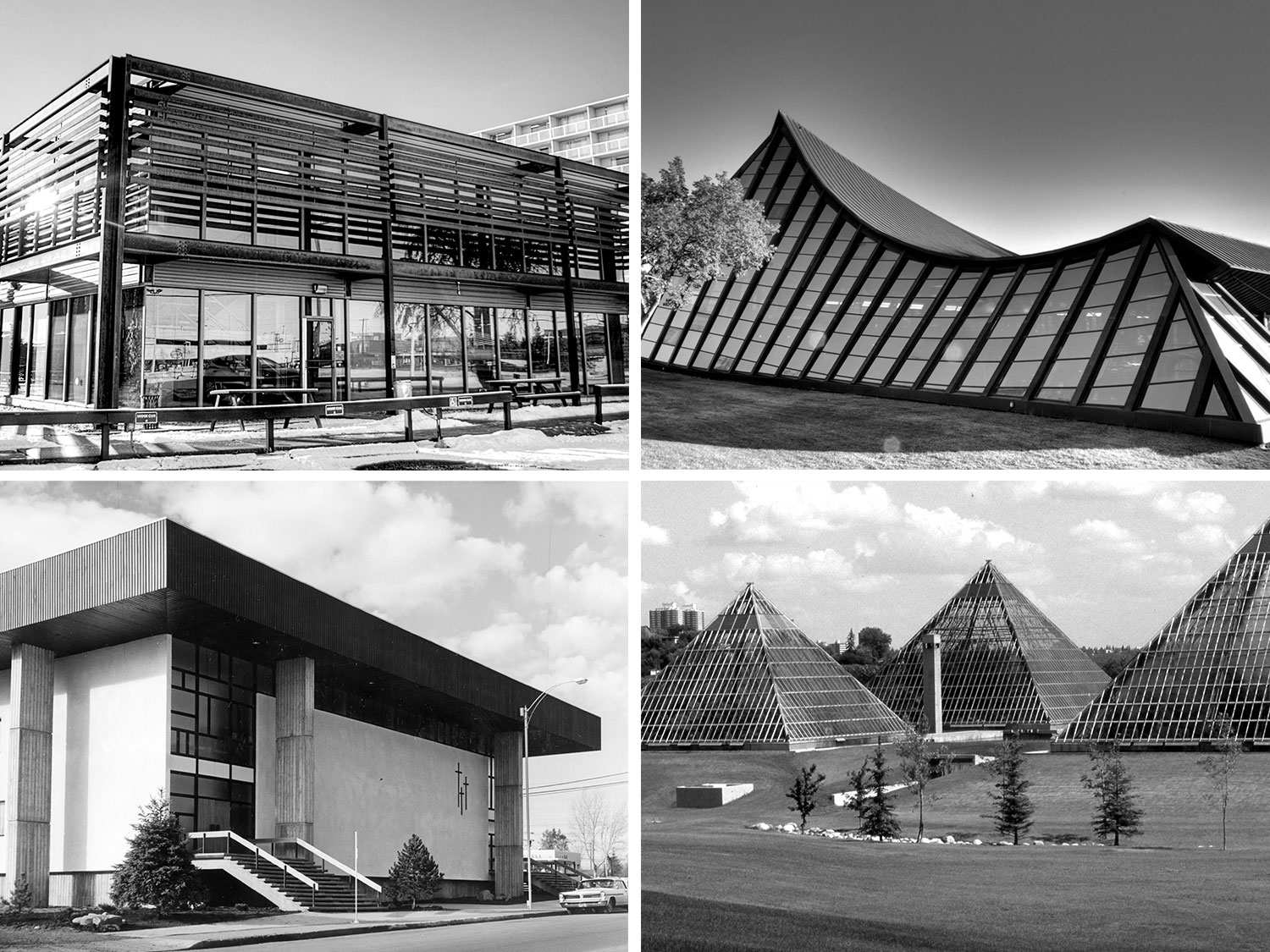
That style derived from Hemingway’s passion for the outdoors. He was a fly fisherman and a duck hunter, says Mistaya; he loved the Rockies. If the pool isn’t mistaken for a giant camp tent anchored by guywires, it resembles a range, an effect amplified by how the building rises from a berm, a feature common to Hemingway’s work and underpinning Murray’s label for it. Mountains recur as the pyramids of Hemingway’s Muttart Conservatory, the long-gone Central Pentecostal Tabernacle Church, and elsewhere. A St. Albert RCMP station turned gallery is a concrete log cabin. The Maduke residence, a private home in Leduc, is practically underground, betrayed by its four chimneys. Hemingway’s Strathcona County Hall features a spiral staircase painted by close friend and celebrated artist Alex Janvier in an intricate yet whimsical blue design that evokes falling water.

Hemingway used the new materials in a new way, with flexibility and fluidity, the buildings standing out for how much he wanted them to fit in as homage to their location.
Nevertheless, says Mistaya, “he was challenging us” with them. Contemporaries felt it. Architect Barry Johns was drawn to Edmonton in 1981 partly by Hemingway’s work. Johns would produce the multi-towered MacEwan University campus and won a Governor General’s Medal in Architecture (successor to the Massey) for the Edmonton Advanced Technology Centre. Like the aquatic centre, it flows from the landscape.
“I consider his pool to be one of the best buildings in Canada, to this day,” says Johns. The National Trust for Canada and the Royal Architectural Institute of Canada must agree with Johns, as they have named the building one of the nation’s finest of the 20th century.
Being of similar mind, David Johnston, one of the City of Edmonton’s principal heritage planners, joined the renovation project early on to lead the designation process.
“We basically shifted the approach somewhat to include a focus on heritage conservation,” he says. “That led us into the process of being more delicate.”
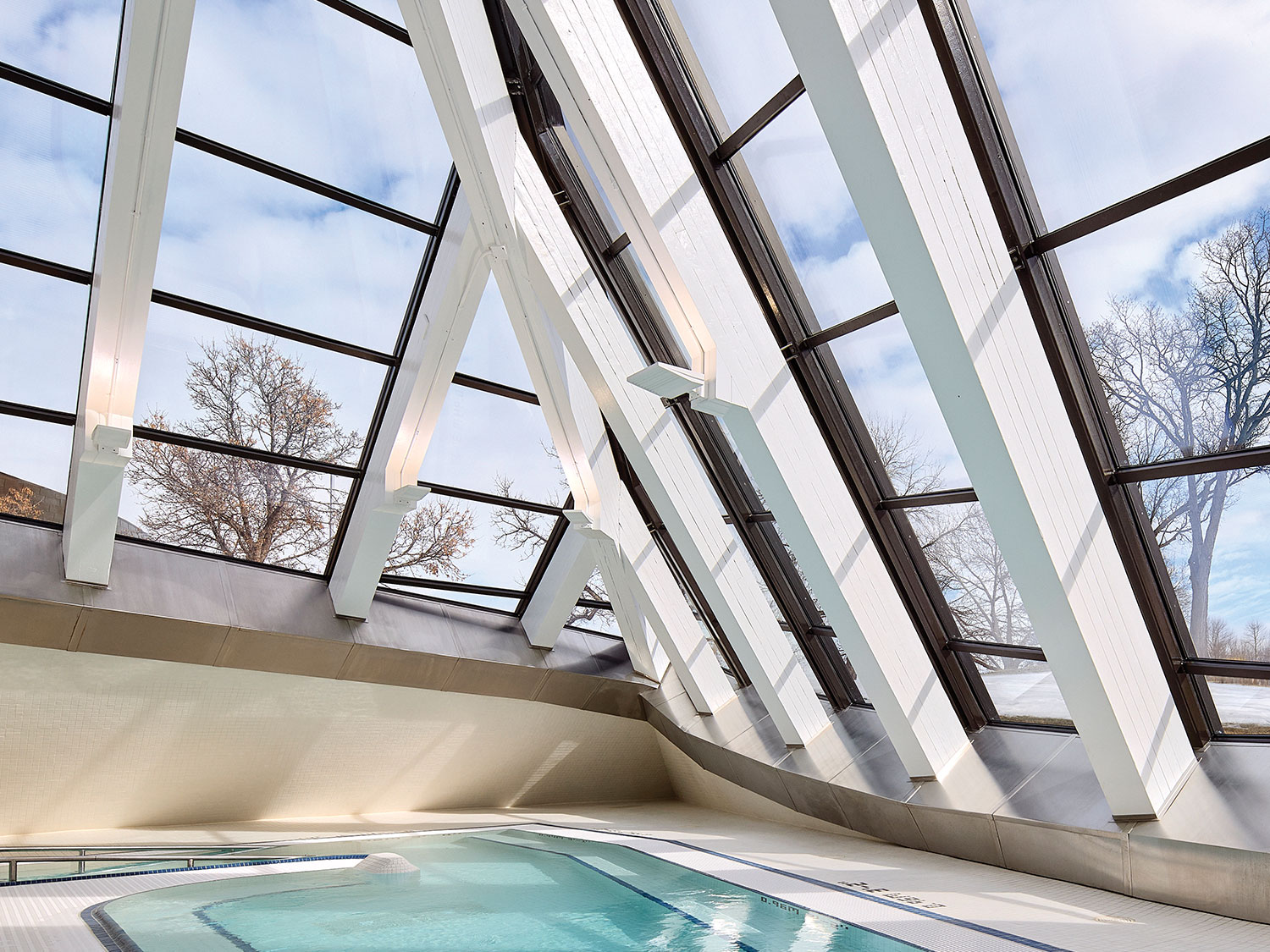
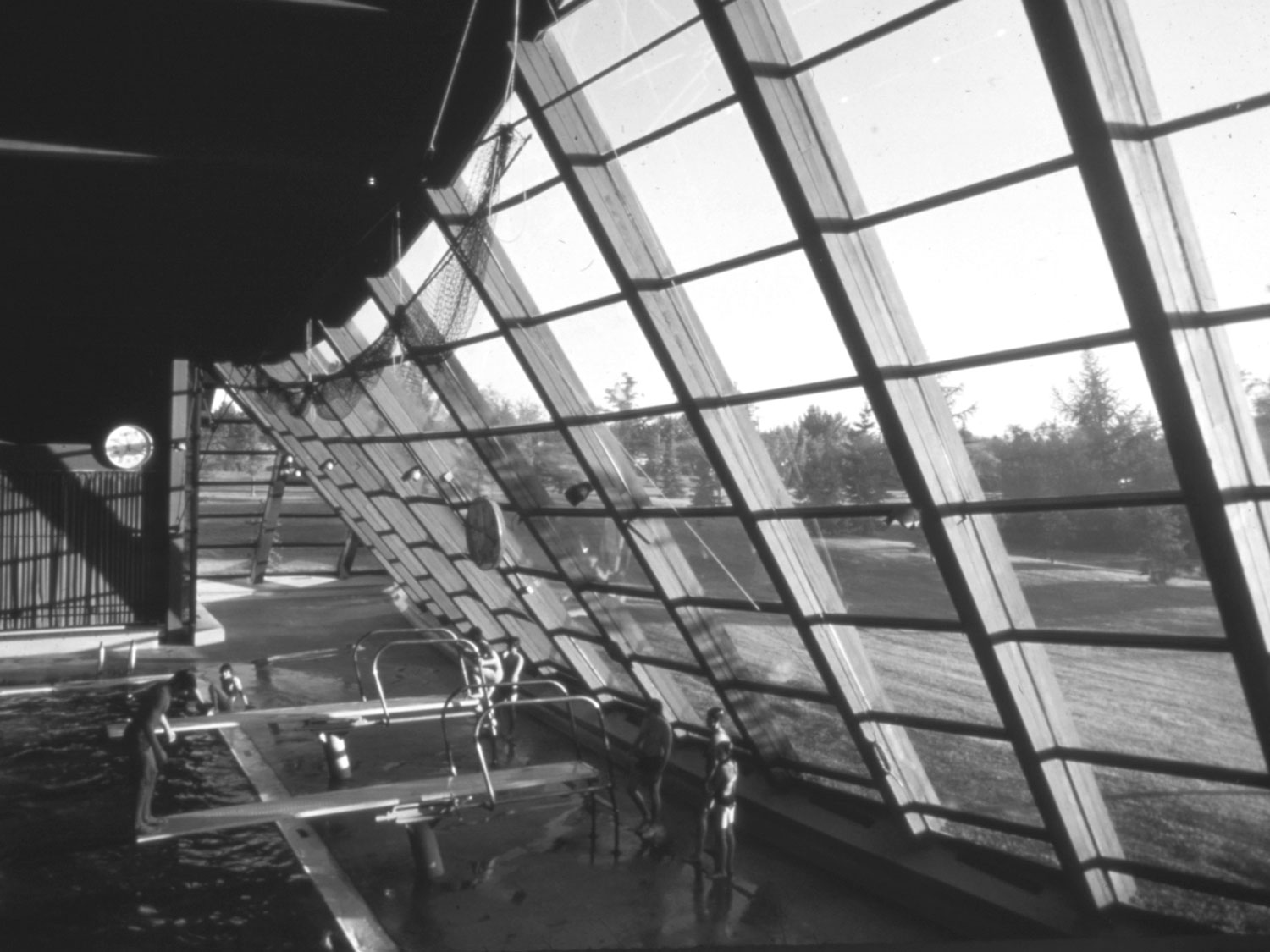
Years of deferred maintenance necessitated a complete overhaul of mechanical and other pool-related systems, but it was crucial to preserve the build’s aesthetic, even when it proved challenging for the designers. The original pattern of the windows, for example — high among the building’s defining features — was so complex that replicating it in line with modern building codes left designers wondering how the architect managed it in the first place, half a century ago.
“It was sort of like us trying to figure out how they built the pyramids,” says Johnston with a chuckle.
But given the lengths Hemingway went in honouring the environment, advancing the International Style as a result, “it makes me wonder if he was trying to look to the future and inspire the idea that we don’t have to build the same old, same old here,” Johnston adds. “We can do fantastic things that stand out.”



The designation of the structure restricts alterations and prevents it from ever being demolished. It also suggests a civic understanding of the value of not just making fantastic things but keeping them — to a point.
That’s important culturally and historically, says architect Vivian Manasc, who spearheaded the first renaming of the facility, in 2005, from Coronation Pool to Peter Hemingway Fitness and Leisure Centre. “I thought that Peter Hemingway’s name should be remembered in Edmonton,” she says. “He was an important modernist architect, and he made an impact on the city.”
Manasc is encouraged by the designation. As founding principal at Reimagine, a local firm with a strong focus on rehabilitating and reusing, she believes the best building tends to be the one still standing. It’s a moral and practical perspective.
“Making buildings last is a responsible thing to do,” says Manasc. Demolition produces problems: rubble destined for the landfill, expensive materials that need repurchasing, and lost revenue during rebuilding.
Preservation is “just good stewardship,” she adds. “Every significant building in our city, its life should be extended.”
In that sense, Johnston hopes the pool project sends a message to private owners of buildings worthy of designation. So does Mistaya, still grieving the 2007 loss of her father’s Central Pentecostal Tabernacle Church. She admired its elongated pyramid form, the way it nestled a heavenward-looking congregation to the Earth. Hemingway was an outspoken atheist, she says, but he had a pantheist’s reverence for the natural world, and the tabernacle’s skylight admitted sunbeams onto the altar. The National Trust ranks the church among the worst architectural losses nationwide.
“I think he felt a deep love for the adoptive home that he found, the landscape that he discovered,” says Mistaya. “He expressed that by leaving us these works. We need to honour them by returning that love and respect.”



While the pool was under repair, Mistaya returned to Edmonton to visit her father’s buildings.
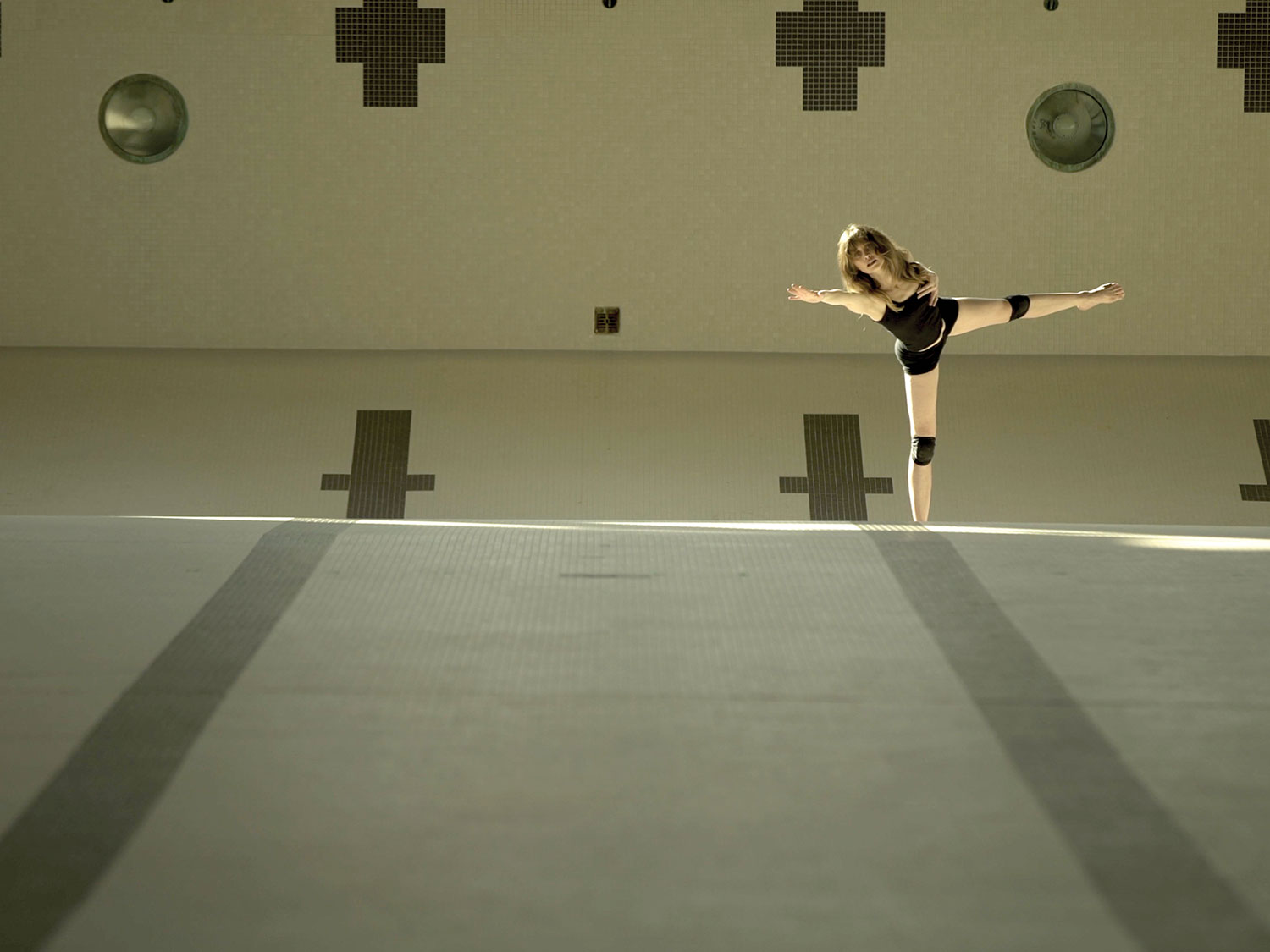
She’s finalizing a multimedia, interactive dance performance and installation about his work that she’ll stage here when it’s ready. It’s deeply personal, an extension of the “conversation” she’s continued with Peter since his 1995 death following a stroke. She was 18, studying ballet in Germany. In Edmonton, she danced in the empty pool, the interior disassembled around her.
“I spent my life since he died trying to understand who he was,” says Mistaya. “He keeps teaching me through his work.”
Murray — briefly, in his youth, Hemingway’s intern — wouldn’t be surprised by that. “The buildings that he left behind are iconic,” he says. “No other buildings have achieved that as much as Peter Hemingway’s.”
To be inside the Peter Hemingway Aquatic Centre today, Murray would say, is to understand the architect’s intention. “The rehabilitation of the aquatic centre has been successful, the original character and heritage value has been retained — bringing this 20th century icon into the 21st century,” he says.
The barrier between the watery interior and the grassy exterior of Coronation Park gives the impression of permeability. “When you’re standing on the inside, you can look out and feel connected to nature,” says Murray.
“It’s the joy of experiencing a provocative space.”
This article appears in the May 2026 issue of Edify