
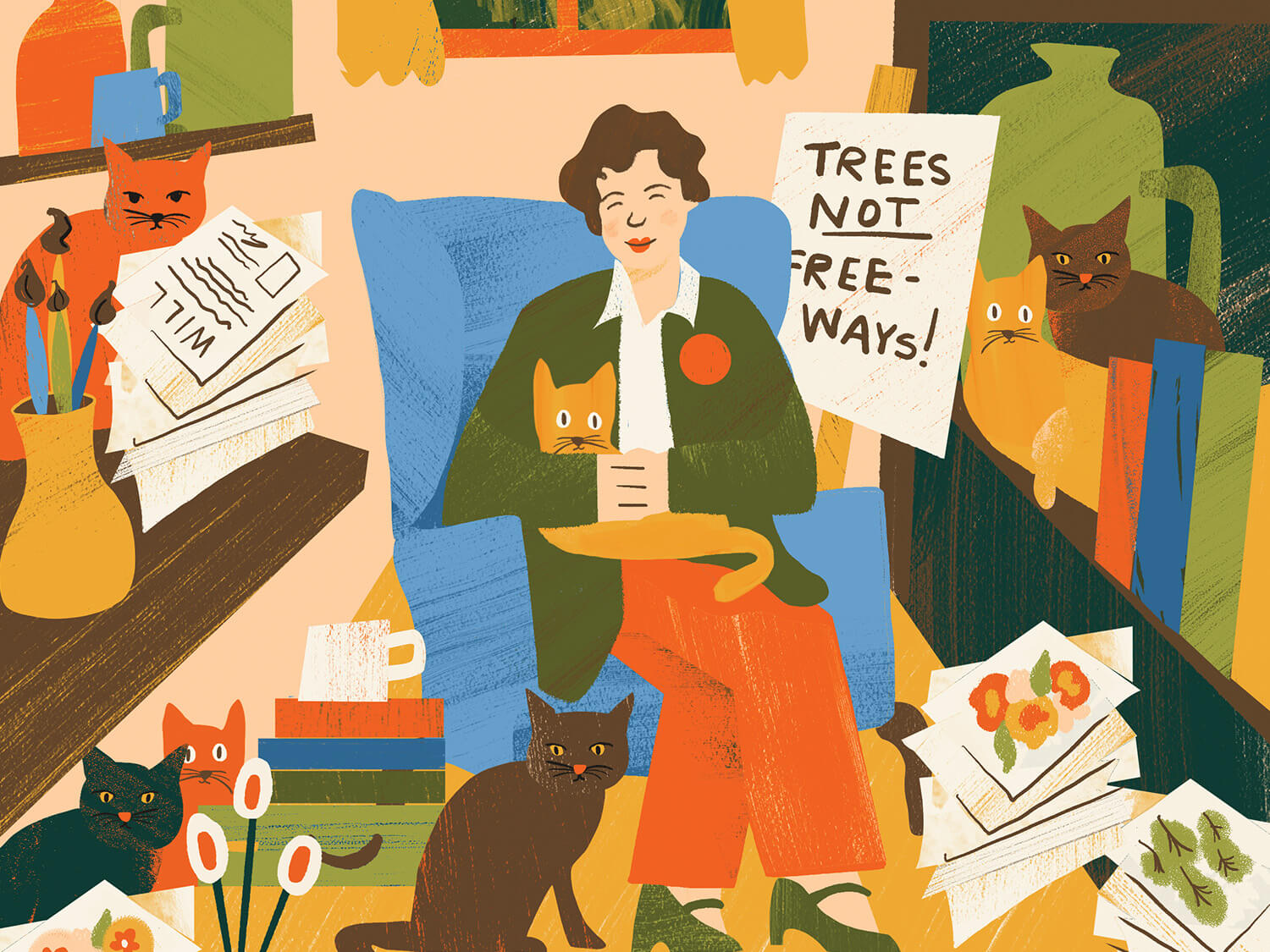
The trust officer had a big task ahead of her.
Margaret Chappelle, an Edmonton artist and activist, had died a few months earlier, on June 29, 1992 — with no apparent heirs. Her husband, a local doctor, had passed four years earlier and the couple didn’t have any children or other close family. After several months passed and no will turned up, trust officer Ellen Armstrong was sent to search the 1.2-hectare Grovenor estate at 146 Street and Stony Plain Road to find one.
Eventually, she reached the property’s cluttered garage.
“What Chappelle would do is, as papers came in — a gas bill or power bill — she’d put them in a pile on the table,” recounts Keith Stefanick, who worked with Armstrong at the time. (Armstrong passed away in 2025.) “Occasionally, she’d write out a will and put it on the pile. Then, when the pile got too high, she’d take it and move it out to the garage.”
And it was in those piles of paper in the garage that Armstrong found several handwritten wills. The major takeaway from them: Chappelle wanted the SPCA, now the Edmonton Humane Society, to be the recipient of her $3.7-million estate, and care for her beloved cats. (The estate, which included her house, would be worth roughly double that in 2026 dollars.) She stipulated that the SPCA hold her art works in trust for 10 years before going to auction.
After the news broke, Chappelle’s longtime friend, Yvette Morin, described her to the Edmonton Journal as a private person. She didn’t seem surprised by the bequest.
“She would only talk about colour and art and beauty,” Morin said. “She was rich and could have easily been a socialite, but she preferred living alone and taking care of her animals.”
The donation was record-breaking for the charity, with a lasting impact. “It was the largest donation to a Canadian Humane Society,” says Liza Sunley, CEO of the society. “The team at the time was really quite shocked.”
The funding kick-started their quest for a new purpose-built building, which today includes a sign welcoming visitors to the Chappelle Centre for Animal Care. “It was truly a legacy,” Sunley adds. “It enabled us to create what we have right now, which is still leading-edge in the animal welfare world.”

But this was far from the only legacy Chappelle left behind.
If you wander Edmonton’s substantial river valley — which is 22 times larger than New York City’s Central Park — or spend time in MacKinnon Ravine today, it probably seems inconceivable that it could be dismantled to build roads. But a decades-spanning battle that started in the mid-1960s and ended in the mid-1980s with Chappelle at the helm could have resulted in just that.
“Look at the bike path in the MacKinnon Ravine today,” says Stefanick. “We can thank Margaret Chappelle for that.”
Chappelle was born Margaret Ayling in Winnipeg in 1915, but grew up in Edmonton’s Garneau neighbourhood. According to the Alberta Foundation for the Arts, her mother was a socialite, while her father was a prominent businessman who served for a time as president of the Edmonton Chamber of Commerce.
All this is to say, she was afforded the luxury of pursuing her passion for art without much concern for its financial viability.
“She was absolutely stunning and totally outrageous,” Dorothy Barnhouse, a friend from high school with whom she took art lessons, told the Edmonton Journal in an extensive obituary from 1993. “She was so beautiful that the boys were afraid to talk to her and the girls were just in awe of her. To us, she had it all, a rich family, elegant clothes and lots of talent.”
Chappelle loved painting from a young age, but she didn’t enrol in art school until 1947, at the age of 32, when she attended the University of Alberta.
Several historical articles say she didn’t become a known artist until after her death, but a long list of art shows, in which she displayed her work, indicates otherwise. How much work she sold, though, is unclear.
“Really, this is the beginning of her art career in many, many ways — the beginning of her track record,” auctioneer Arthur Clausen told the Journal in 2003, ahead of the art auction to benefit the humane society.
That event — featuring 125 of her paintings and 70 wheel-potted vases, bowls and jars — went on to fetch the organization $76,000 from a standing-room-only crowd, much larger than they were anticipating.



By the time she was studying art formally, Chappelle had been married to Gerard Chappelle, a local doctor, for 11 years. His wealth, paired with family money, set her on a comfortable path.
She was a member of the Alberta Society of Artists and served as president of both the Edmonton Art Club and the Federation of Canadian Artists. Her work was featured in shows across Canada and internationally, with one of her vases chosen for display at the Smithsonian Institute in Washington, D.C. She also won the medal of honour for ceramics at the International Exposition of Contemporary Ceramics in Prague.
Arguably, her best work is her dreamy landscapes, depicting everything from the river valley to the Rocky Mountains, in the tradition of Canada’s impressionist movement, the Group of Seven. (She once helped bring A.Y. Jackson to Edmonton for a lecture.)
“That modernist treatment of the landscape and being more expressive with colour, I think that’s where she’s strongest,” says Danielle Siemens, collections manager and associate curator at the Art Gallery of Alberta.
From November 2021 to March 2022, the gallery curated a show celebrating the 100th anniversary of the Edmonton Art Club that featured Chappelle. The SPCA also donated two of Chappelle’s pieces to the gallery in 1996.
“Her art practice was pretty diverse,” Siemens says. “She worked in watercolour, oil painting, sculpture and printmaking. That in itself is interesting. She seemed like she was trying a lot of things, stylistically.”
Al Forbes, a retired art professor who studied with Chappelle at the U of A, told the Journal in her obituary, “The paintings she was doing at the time were as good as any being done in the period. She was anything but a recluse back then … She sat on many committees and was devoted to bringing talent to the forefront.”
Chappelle might have remained focused on art and never pursued activism if the wild and natural backyard she loved so dearly hadn’t suddenly come under threat.



In 1964, the City of Edmonton released its Metropolitan Edmonton Transportation Study. It included several recommendations that aligned with transportation planning trends at the time favouring freeways — one of them a six-lane roadway right through MacKinnon Ravine, 300 metres from Chappelle’s home. The network of roads aimed to give suburban commuters easier access to the downtown core.
The plan would also see 11 per cent of the river valley gobbled up by asphalt. City council approved it at the end of that year and by 1965 construction had begun.
Suzanne McAfee didn’t know Chappelle personally, but later joined another group protesting the freeway called the Sound Transportation and Environmental Planning society.
“When I walked down there as a child, it was a lovely ravine,” she recalls. “There were trees, there was a creek and all that. But once they did the clear cutting, it was really just barren. You could still walk through there, but it took a lot of the beauty.”
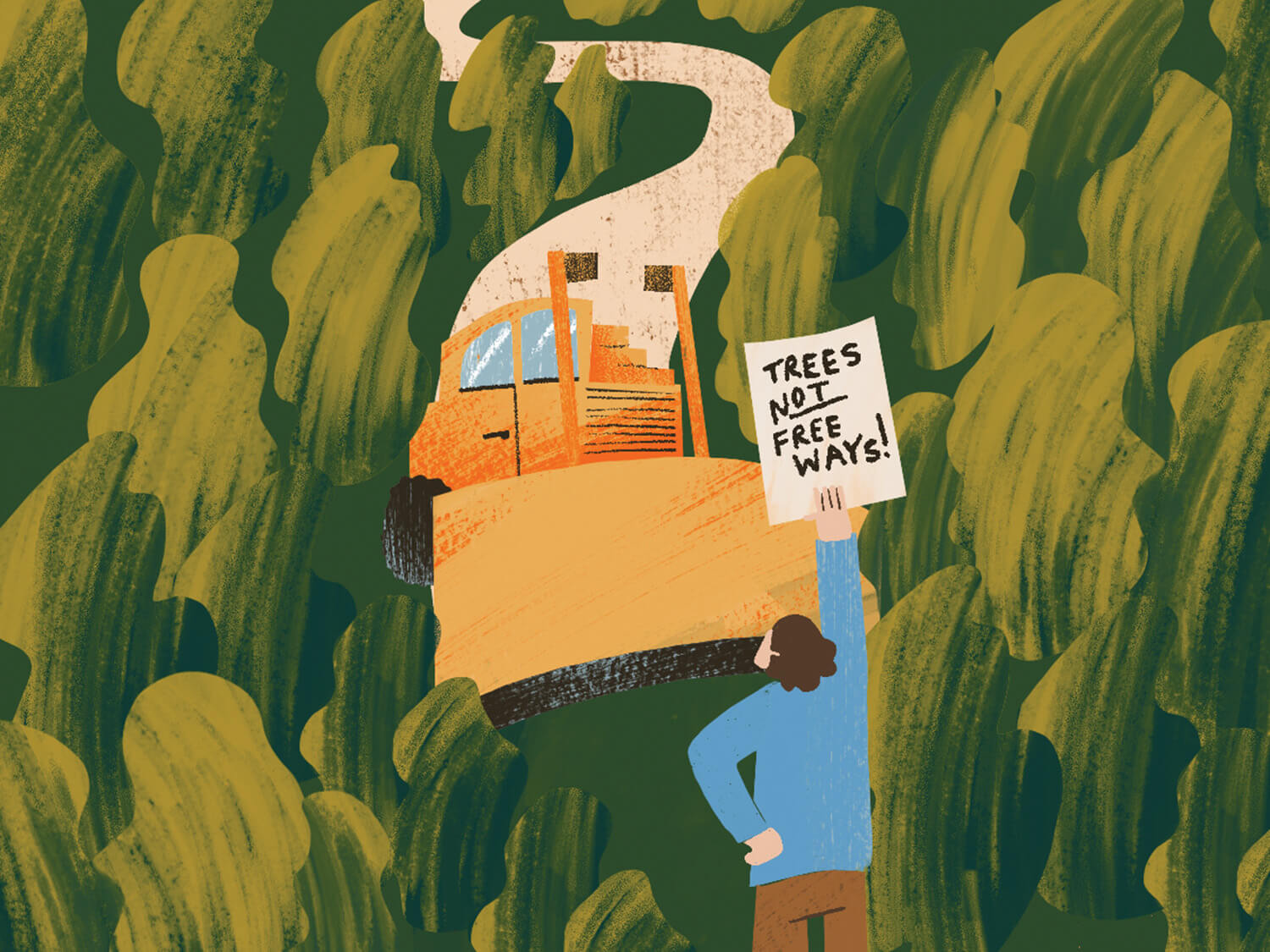
The destruction — which, in addition to cutting trees, storm sewers and road beds — motivated Chappelle into action. In October 1965, she and a small group of women, including Maria Jablonski, Anne Packer and Olive Hoyle, dubbed themselves the Save Our Parks association, and marched down 142 Street with picket signs reading “Trees — Not Freeways.” Their protest moved into the ravine, where they picketed at the worksite.
Some newspaper articles of the time report that Chappelle laid in front of a bulldozer as a last-ditch effort to stop the machine in its path. Whether this is true or apocryphal is lost to time, but it was spoken of with confidence in some camps. “I remember her pushing a baby carriage in front of the bulldozers and then lying down in front of one,” said Bettie Hewes, a city alderman from 1974-84 and, later, a Liberal MLA, in a Journal article.
A better documented accomplishment: Chappelle and Save Our Parks collected 9,000 signatures — well above the 5,700 threshold — to stop a bridge from being built as part of the project.


“We don’t mean to stand in the way of progress,” Chappelle told the Journal. “We are perfectly willing to give and take. But I think those of us with convictions about preserving the city’s ravines and parklands should stand up and be counted.”
That story was relegated to a column from the women’s editor of the day, who also described Chappelle as “handsome” and “the attractive wife of a city doctor.”
Still, Save Our Parks demanded to be taken seriously, attending council meetings and even calling the mayor at home. (It should be noted that neither Chappelle or other members of her group were responsible for the effigy of the city’s chief engineer that was found hanging from the 142 Street Bridge.)
In 1971, city council decided to downgrade the road to a four-lane highway, but when they picked up construction the following year, Chappelle and Save Our Parks got to work once again. At a council meeting, Chappelle argued that the city should consider rapid transit, like other major American cities were beginning to pursue.
“Big cities should hang onto every tree they can possibly keep,” she said. “We hope that the citizens of Edmonton will realize the importance of retaining the river valley and not letting it go to waste.”
This widely polarizing issue raged on for years — in living rooms and offices, and in council chambers and headlines. Environmentalists found a friend in Alderman Una Evans who, on more than one occasion, introduced motions to stop freeway construction. On the other end of the spectrum was Alderman Olivia Butti, who long lobbied for the construction, even after the issue came to a close.
Ultimately it came down to a narrow vote on Aug. 29, 1974. City council voted 6-5 to kill the $4-million MacKinnon Ravine freeway. The idea was revisited briefly in 1983; public outcry again quashed further exploration. Council instead declared that both the river valley and ravine systems should be used for “urban and natural parks and environmental protection uses.”

For Hewes, the alderman-turned-MLA, Chappelle helped launch a shift towards conservation.
“That movement she organized stopped the freeway cold and really was the forerunner of the urban reform group that took shape in the ’70s,” she said in Chappelle’s 1993 Edmonton Journal obituary. “She can take a lot of credit for the way the river valley looks today. She did the city a big service.”
The true conclusion to the MacKinnon Ravine battle arguably came in June 1984, when MacKinnon Ravine Park officially opened — forever protecting the slice of forested land.
McAfee remembers the day well. Along with the Sound Transportation and Environmental Planning society, she unveiled a plaque donated to mark the opening of the new ravine park. “It wasn’t just the opening of a park,” she says. “It was a celebration.” The festivities included hot air balloon rides, ice cream and treasure hunts.
A picture from that day captures Chappelle, Jablonski, Packer and Hoyle beaming, arms slung around each other.
Chappelle is in the centre, with a khaki trench coat left unbuttoned, revealing an “I heart MacKinnon Ravine” button pinned to her shirt. Scores of others who were there that day wore similar buttons.
The park’s plaque still remains at the site where it was placed, but takes a bit of hunting to find amongst overgrown bushes, McAfee says. It seems like an apt metaphor.
As Margaret Chappelle said in the Journal during the early stages of the fight for the ravine, Edmontonians must protect what makes the city special.
“I am among many who disagree with what has been done, is being done, and will be done in the future to destroy the beauty of this city,” she wrote. “Is Edmonton different from other cities? Yes! Because of a few God-given assets — our lovely river valley, the well-treed ravines. Without these we would have another flat, windy, uninteresting city.”
This article appears in the July/August 2026 issue of Edify