
Back in 2018, Milena McWatt was struggling with severe depression.
In the midst of that darkness, she found herself drawn to the river valley. She would take her dog and wander amongst the trees for hours.
“I didn’t really understand why I was so instinctually drawn to that,” she says. “But I would always come home after those few hours and feel a lot more calm. Not necessarily good, but more OK.”
When she stumbled upon some information about the practice of forest bathing — in which you spend intentional time in the forest, observing nature around you to increase your well-being — it all clicked.
She remembers texting her brother at 3 a.m.: “Hey, I just learned about this and I’m going to do it. I’m going to name my business Wild Calm Forest Therapy.”
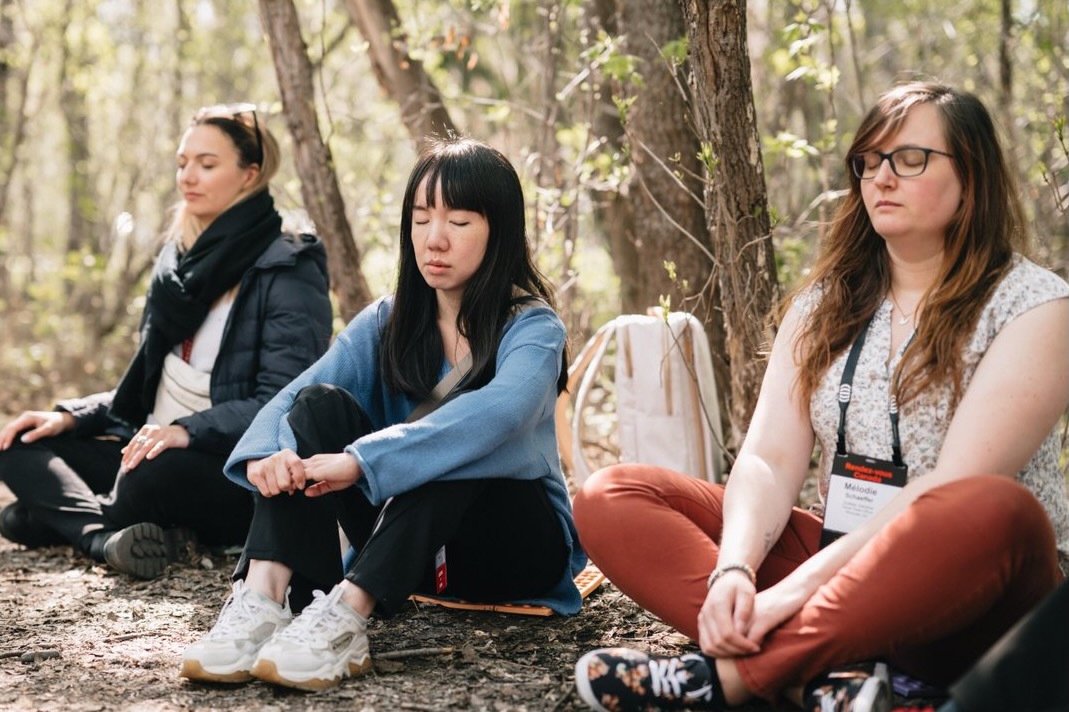
Eight years later, McWatt (who has an undergraduate degree in biology and a master’s degree in resource and environmental management) is still guiding Edmontonians through the practice in the river valley, helping them slow down, notice the nature around them and de-stress. The sessions culminate in forest-foraged tea.
“It’s very open ended,” she adds. “Throughout the session, the guide will offer a series of sensory invitations. There’s no right or wrong way to participate. The invitations are designed to help folks connect, through their senses, to their environment.” The goal is for participants to dwell less in their thoughts and more in what she calls their “embodied experience in that place.”
Rooted in the Japanese concept of shinrin-yoku, forest bathing is surprisingly well studied, with research reflecting the benefits similar to those McWatt experienced. In fact, it became part of a national health program in 1982, introduced by the Forest Agency of Japan for the stress management of workers in Japan.
Forest bathing has been gaining popularity in the Western world, too.
Participants don’t have to hike far or fast to reap the rewards. Most guides will work to make the experience accessible, even if you’re not an outdoorsy person.

“It’s really about helping people to slow down and be curious about what they’re noticing around them, the sensations of their own body, and all of their different senses and the interaction with other participants as well,” McWatt says.
Last summer, the City of Edmonton launched a pilot project hosting forest bathing at several locations around the city. Those 25 sessions saw 200 participants and immediate interest.
“The sessions filled up quite quickly within only a couple of days,” says Allyn Esau, one of the guides. “The demand was high throughout the season, so we were really excited this year to expand offerings. This year, we have 35 sessions for the public and capacity for 400 participants.”
Those sessions fall into different categories: an introduction to forest bathing, immunity boosting, nature reconnection, and teas and trees. Locations vary from Whitemud Creek Ravine to Twin Brooks District and Nature Park and Capilano Park.
“We looked at those parks for a number of reasons,” Esau says. “One is the feeling that you experience when you’re in the park. We’re looking for parks that are peaceful and reflective, but we also consider accessibility.”
Should you find yourself in one of these areas and want a taste of forest bathing outside the auspices of a guided experience, Esau says one activity is noticing scent.
“One of the mechanisms that triggers these benefits is the volatile organic compounds that plants produce,” she says. “Engaging with your sense of smell can be a really powerful way to engage in this practice. One activity I might encourage people to do is slow down and take a moment to smell a range of different things around them — maybe leaf buds or sap from the tree or bark. Just inhale and see how those scents feel, and what they trigger in you. The practice isn’t just about engaging in those physical experiences, but also engaging in the feelings those experiences bring up.”
If it sounds like the domain of hardcore nature lovers, Esau says she’s actually guided a huge range of participants.


“Most people are coming to this practice already curious about it, but I have had people who are quite skeptical,” she says. “I’ve seen people of all professional backgrounds, from the trades to university educators. I’ve seen 12-year-old children and had 80-year-old attendees. If you’re curious, I encourage you to give it a try.”
The City of Edmonton is hosting forest bathing sessions through September. Wild Calm Forest Therapy, meanwhile, has a variety of events booking throughout the summer.