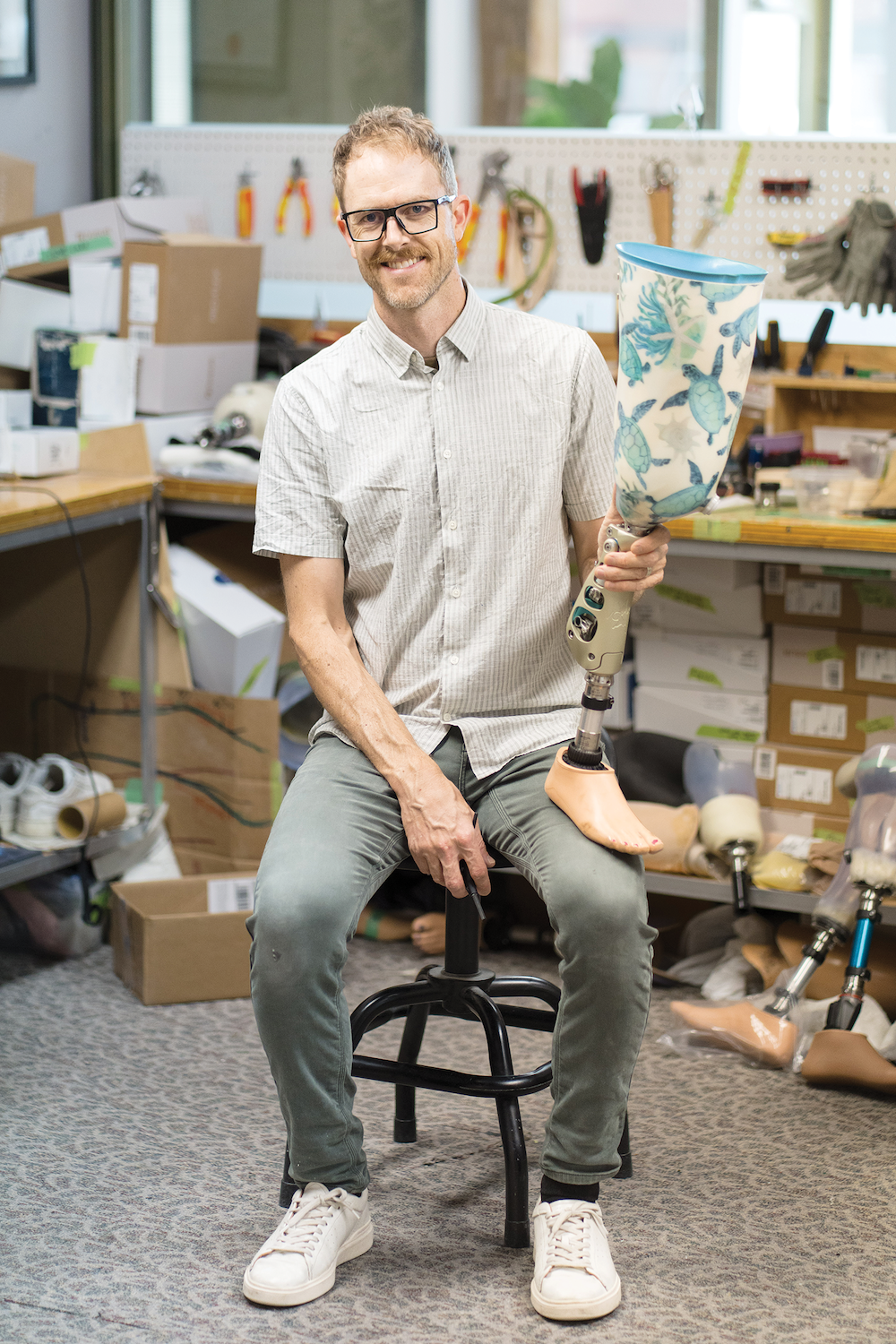
Duane Nelson, owner of Synergy Prosthetic Services, is a certified prosthetist — a specialist who designs, creates and fits artificial limbs for people who have lost the original. A prosthetic limb is personal, and the job of the person who makes them is as much about ensuring functionality as it is that the limb reflects the personality and wishes of its owner. We talked to him to find out more.
Edify: You said you once saw a magazine story about a runner with a prosthetic leg.
Nelson: Yes, the article was about the athlete, but it also mentioned the prosthetist who worked with them to meet their highest abilities. They even went to the track and field complex together to fine tune the prosthesis. I was in carpentry school at the time, and I had always been interested in the medical field. That was the first time that I had been like, “Oh yeah, somebody does that as a job.”
Edify: Where did you go to school for prosthetics?
Nelson: I went to British Columbia Institute of Technology. When I went through the education system I didn’t need to complete an undergrad degree before I got into the certified prosthetist program. I needed some university courses, and I graduated with a diploma. Then I did a residency, which is governed by the national board, Orthotics Prosthetics Canada. Then I wrote certification exams. That certification is still the standard today, but now students require a degree before they can get into the program.
Edify: What’s the balance of form and function?
Nelson: We meet a patient for an assessment of their movement, range of motion and muscle strength. We design for comfort and functionality first. We do a shape capture of the remaining limb with a cast, and use that to prototype a prosthesis. The thing we don’t do is impede function, like inhibiting a microprocessor-controlled knee joint for example.
Edify: How do your patients’ creativity and preferences figure in?
Nelson: We can provide an aesthetic covering that can look lifelike or bold and vibrant. The surface of the prosthesis might be soft and skin-like — vinyls or silicones act as replacement skins. Or we use materials that are hard shells or 3D-printed. No single one is the same as another. You’ll get people who don’t care about how it looks, they just want it to function right. But other people express themselves through this new part of who they are.
Answers have been edited for length and clarity.
This article appears in the October 2026 issue of Edify