
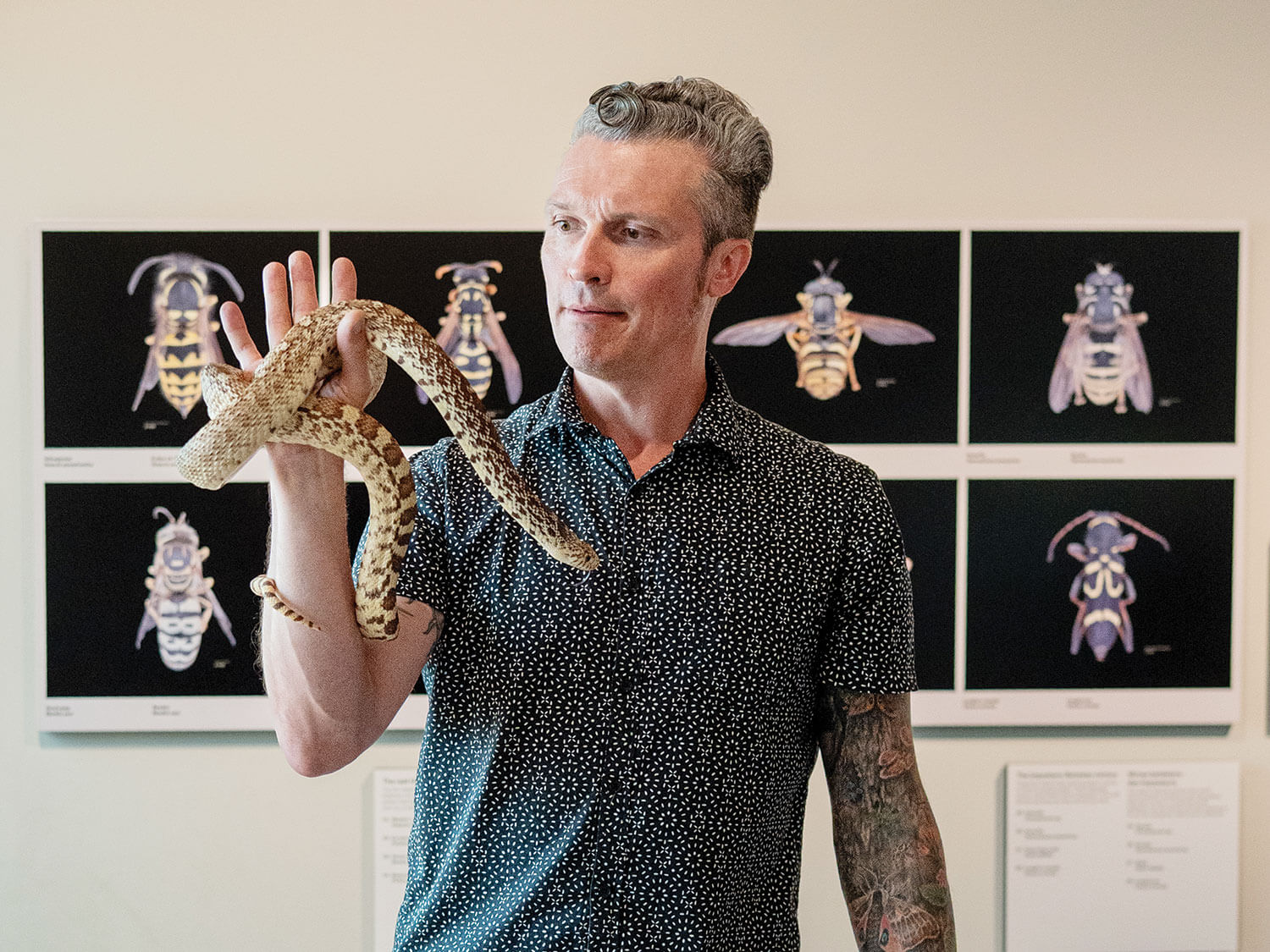
It’s not something Pete Heule imagined he’d do when he was a kid, but when he was 16 and regaling his bagpipe instructor with bug facts, the teacher told him he should think about making a career out of his interest when he was older. Edify visited him at the bug room recently to find out what it means to be a custodian of these creatures.
Edify: Why did you want to do this job?
Heule: As a kid I’d go to the museum with my family and always really enjoy it. I started as a volunteer in 1998, and then it became a government job in 2006. I’m not really sure when the “live animals supervisor” title came about, but that’s what my position had become.
Edify: What kind of education do you need?
Heule: I went to the U of A and got a bachelor of science specializing in animal biology, but at that point I was already volunteering here. I already knew that being able to talk to any visitor of any age or background about any kind of animal was more important to me than becoming an expert in one particular thing.
Edify: Are any of the animals at the museum dangerous?
Heule: Most of our venomous creatures are in the reef tanks. Our Western Harvester ants actually pack a bit of a wallop — they have the most potent venom of any insect. Now, how much do they inject per sting? You’d have to fall into a full nest of these guys for it to be dangerous.
Edify: What’s your favourite part of the job?
Heule: Something that I find rewarding is taking a snake out to show people and talking to them for half an hour. They leave the room feeling better about snakes, and it’s the same for any of the creatures people might misunderstand. It fosters tolerance, appreciation and respect. Our relationship with insects has a lot to do with our attitude towards nature in general. If we say that an animal is worthy of our contempt, or doesn’t think and feel, it’s a lot easier to reach for the pesticide. That’s just not the right approach. You don’t have to want them as a pet, but ecologically they have a job to do.
Answers have been edited for length and clarity.
This article appears in the September 2026 issue of Edify