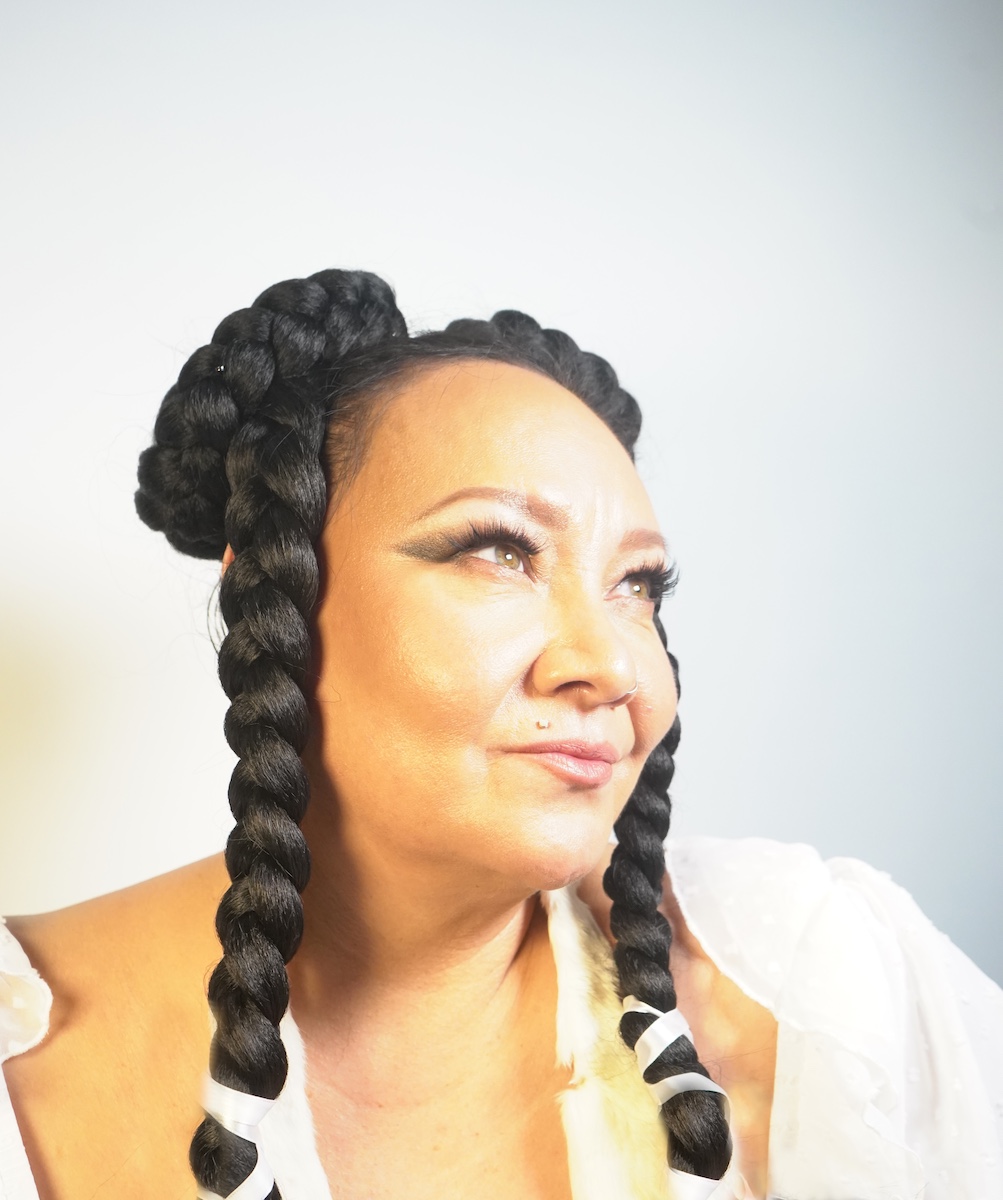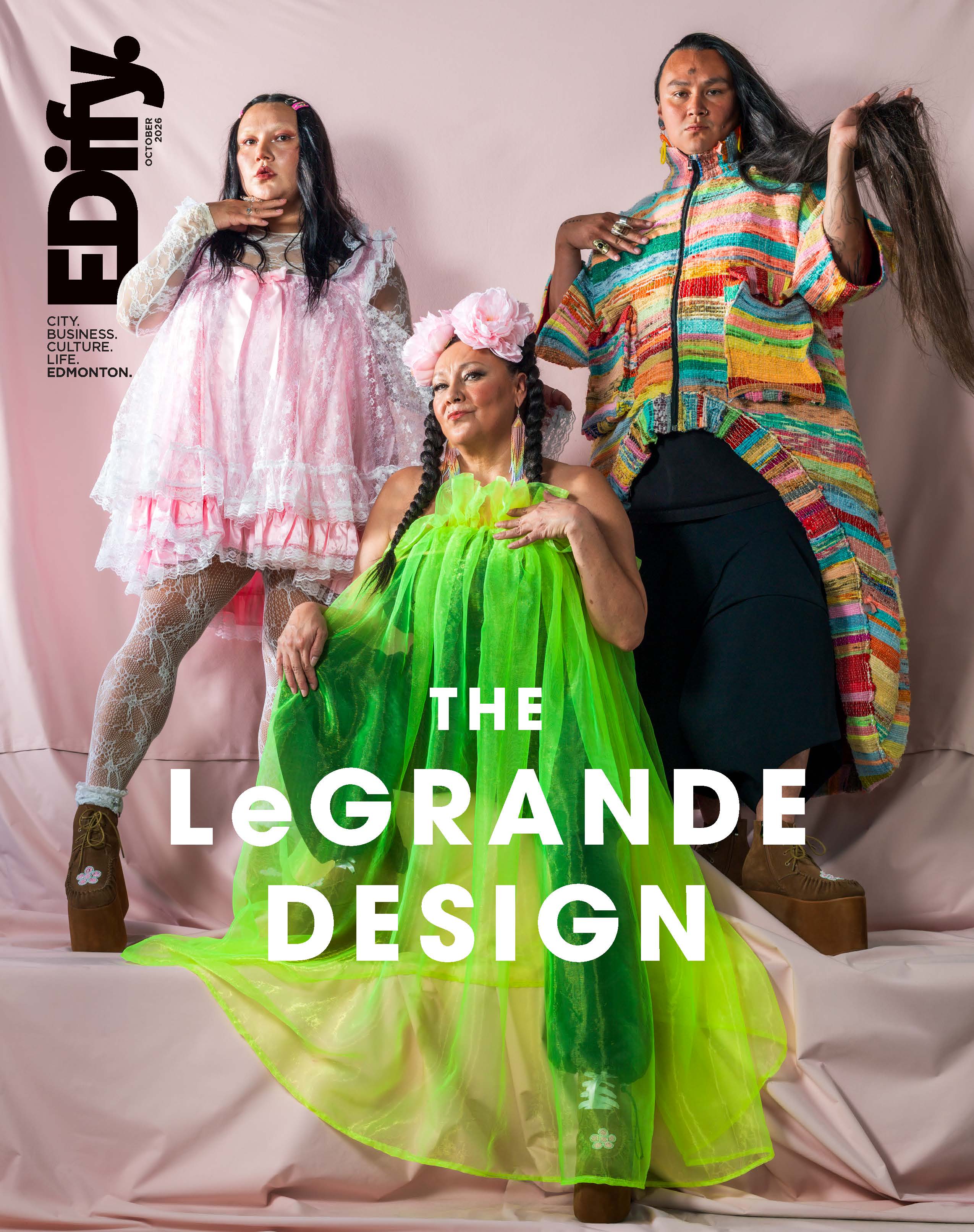

It’s a hot July day when I walk into Connie LeGrande’s home. Though she just moved into the apartment a month ago, it is already fabulously decorated: richly coloured paintings hang on the walls, not one but two sculptural busts on plinths are tucked into a windowed alcove, vintage lamps sit on side tables next to an ornately carved wooden armoire. There’s an immediate grandeur to the place that makes me feel like I’ve stepped into a museum or art gallery. Connie, whose stage name is Cikwes, is a singer-songwriter whose moody music blends jazz and soul with nehiyawewin (Cree language) and intimate chanting.
Connie is not the only creative force in the household.
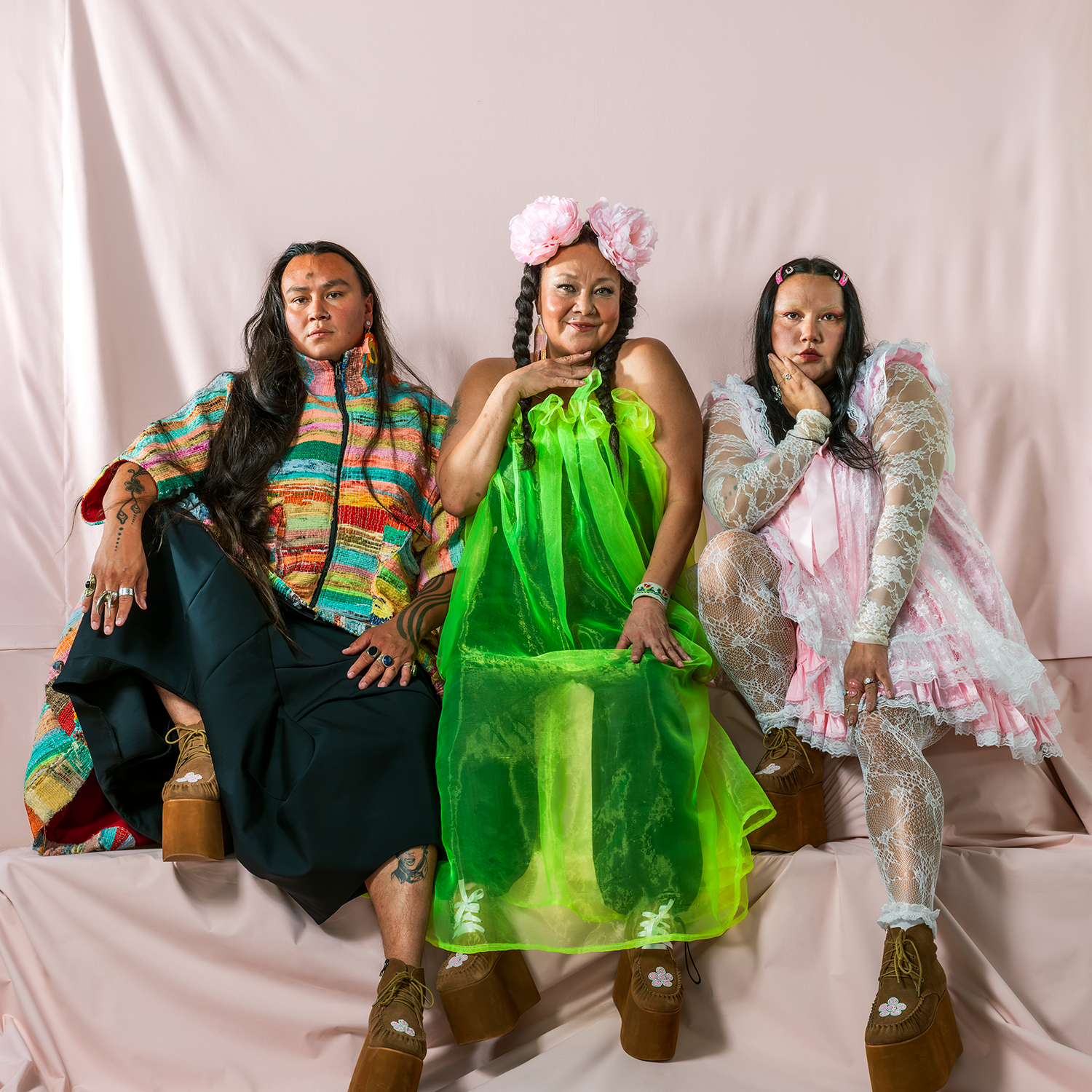
Cheyenne Rain LeGrande, Connie’s middle child, is the one who greets me at the door. Cheyenne is wearing a bright dress with tulle and platform shoes. Blue clips peek out of their hair. They pour me an iced tea and gesture to the L-shaped couch in the living room where we sit together. Seconds later, Connie comes into the room. She’s dressed in a white, flowy top and pants for the hot weather.
“I’m still organizing all of this,” Connie says, gesturing to a small pile of boxes, vintage lamps and lampshades stacked onto one another, and at least six mirrors with ornate metal frames. I remark that she’s far more organized than I would be only a month after moving. I ask if she’s happy to be back on the north side of the river, having spent the last three years on the south side. “I really am,” she says. “This side of the city is my home. I feel like it’s a returning.”
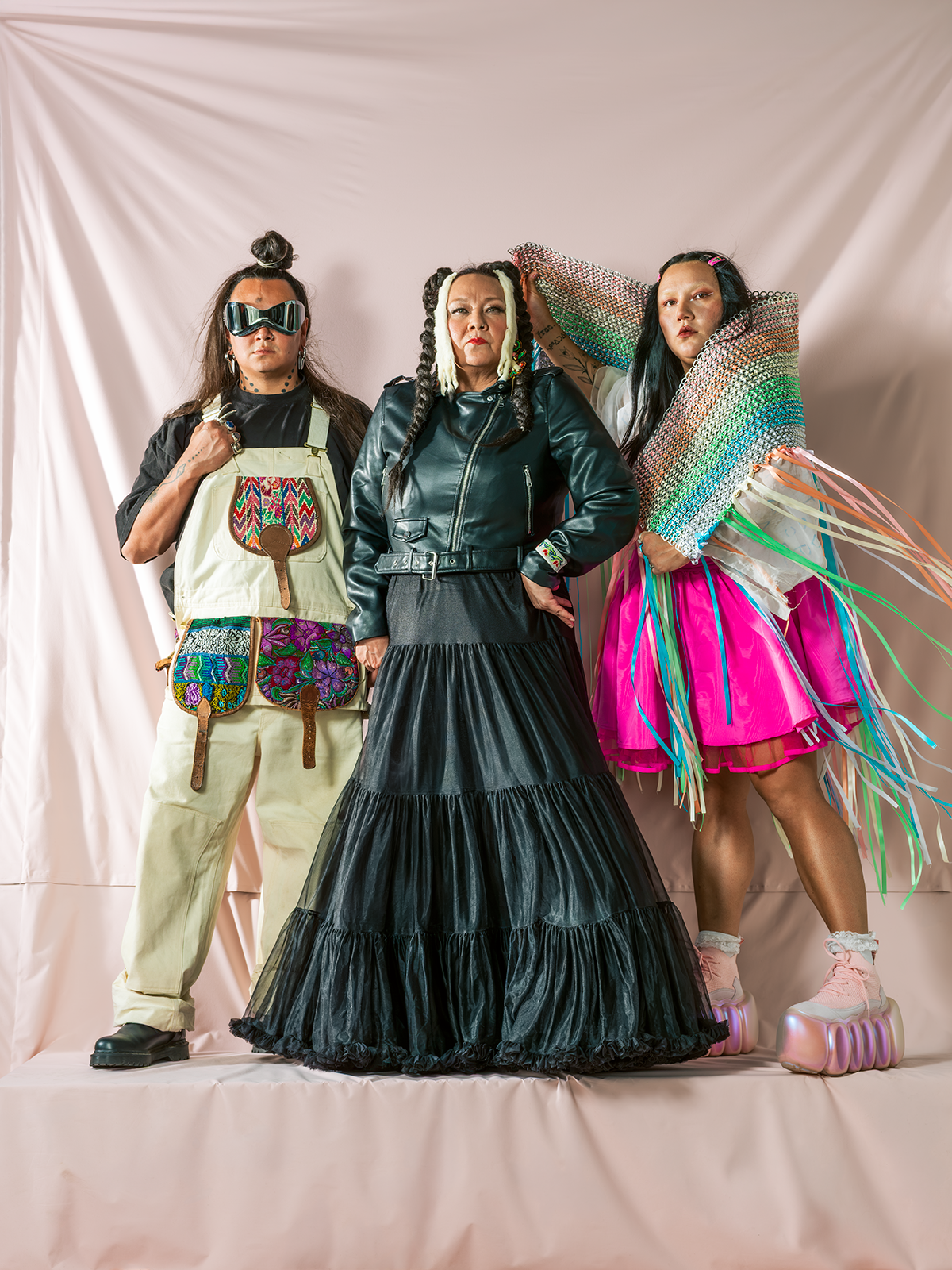
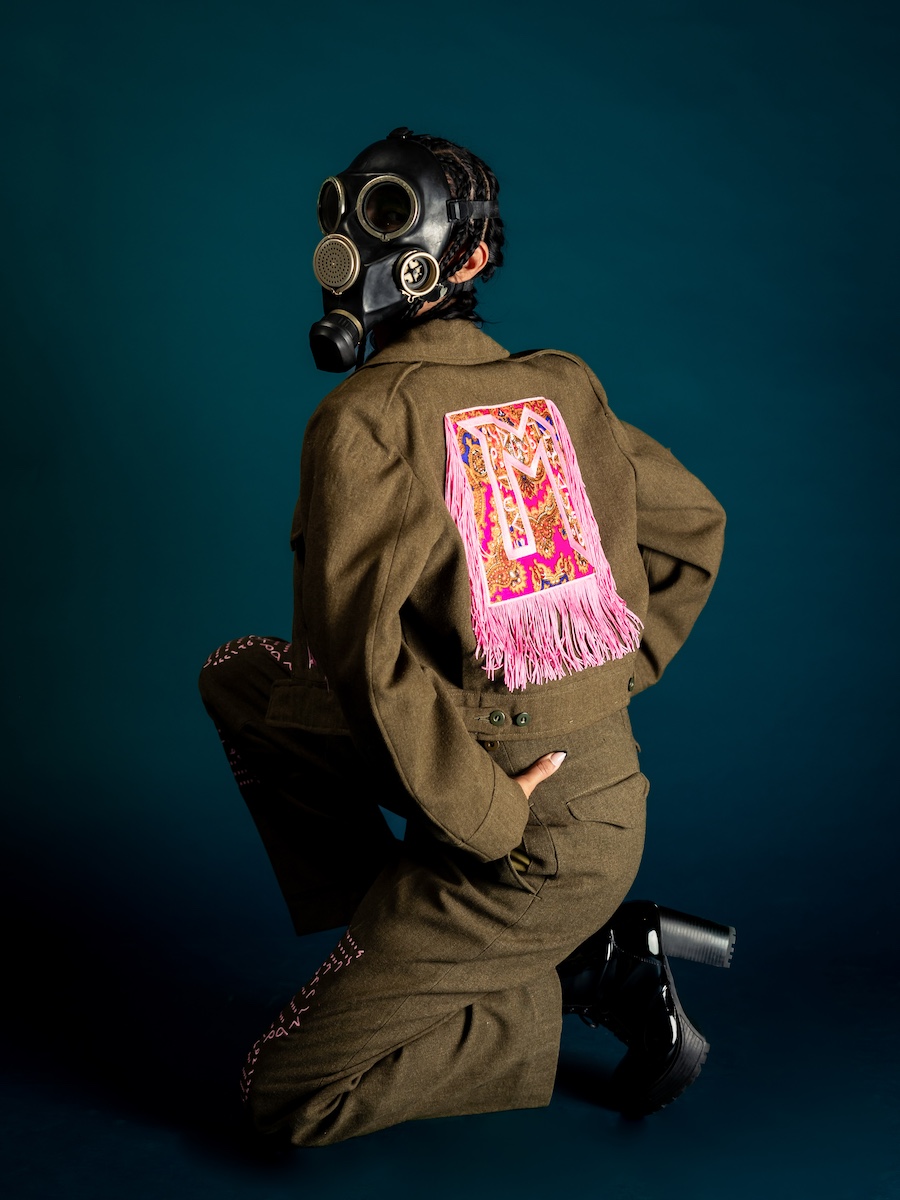
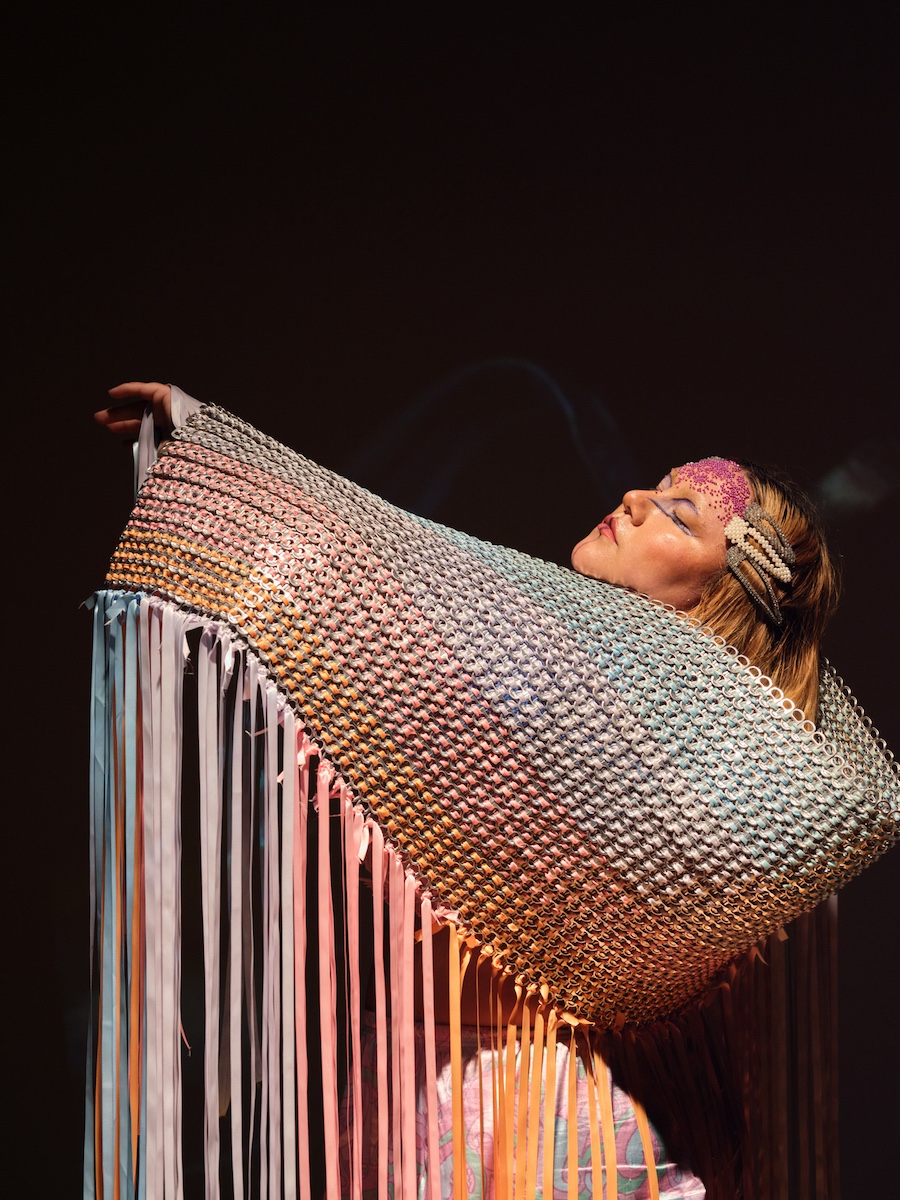
While Connie checks on the bannock in the oven and the stew on the stove, Cheyenne pulls a battery-powered fan out of their transparent purse and clicks it on. Also visible in the purse: a phone, a lighter, beaded earrings, a multicoloured sucker that matches their outfit. All of this checks out for Cheyenne’s aesthetic. In all of their artistic work, from their famous moccasin platform shoes, their shawl made of pop can tabs and ribbon, their performances that use projections, movement and sound, to their recent sculptural public art piece (a 14-foot-tall beaded earring constructed of painted fibreglass the colours of a pastel rainbow) there is colour, ethereal beauty and a hint of camp.
Dusty arrives a minute later. Connie and Cheyenne see him first — they have a better line of sight down the hall to the front door — and they laugh. He laughs with them as he enters the living room. He’s dressed in tight bike shorts, a helmet, a fanny pack across his chest — a sharp contrast to his usual style, which mirrors the aesthetic of Mobilize, the streetwear brand he founded in 2018. “Don’t worry, I brought my other shorts,” he says, pulling black baggy Mobilize shorts out of the fanny pack and disappearing into the other room to change. When he comes back, he tells us that everyone at his shop Artwear made fun of his legs. (Artwear is the custom embroidery and branding company he recently purchased and now runs.) Always dressed in baggy pants or shorts, no one at work ever sees his legs. He laughs about it; the rest of us do too. Laughing: this is how we’ll spend the rest of our afternoon together.
Individually, Connie, Cheyenne and Dusty have made a mark on the music, art and fashion world. Between her three albums, ISKÔ, kâkîsimo ᑳᑮᓯᒧᐤ and Nehiyaw Iskô, Cikwes has received nominations from the Juno Awards, the Summer Solstice Indigenous Music Awards, the Edmonton Music Prize and the Western Canadian Music Awards, as well as consideration for the Grammy Awards.
Cheyenne has won numerous awards, has performed and exhibited their artwork at Daphne Art Centre in Montreal, the Centre for Cultural and Artistic Practices in Winnipeg, the Art Gallery of Southwestern Manitoba and the A.K.A. Gallery in Saskatoon. And they were the 2026 artist in residence at McGill University.
Dusty has shown Mobilize collections at Indigenous Fashion Arts in Toronto, Vancouver Indigenous Fashion Week and the Sante Fe Indian Market Fashion show. He’s worked with Hockey Canada, Canada Skateboard, Lululemon, the Toronto Raptors and has been featured in Vogue, Fashion Canada, Complex, Elle and Amazon Designer Spotlight.
Needless to say, each of these artists are powerhouses. Together, they are truly something special, and they often collaborate on projects.


We each dish up some stew and bannock — “little bannocks” as Cheyenne calls them since they’re bite-size — and talk about the ways they’ve collaborated in the past: Cheyenne and Connie have both designed garments for Mobilize, Cheyenne has modelled in numerous Mobilize shows, Connie has sung in many of Cheyenne’s performances, and Cheyenne did backup vocals on Connie’s albums and designed her most recent cover.
But collaborating and creating art together isn’t something new for them. In fact, Cheyenne and Connie have been drawing together since Cheyenne was in Grade 3. “Me and my mom have always had this language of creating these doodles,” Cheyenne recalls. “I used to call them ‘doodlies.’ They’re spiritual to me, and we have always both made them. I probably learned them from her because she was always doing them. But it’s cool to see our different styles.”
They show me some of their doodlies. Cheyenne has a tattoo of one of theirs the length of their arm, from wrist to elbow. It looks almost floral: the shape of a flower, fine lines extending from both ends into other shapes and dots. Connie flips through a notebook until she finds some of her own. They are expansive sketches of shapes that give a celestial impression. Connie’s and Cheyenne’s doodlies differ, but you can tell they come from a similar place.
In terms of collaborating with each other in the present day, Cheyenne says it’s an organic process. “It’s fluid because we’re all really close and we’re all artists. It’s not even conscious sometimes. We’re in each other’s lives and communicating about our art, and then it just comes about. It’s organic.”
Dusty agrees. “Some of the collections or fashion stuff that we’ve done between the three of us have literally happened over sitting together and talking and being together. And then all of a sudden it develops into something. There’s not much critiquing. Everybody gets to create how they do.” He pauses. “And then afterwards we argue over who has intellectual property.” They all burst out laughing and riff off the joke.


Dusty admits that he had to go through a lot of personal and professional growth when he first started Mobilize.
“When I first started, I was, like, ‘No, this is my brand, this is what I do.’ What I learned working together was that things became stronger and more beautiful when they were shared together. Things are stronger when it is collective, and when it gets to evolve.”
When it comes to arguments or disagreements, they don’t let things fester. “We hash it out,” Dusty says. “If something goes wrong, it’s opened up and raw right there.”
Collaboration doesn’t happen between just the three of them, though. Their projects often involve other family members. Nikaeo, Cheyenne and Dusty’s youngest sibling, used to model for Mobilize, and has collaborated on past artistic projects with Cheyenne. Lyle, their dad, also modelled for Mobilize. In fact, he’s still the first face that appears on the Mobilize website.
“What’s ironic about him being the face of the Mobilize site is that he would never wear anything Mobilize,” Dusty says. Cheyenne laughs and agrees, noting that their dad is interested in his own particular type of fashion, which is all about comfort. Though they no longer actively model, Lyle and Nikaeo still support behind the scenes by building sets and stages and helping out.
Dusty’s children, too, are artistic, often participating in the family’s projects. Nayana, the second oldest of Dusty’s four children, sings a hook in a song in Connie’s newest album, Nehiyaw Iskô. Dusty’s oldest, Jak, designed a hoodie when he was four, which now appears in the Royal Alberta Museum. Connie notes that one of her songs, “tohtahin sipiyihk,” which means “take me to the river” in Cree, was inspired by Jak, and Cheyenne sings a part of this song on the album. “It gets layered,” Connie says. “It started off as a song being inspired by Jak, and then Cheyenne coming into the studio and singing that part, and then it became an experience between her and I.”

Connie says that her journey hasn’t always been easy. She grew up in a household with parents traumatized by residential schools, and she had to find her voice as an artist without a blueprint of what that looked like. She is honest with her children about these difficulties.
“In the past 20 years, I’ve had layer after layer come off, so many layers. It’s been the best time of my life and the most hard and emotional time of my life. My mom’s generation were afraid and then my generation had to become really fierce to be able to even have little glimpses of art or singing. It’s been hard.”
But despite this, she has earned her success: “I’m proud of my relationship with myself and my children. I’m proud to know my grandchildren adore me. I know how much they love me. Now I’m able to take that love, because before I couldn’t accept love. Now I can.”
Art, it becomes clear, has been a way for all of them to express themselves, peel back layers of generational trauma and create legacies of generational joy.
“The whole journey is special,” Dusty says. “Seeing my kids are getting to grow up. They know from such a young age who they are. All of my kids are fluid, know love for love, and see the world in so many different ways. They correct us parents constantly and give us little teachings all the time. I don’t think the little ones know the healing they’re bringing by just living in this way.”
Connie LeGrande’s makeup by Tiiu Vuorensola
This article appears in the October 2026 issue of Edify