
Rob Tryon can tell you where an oyster came from just by tasting it. “For me, the perfect oyster platter is a big variety of east coast and west coast. I’ve had some oysters from Puget Sound that are actually the east coast species and they’re amazing,” he says.
Tryon explains that the different tastes come from the type of plankton the oysters have been feeding on, which differs based on location. “You can have cucumber, melon and seaweed notes. You’ll have different levels of salinity. The brininess will change from region to region, depending on if it’s near an estuary or a freshwater source or a deep water source,” he says. “That’s just part of the whole experience.”
Tryon has been around oysters and fishing his entire life: currently the VP of business development in Alberta for Seven Seas Fish Co., he’s also the founder of Effings Surf and Turf in St. Albert and, before making the move to the prairies, was an oyster farmer on the west coast of Vancouver Island. That’s where the name Effing comes from — the majority of his work took place in the Effingham Inlet. Tryon and his daughters Sierra and Savannah (who now run Effing Surf and Turf) also run Oyster School to teach proper shucking and preparation techniques. And they operate the Effed Oyster Bar, where they bring everything to set up an oyster bar at your home or event. So when it comes to this shellfish, he knows what he’s talking about.
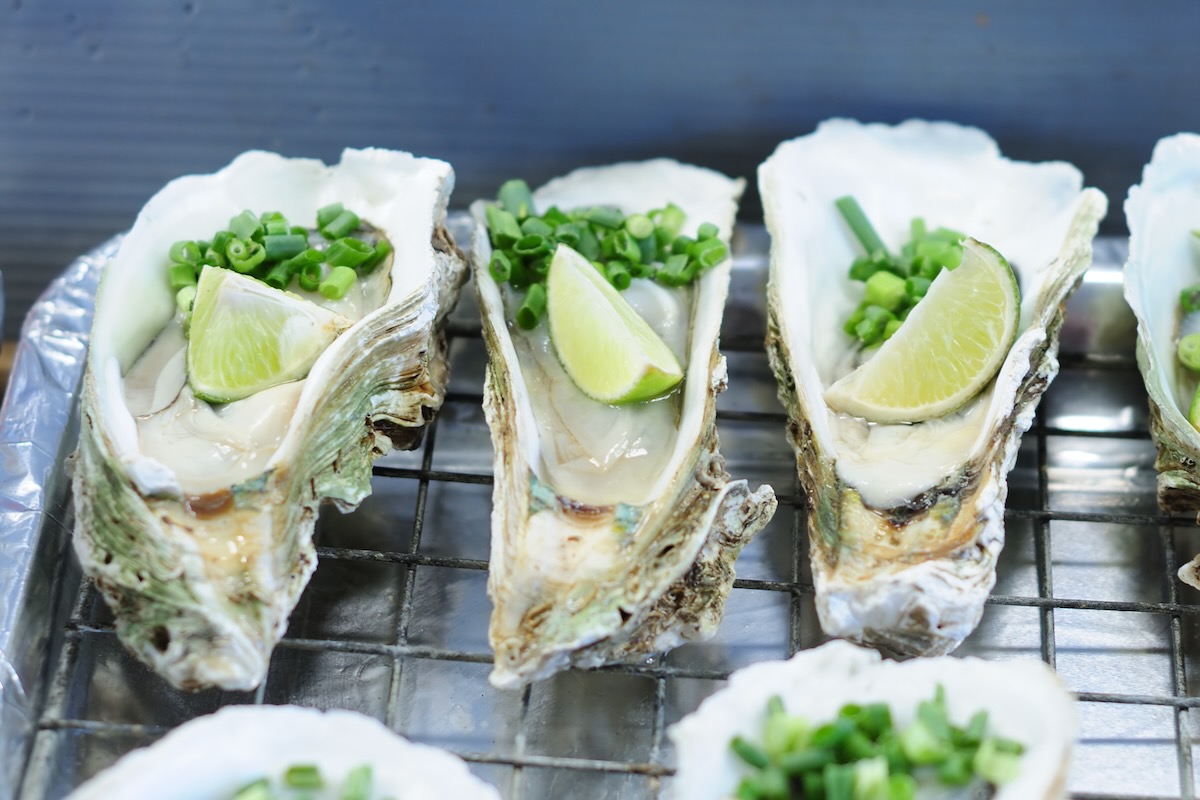
“A good oyster is a meaty oyster,” Tryon says. “A little bit of an off-white colouring, it’s plump and fills the shell once you’ve shucked it, it’s full of water.” He explains that when he’s sourcing oysters he tries to avoid ones that are at the peak of their reproductive cycle. They’re not as plump, not filling their shell, and Tryon personally finds their texture at that stage in the life cycle to be less pleasant.
Fortunately, oysters in different locations enter their reproductive cycles at different times. “B.C. oysters are at the peak of the reproductive cycle from August to mid-September,” Tryon says, “but a lot of the east coast has already gone through that cycle, and they’ve plumped back up nicely.”

In addition to the plankton they consume, the mineral composition of the water an oyster lives in will also affect its taste. The Effingham Inlet, for example, gets a plankton bloom and runoff from the mountains in the spring that together impart the oysters with a distinct cantaloupe taste.
There’s a variety of ways to prepare an oyster from baking and frying to pickling. What most people think of first, however, is eating them raw at an oyster bar.
No matter if they’re raw or not, the process starts with shucking. “There’s a technique,” Tryon says. “Knowing the basic anatomy of an oyster is key.” His other advice is simple: have the proper tools and make sure to protect your hand so that it doesn’t get cut. He emphasizes that for the best results you should watch an expert at work.
As for pairings, it’s entirely up to an individual’s tastes. Early on in his time in Alberta’s seafood industry Tryon provided oysters for a pairing night with local breweries, and says the oysters and beer went great together. (In fact, the first step in Tryon’s video explaining how to shuck oysters is to start by getting a cold beer.) Beyond that, a variety of hot sauces and mignonettes are served at oyster bars to compliment the natural taste of the shellfish.
“There’s a misconception that you should swallow an oyster whole,” Tryon says. “You definitely want to chew it because that’s when you release the plankton that they’ve eaten and get those different finishing flavours.”
Courtesy of Rob Tryon
1 part tequila
2 parts lime juice
1 shallot finely chopped
Combine and serve on top of fresh, raw oysters. Don’t forget to chew!